
It is not
mathemachristian 2 points 2 years ago
solution
Assuming the series converges it converges absolutely. Therefore
sum{n/2^(n-1)^ | n >= 1}
= sum{(n+1)/2^n^ | n >= 0}
= sum{n/2^n^ | n >= 0} + sum{1/2^n^ | n >= 0}
= sum{n/2^n^ | n >= 0} + 2
= sum{n/2^n^ | n >= 1} + 2
=>
sum{n/2^(n-1)^ | n >= 1} = sum{n/2^n^ | n >= 1} + 2
=>
2 = sum{n/2^(n-1)^ | n >= 1} - sum{n/2^n^ | n >= 1}
= sum{n/2^(n-1)^ - n/2^n^ | n >= 1}
= sum{n/2^n^ | n >= 1}
= 1/2 * sum{n/2^(n-1)^ | n >= 1}
=>
sum{n/2^(n-1)^ | n >= 1} = 4
zkfcfbzr 1 point 2 years ago
solution
This series can be rewritten as:
2 * lim (n → ∞) Σ (k = 0 to n) k / 2^k
The final term of this series will of course be n / 2^n. So let's try to write each term with 2^n as its denominator:
2 * lim (n → ∞) Σ (k = 0 to n) k * 2^(n-k) / 2^n → Multiply by 2^(n-k) / 2^(n-k)
= lim (n → ∞) 1/2^(n-1) Σ (k = 0 to n) k * 2^(n-k) → Factor the denominator out of the sum, combine it with the 2 from in front of the limit
What will this sum look like, though? Its first few terms are:
0*2^n + 1*2^(n-1) + 2*2^(n-2) + ... + (n-1)*2^1 + n*2^0 (my construction below works backwards, from the last term here to the first)
This can be written as a double sum: Σ (k = 0 to n-1) Σ (j = 0 to k) 2^j (which is 2^0 + 2^0 + 2^1 + 2^0 + 2^1 + 2^2 + 2^0 + 2^1 + 2^2 + 2^3 + ..., so we have n copies of 2^0, n-1 copies of 2^1, etc)
So we have:
lim (n → ∞) 1/2^(n-1) Σ (k = 0 to n-1) Σ (j = 0 to k) 2^k
= lim (n → ∞) 1/2^(n-1) Σ (k = 0 to n-1) (2^(k+1) - 1) → Evaluate innermost sum, just sum of powers of 2 from 0 to k
= lim (n → ∞) 1/2^(n-1) * (2^(n+1) - 2 - n) → Evaluate next sum, which is powers of 2 from 1 to n, and don't forget the -1 part
= lim (n → ∞) (2^(n+1) - n - 2) / 2^(n-1) → Combine leftover terms into one fraction in the limit
= lim (n → ∞) 4 - n/2^(n-1) - 1/2^(n-2) → Distribute denominator to each term
= 4 - 0 - 0 → First term is just 4, other terms go to 0
= 4
I've been checking and thinking about this at least a bit each day, and today's the first day a solution came to me.
Edit: Checking your solution now, it's obviously much nicer than this - but at this point I'm just happy I solved it at all. Obviously I knew it was 4 from just calculating partial sums from day 1, but proving it proved challenging.

dailymaths
@lemmy.world
264
40
1
Share your cool maths problems.

Complete a challenge:
- Post your solution in comments, if it is exactly the same as OP's solution, let us know.
- Have fun.
Post a challenge:
- Doesn't have to be original, as long as it is not a duplicate.
- Challenges not riddles, if the post is longer than 3 paragraphs, reconsider yourself.
- Optionally include solution in comments, let it be clear this is not a homework help forums.
- Tag [unsolved] if you don't have a solution yet.
- Please include images, if your question includes complex symbols, attach a render of the maths.
Feel free to contribute to a series by DMing the OP, or start your own challenge series.
go to feed...
dailymaths
@lemmy.world
264
40
1
Share your cool maths problems.
Complete a challenge:
- Post your solution in comments, if it is exactly the same as OP's solution, let us know.
- Have fun.
Post a challenge:
- Doesn't have to be original, as long as it is not a duplicate.
- Challenges not riddles, if the post is longer than 3 paragraphs, reconsider yourself.
- Optionally include solution in comments, let it be clear this is not a homework help forums.
- Tag [unsolved] if you don't have a solution yet.
- Please include images, if your question includes complex symbols, attach a render of the maths.
Feel free to contribute to a series by DMing the OP, or start your own challenge series.
go to feed...
Hint: ::: spoiler spoiler It is not a telescoping series :::
Solution: ::: spoiler spoiler https://gmtex.siri.sh/...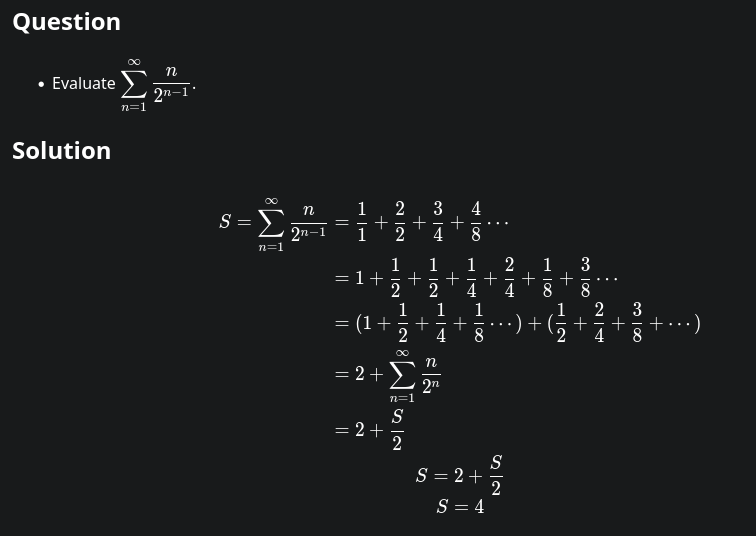 :::
:::
save