Does lacto-fermentation break down agaritine in Agaricus?

2 years ago by malte to c/fermentation

I love the flavor that develops from lacto fermenting mushrooms. I'm a little bit suspicious of white button mushrooms (Agaricus species) since they contain agaritine. Agaritine is broken down by heat, making it safe. If you eat raw Agaricus, the agaritine is made into phenylhydrazines in the gut, which causes liver damage and can eventually make you anemic. Under no circumstances should you eat raw Agaricus.

So what about lacto-fermenting them? We know agaritine is heat sensitive. Is it also sensitive to microbial activity, so that it breaks down?
t_chalco 2 points 2 years ago

The exchange in this thread is inspiring. Thank you.

path: 0 15125430, hotness: undefined, score: 2, children: 0
Sal 2 points 2 years ago

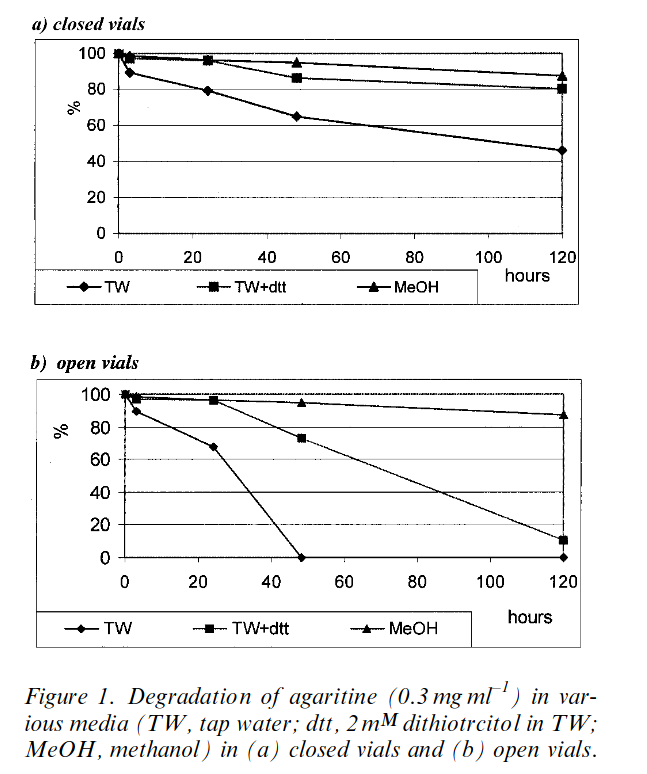
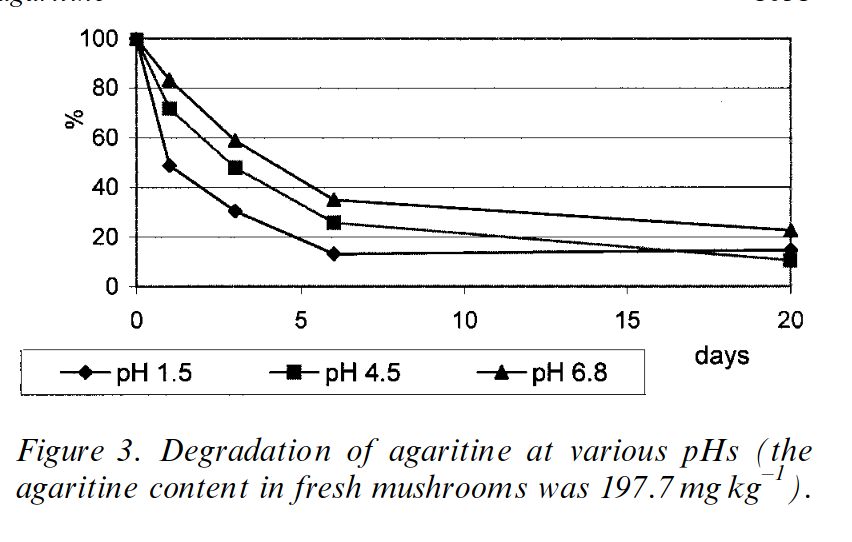
Short summary from a quick search in the literature: Agaritine in water degrades quickly if oxygen is present, so if you can have an extended amount of time during which the mixture of water and ground mushroom is exposed to fresh air, that will help. As the mixture becomes acidic, degradation speeds up again even if the the atmosphere becomes oxygen poor. If the fermentation is meant to take more than 3 weeks, the acidic environment will probably be enough. Enzymes from the microbes are likely to have a combined effect that ultimately speeds up degradation as well, but that is a more complicated process and so it is not so easy to estimate the rates.


Low pH, exposure to water, oxygen, and time will help. It seems like it degrades quite quickly in water if oxygen is present, but in lacto fermentation you do want to create an anaerobic environment so you might have a quick degradation followed by the formation of a protective atmosphere.

The lowering of the pH will then help speed up the degradation again, but not as much as oxygen does.

Have a look at the following paper to see curves of how agaritine degrades in water in the presence of fresh air, in a closed vial, at different pH levels:

Hajšlová, J., Hajkova, L., Schulzova, V., Frandsen, H., Gry, J., & Andersson, H. C. (2002). Stability of agaritine-a natural toxicant of Agaricus mushrooms. Food Additives & Contaminants, 19(11), 1028-1033.

Since you have a microbiologically active community, you also have access to the enzymatic pathways. I have not found a specific paper about agaritine during fermentation. I can find other articles describing enzymatic transformations and degradation. Some of these transformations can change the molecule into more toxic forms, and other enzymes move it towards a degraded product. What I expect that you will see is that the net effect of having a complex enzymatic mixture will be faster degradation, even if the pathways may cross the more active toxic intermediates (which would also probably form in your intestine), these will only form for a short time and degrade.

You can refer to the paper below for specific examples of the enzymatic transformations that I am referring to. In this paper, the enzymes come from mushrooms that are ground into a liquid, and so they are mushroom enzymes. In the context of fermentation the source of the enzymes would be excreted by the fermenters into the ferment. These enzymes would likely not be specifically evolved for agaritine but instead represent general classes of enzymes that affect functional groups that are present in agaritine. It is difficult to make specific predictions.

Walton, K., Coombs, M. M., Walker, R., & Ioannides, C. (2001). The metabolism and bioactivation of agaritine and of other mushroom hydrazines by whole mushroom homogenate and by mushroom tyrosinase. Toxicology, 161(3), 165-177.

path: 0 15089978, hotness: undefined, score: 2, children: 8
malte 3 points 2 years ago

Thanks for taking the time to do a "quick search". It seems like you did quite a lot of reading. I have a bit of difficulty following some of the reasoning. Can I ask if you used an LLM chatbot to assist you in your answer?

path: 0 15089978 15092427, hotness: undefined, score: 3, children: 7
Sal 2 points 2 years ago

No problem! I searched "Agaritine degradation" in Google Scholar and selected to those two articles from the results page as they seemed relevant. I also searched for more specific fermentation based papers but did not find any - this is what I mean when I say quick search.

I did not use an LLM chat bot to formulate the answer, but I did copy and paste it to ChatGPT and asked whether it agreed. I often do this in case it catches some obvious mistake. But it did not suggest any corrections, and it did not affect my answer. So an LLM chatbot did assist me in validation.

If you want I can explain some of the reasoning in more detail. Figures 1 and 3 of the first paper have data on what happens when agaritine is dissolved in water in the presence of air ('open vial'), no air ('closed vial'), and at a low pH with a closed vial. I think that these two figures are the most relevant to this particular question, as they give you an estimate to how fast agaritine will break down due to conditions that are easy to control and measure. Other types of microbiological activity can have an effect, but in this case it is not essential to invoke these more complicated processes.

path: 0 15089978 15092427 15092916, hotness: undefined, score: 2, children: 6
malte 4 points 2 years ago

I assume those articles studied the degradation of pure agaritine in various milieus. It's interesting how both water, air and sour pH degrades agaritine. If I was doing the primary research myself, it might indicate some new experiments to try and test. My question has to do about the agaritine content in mushrooms that are subjected to fermentation. That agaritine might behave differently when contained in a mushroom. What answer to my question does the articles give you?

path: 0 15089978 15092427 15092916 15099956, hotness: undefined, score: 4, children: 5
Sal 2 points 2 years ago

My question has to do about the agaritine content in mushrooms that are subjected to fermentation. That agaritine might behave differently when contained in a mushroom. What answer to my question does the articles give you?

It is true. I am not sure, the articles do not address this specific question. It would depend on the process and the amount of time that you let it ferment. Over a period of weeks, it is likely that the mushrooms will have died, the cell membranes will have broken down, and the chemistry of degradation described in those papers will have taken place.

Fresh mushrooms are still alive at the beginning of the process. Until they die, the mushroom's cells may continue to produce agaritine, and the chemistry inside of the cells is not necessarily going to be the same as in tap water. The amount of time that it will take for the cells to die depends on the process. If you are submerging the mushrooms into a brine, I don't think that they will survive for long because of the osmotic pressure.

path: 0 15089978 15092427 15092916 15099956 15100956, hotness: undefined, score: 2, children: 4
sfjvvssss 1 point 2 years ago
path: 0 15125560, hotness: undefined, score: 1, children: 5
malte 1 point 2 years ago

I follow mycological authorities on this issue instead of judging on my own from the scientific articles. The consensus in the fungi community where I come from is that agaritine and the phenylhydrazines it creates in the gut are at the least suspect and potentially damaging to the liver. The official advice is to keep intake low until we know better and to not eat Agaricus raw (you shouldn't eat mushrooms raw anyway).

path: 0 15125560 15134902, hotness: undefined, score: 1, children: 4
sfjvvssss 1 point 2 years ago
path: 0 15125560 15134902 15143255, hotness: undefined, score: 1, children: 3
malte 1 point 2 years ago

Yes, here's a source from Atlas of Danish Fungi: https://svampe.databasen.org/taxon/10061 It's an online version mirroring Fungi of Temperate Europe, one of the most comprehensive mycological guides ever published.

path: 0 15125560 15134902 15143255 15176126, hotness: undefined, score: 1, children: 2
sfjvvssss 1 point 2 years ago
path: 0 15125560 15134902 15143255 15176126 15228221, hotness: undefined, score: 1, children: 1
ewigkaiwelo 1 point 2 years ago

That sounds cool, what mushrooms did you ferment? Did you use the simple 2-3% salt water brine? I've just looked up "lacto fermenting agaricus" and the first article that came up is from 2017 and has got the same picture as in the post but doesn't mention agaritine

path: 0 15114409, hotness: undefined, score: 1, children: 1
malte 3 points 2 years ago

I ferment all kinds of mushrooms, cultivated and wild. Part of my job is to forage so I come across different kinds. Some develop very interesting flavors, others are just good and a few are terrible (Flammulina velutipes, for example). The most available mushroom we have is white button mushroom (Agaricus bisporus) and it gives a nice sour-salty, concentrated mushroom umami liquid.

All agaricus mushrooms, regardless of species, contain agaritine. This has been well-known in mushroom circles for a while and the official advice is to moderate your intake because it is potentially very problematic and doesn't totally break down when cooking, but raw is definitely there. https://en.wikipedia.org/wiki/Agaritine

Mycophagy is a pretty experimental endeavour still and there's lots we don't know. So the available knowledge can sometimes be scarce. Most I know I have directly from local mycologists and our fungi association that sometimes reports on the science. Fermenting mushrooms is even more obscure where I come from, so very few people have good knowledge on this.

path: 0 15114409 15118190, hotness: undefined, score: 3, children: 0
fermentation
fermentation

@mander.xyz

login for more options
933
55
3

go to feed...