
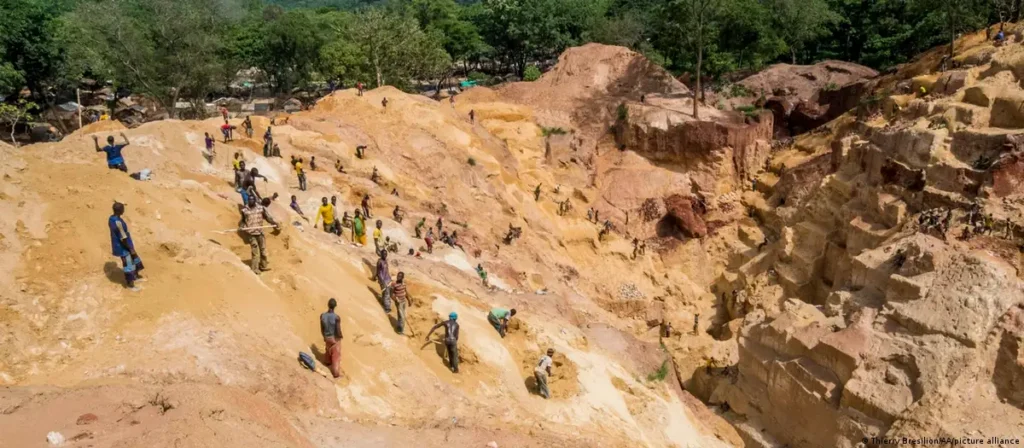
Central African local authorities confirmed this Wednesday a massive landslide at an informal gold mine in Zamboye killed at least 100 workers on Tuesday morning.
The catastrophic landslide occurred on Tuesday at approximately 10:00 A.M. local time in the Nana-Mambere subprefecture, specifically in the Abba region near the Cameroon border.
Rescuers fear the death toll will increase because of the high number of workers trapped under the heavy debris. Local emergency services face severe technical limitations in the remote western region.
RELATED: Collapse in Disused Mine Leaves at Least 14 Illegal Miners Dead in Northern South Africa
The vice-mayor of Zamboye, Souleymane Bi, confirmed the recovery of 100 bodies from the gold mine. The official stated that this figure is preliminary and that his office will provide an official update later.
Bi described the disaster as predictable because the operators conducted deep excavations without implementing basic safety protocols. The vice-mayor lamented that local youth must accept these high-risk jobs because of a lack of alternative economic opportunities.
A deadly collapse occurred at an artisanal gold mine in Zamboye, in the Nana-Mambéré prefecture of the Central African Republic, near the border with Cameroon.
The incident occurred on Tuesday, August 18, 2026, when part of the site, which involved open-pit work and underground… pic.twitter.com/mHTXQqt4fO
— T_CAS videos (@tecas2000) August 19, 2026
Emergency teams transported injured workers to Bouar, the capital of the prefecture, for urgent medical treatment. Meanwhile, local miners expressed profound grief and anger over the lack of machinery to rescue their colleagues. Wilfried Ngoloyangue, an artisanal mining worker who survived the collapse, reported hearing a sudden roar followed by desperate cries for help from his coworkers.
Another miner, Florian Gaguende, warned that hope of finding survivors is fading quickly. Gaguende emphasized that local residents are deeply shocked by the disaster. He added that the ongoing rescue operations rely entirely on manual labor by local volunteers using basic tools, which are insufficient to clear the massive volume of earth.
Regulatory Failures Exposed
Following the tragedy, government spokesperson Évariste Ngamana expressed official condolences to the families of the victims. Ngamana announced that the central administration is coordinating efforts to deliver immediate humanitarian assistance to the affected community. He also called on national and international organizations to show solidarity with the Central African Republic during this humanitarian crisis.
The catastrophe occurs amid a rapid expansion of gold extraction in the western region of the country. This mineral-rich zone hosts both small-scale artisanal mining cooperatives and larger, semi-mechanized operations partnered with foreign corporations. Civil society organizations have repeatedly warned that these operations frequently bypass environmental and safety standards to maximize extraction rates.
Every year, the country records fatal cave-ins and severe environmental damage, including the chemical contamination of local water sources. These recurring incidents have intensified demands from civil society groups for the state to enforce rigorous regulations on the mining sector. Activists argue that transnational interests and local intermediaries profit from the unregulated extraction of valuable resources while local communities bear the environmental and human costs.
As recovery efforts continue in Zamboye, the Plurinational Assembly and Human Rights groups demand a comprehensive investigation into the operating licenses of these gold fields.
From teleSUR English via This RSS Feed.
