Because the PC enables me do do my hobbies (gaming, 3d modelling and printing), the PC itself isn't my hobby. If I spend more time tinkering with the OS than having the OS run the things I actually want to do, I'll go do something else.
2
182
Bimfred
@lemmy.world
Bimfred 71 points 3 years ago
Showing my age here, but the OGs of Doom, Mortal Kombat and GTA turned all the millennial gamers into murderous sociopaths who can't tell the difference between video games and reality. That's after Dungeons & Dragons turned us into murderous sociopaths who can't tell the difference between board games and reality. If I recall correctly, the hoopla around all of that made national news in the States.
Bimfred 34 points 2 years ago
Crew Dragon has been solely responsible for the US side of ISS rotations for four years, without incident. 8 successful missions, not counting the privately funded trips. Cargo Dragon has been doing resupply missions since 2012.
Bimfred 27 points 2 years ago
There's two main benefits: faster reuse and more payload to orbit.
A Falcon 9 landing on a drone ship needs to be transported back to shore. That's multiple days before the engineers even get their hands on it to prepare for the next flight. The design goal of Starship is to launch a Ship into orbit, return to the tower, be restacked, refuelled and launched again in the same day. Will they actually get it to the point where that's possible? Remains to be seen. Until now, they had no way to see what real stresses a Starship booster goes through in a flight. They're gonna rip this one apart down to the spacers in its bolts to examine it. With the flight and physical inspection data, they'll make what improvements they can to the already built boosters and design future boosters to be more resilient. SpaceX has, by now, a well proven track record of doing what others think is insane to even attempt. If anyone can launch the same rocket twice in a day, there's no one better to give it a try.
The increased payload comes from not having the mass of the landing legs. The Falcon's landing legs weigh several tons. Starship, being 3x the diameter and 10x the mass, would need titanic landing legs. That's a lot of tonnage you won't be taking to orbit. Catching on the tower means that all but a fraction of the landing hardware's mass isn't on the rocket itself. As an additional benefit, the landing hardware needs to be built only once. Every Falcon has its own landing legs, but every Starship they ever build could land on the one tower they have now. That won't be the case, they're planning to build multiple towers, but the sentiment remains the same.
Bimfred 24 points a year ago
Most of us lose the playfulness as the responsibilities of adult life pile up. Between work, family and everything else, there's just no time. But that playfulness, doing something just for the fun of it, is armor. It helps ward off depression, relieves stress, it keeps our mental health up. We need hobbies, we need things in our life that are just fun and enjoyable, and we don't need to feel guilty about taking some time to relax and unwind.
Bimfred 24 points 2 months ago
I see what you mean. But in order to reach the point where Arch is configured and my machine Just Works, I would have to learn how to install Arch, what packages I need, what are the ups and downs of the various packages for handling the same things, resolve any conflicts I accidentally created, and then I can get to installing the things I actually want. It's a lot of work and time that isn't going into something I consider fun.
Arch is great for people who want to build their OS to be precisely what they want it to be. I happen to not be one of those people.
Bimfred 23 points 2 years ago
The production lines are shut down and any custom tooling has had its materials reclaimed to make other things. The institutional knowledge, the little bits that never got written down in the blueprints or manufacturing instructions, it's all gone. The people who worked on that rocket and its components are dead or have been working on something else for the last 50 years. How well would you remember some little tidbit of information that you last needed half a lifetime ago?

Bimfred 17 points 9 months ago
Three years? A low energy transfer orbit gets you to Mars in less than a year. In the past, theoretical crewed missions were planned with an 8-9 month travel time. With enough propellant, could get that down to just over three months. And that's with chemical rockets, not some hypothetical nuclear or torch drive.
Bimfred 17 points 2 years ago
People love bringing up that Starship was supposed to be doing round trips to the Moon and Mars by now, but when has anything space ever been on budget, in time, and working perfectly on the first try? Every new launch vehicle takes longer and more money than initial optimistic predictions state. Damn near every probe and telescope is years over deadlines and often a significant percentage of first estimates over budget.
Bimfred 16 points 2 years ago
Even the Stream version doesn't require Steam. You can just run the executable. A few folks over on Reddit claim they've given the game to their friends just by copying the files from an external drive.
Bimfred 16 points 2 years ago
Because if you launch something from Earth, you inherit the Earth's orbital speed around the Sun. At that point, whatever you launched will just continue to orbit the Sun. It takes less energy to accelerate to a solar system exit trajectory than it does to scrub off all of the excess velocity and end up on a trajectory that intersects the Sun.
Bimfred 15 points 2 years ago
Right now, the Earth is losing mass at about 55 000 tons per year. Yes, losing. About 100 000 tons of hydrogen and helium escapes the upper atmosphere, partially offset by roughly 45 000 tons of dust and meteorites getting scooped up along our orbit.
Considering this has been happening for millions of years, I think we're quite safe from affecting the Earth's mass and orbit within the span of even centuries.
But it's much more likely that the majority of material mined and processed in space will not be coming down to Earth. It's much better put to use in orbital construction, or shallower gravity wells like the Moon and Mars.
You're entirely right that getting to the rocks, and getting the mined stuff to where it's actually useful, are gonna be a problem. Maybe we'll finally get some nuclear thermal engines, cause the shite ISP of chemical rockets is really insufficient for these trips and ain't no one wanna wait on the gravity assists.
Bimfred 14 points 2 years ago
It's hard to tell, but I don't think it's from IFT-6. The banana cam gave us a view inside the payload bay and the reinforcing structures look a little different.
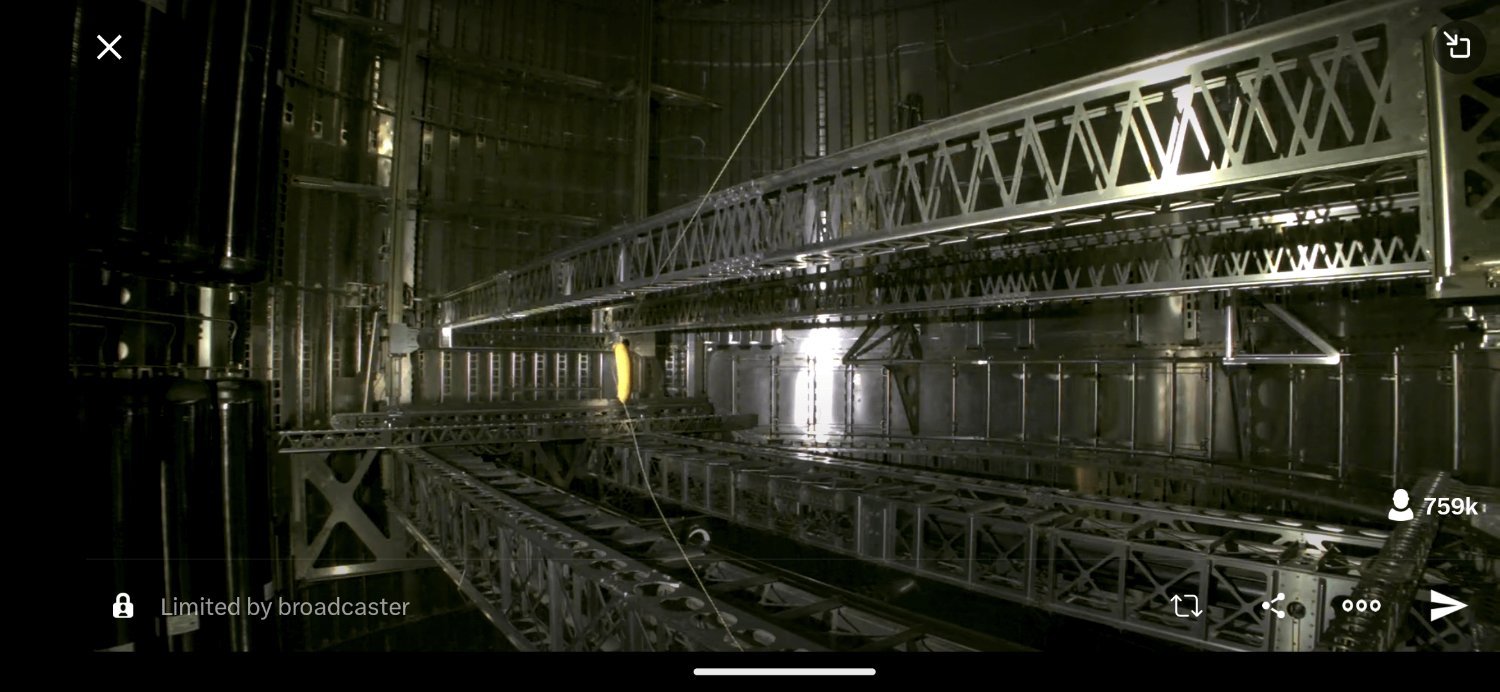
I believe the truss that the banana is strapped to is the same as the one running along the lower edge of the OP image. But if you look at the reinforcements noseward, the OP shows a closer arrangement of three ribs with cross-braces in-between, whereas the IFT-6 image shows more regularly spaced ribs with no extra bracing. The ribs themselves look different, with a uniform line along the entire inner side in the OP, and a shallower middle segment on OFT-6. The OP's low resolution makes it difficult to tell, but I think it's also missing a lot of the lengthwise stringers that SpaceX added on the later ships.
EDIT: I may be talking out of my ass. Had a look at IFT-3 and the view towards the payload door shows the same reinforcing structures as IFT-6. So it's possible that the OP image is from farther up the payload bay, the ribs we're seeing are reinforcing the flap hinges, an area that's not visible in the banana cam. We didn't get a payload bay view for flights 4 and 5, so can't compare those.
EDIT 2: The OP image is definitely farther up the payload bay, looking at the hinge area that we didn't see in other bay views. There's no telling whether or not it's from the 6th flight, based on the publicly available images.
Bimfred 14 points a year ago
NASA is funded with tax money and failures mean they get called in front of Congress like a child who sharpied the brand new tv. They don't have the luxury of failure, so they over-analyze and over-engineer everything, to the point that everything they build is reasonably expected to work on the first try.
SpaceX doesn't have that restriction and so they're free to blow up as much stuff as they need to. How many Falcons failed along the way to building the safest, highest flight cadence launch vehicle in history?
Bimfred 13 points 2 months ago
The complicated parts of the setup are already done and I still get the benefits of a fast update schedule, without (mostly) having to worry about accidentally breaking something.
And you're right about running another, less finicky distro. It's why I've got Bazzite on the HTPC and the handheld. Because I want those to be zero finicky, as poking around in them is way more of a pain in the ass.
thanks for using Leebra!
go to feed...