vga256
34
46
vga256

@dialup.cafe

indigenous canadian, recovering academic → gamedev & interactive media artist with a penchant for dial-up modems, the 4o3 bbs scene, 1-bit art, classic macs, and 80s/90s gaming. curator of internet, canadian & gaming obscura.

current major projects:
→ tomo: a reddit-like decentralized discussion group network built on NNTP https://tomo.city
→ exigy: a VB/Hypercard-like shareware game creation kit https://exigy.org

#nobot #nobots #noindex
(profile pic: a 1988 red fox 6¢ canada stamp)

vga256 2 points 2 years ago path: 0 12684690 12684867, hotness: undefined, score: 2, children: 0
vga256 2 points 2 years ago

@root42@chaos.social this is exactly the kind of shareware adventure game i'd love to see made with #exigy some day. thank you!

path: 0 15097473, hotness: undefined, score: 2, children: 0
vga256 2 points 2 years ago path: 0 12441595 12441805, hotness: undefined, score: 2, children: 0
vga256 2 points 2 years ago

and fwiw, here's the Ultima VIII: The Lost Vale plot. i had no idea it existed in any form:

http://sherigranerray.com/?p=13

"the premise behind Lost Vale was a group of people had been locked away from the rest of Pagan and were still following the “old gods.” These gods , the villagers believed, lived in a city at the top of a cloud shrouded mountain. It was forbidden to attempt to climb the mountains to see the gods. Two young boys, however, decided to see if they could do it, and attempted to climb the mountain. They fell to their deaths. At the same time, the Gods seemed to stop answering the prayers and withdraw their support for the people of the valley – taking away the seasons and causing crops to wither...."

edit: lost vale design documents in their entirety
https://gallery.ultimacodex.com/...

#ultima #retroGaming #dosgaming

path: 0 13671084, hotness: undefined, score: 2, children: 2
vga256 2 points 2 years ago path: 0 12925264 12925290, hotness: undefined, score: 2, children: 0
vga256 2 points 2 years ago

two weeks ago i posed what i thought would be a rather straightforward historical research question, which went unanswered. i wondered: what did the people of the middle ages (peasants, villagers, blacksmiths, monks, abbots, knights, etc) think of technological change in their time? was it seen as a boon for replacing manual labour? a threat to everyday craftspeople and craftsmanship? a new evil at odds with moral duty to god?

just cobbling together a reading list to begin answering the question was itself a week's worth of work. finally, today i began finding direct answers to the question in Frances and Joseph Gies' "Cathedral, Forge and Waterwheel: Technology and Invention in the Middle Ages."

while everyday people like serfs and peasants beliefs are not covered due to a lack of historical records, its early chapters provide some insight from the medieval monastic orders. the answer? the various churches were openly ambivalent, but *not* openly opposed to technological change and invention.

Why did the churches not openly embrace technologies?

... for many years monastic orders like the Benedictines and Cistercians saw manual labour as critical for self-sufficiency and spiritual development. When technologies that allowed for reduced manual labour became available, monastic orders began questioning their potential value in relation to their relation to God.

Why did monastic theologians not openly reject technologies that would relieve them of physical burdens?

... because most of these orders retained an old Greek suspicion and distaste for what Aristotle called "banaustic arts" (or utilitarian arts like crafting and manual labour. These were seen as important for living, but a distraction from intellectual life. Technology's promise was that it could relieve a monk from the banaustic realities of carpentry and millwork and stonemasonry, and let them practice prayer and writing and intellectual pursuits without time/energy-consuming distractions.

A picture of the middle ages is beginning to emerge that is not unlike our own in modernity: technology was seen in relation to its potential for reducing labour. what is different between then and now is that a person's relationship with God was at stake in the middle ages. few today believe that manual labour "keeps us honest".

in other words: technology in the middle ages was understood as both spiritual and instrumental

#history #medieval

path: 0 12399132 12576667, hotness: undefined, score: 2, children: 0
vga256 1 point 2 years ago

@OtterMatic@woof.group huh? that compression method appears to have nothing to do with Radius' Cinepak codec used on the sega cd

path: 0 12160872 12160964, hotness: undefined, score: 1, children: 0
vga256 1 point 2 years ago

@starfiend 😆 amazing. i ended up building a single player game using UOSphere just for fun

path: 0 12159851 12184315 12184316, hotness: undefined, score: 1, children: 1
vga256 1 point 2 years ago path: 0 12267872 12267984, hotness: undefined, score: 1, children: 0
vga256 1 point 2 years ago

@matt@proud.social i'm fascinated that i somehow missed an Apogee shareware game over all the years. surprisingly beautiful and bizarre. thank you!

path: 0 12930080 12935926, hotness: undefined, score: 1, children: 2
vga256 1 point 2 years ago

@mugraph@chaos.social yeah, i know what you mean - and i think that strays beyond my immediate historical needs. i'm basically looking for someone to fill in a lot of the historical gaps that heidegger leaves wide open with his historical examples (grist mills, hydroelectric dams, etc). foucault is his own wilderness anyway 😅

path: 0 12382195 12382352, hotness: undefined, score: 1, children: 0
vga256 1 point 2 years ago path: 0 12398405 12398457 12402161 12402213 12402298 12402347, hotness: undefined, score: 1, children: 3
vga256 1 point 2 years ago

@ve3qbz@mastodon.radio 2 was a travesty. iirc, it was developed by a third party company. most of the game was completing "missions" and it completely lost the joy of just building on the landscape

path: 0 12398405 12398457 12402161 12402213, hotness: undefined, score: 1, children: 5
vga256 1 point 2 years ago

@ve3qbz@mastodon.radio it's a very different kind of game, but boy does it feel great - it really nails the experience of creating a transportation network

path: 0 12398405 12398457 12402161 12402213 12402298 12402347 12402439 12402476, hotness: undefined, score: 1, children: 1
vga256 1 point 2 years ago path: 0 12404122 12413959, hotness: undefined, score: 1, children: 0
vga256 1 point 2 years ago

@pixel@social.pixels.pizza now that i look at it, it kinda makes sense. almost all of the boards are running TBBS or wildcat or something else that is built for multi-node. i bet the only reason these mega-boards got a lot of votes is because they had a ton of readers/users.

path: 0 12403036 12413973, hotness: undefined, score: 1, children: 0
vga256 1 point 2 years ago

adding to the aforementioned bibliography of books concerning the intersection of the 15th-19th centuries and technological change. found them at a local used bookstore.

web searches for broad topics like this are often fruitless. a good library or academic bookstore already has this presorted by topic.

#bookstodon #books

path: 0 12399132 12418914, hotness: undefined, score: 1, children: 8
vga256 1 point 2 years ago

adding two incredible finds to this medieval technology reading/research bibliography: Cathedral, Forge and Waterwheel by Frances and Joseph Gies. The bookseller immediately recognized it and exclaimed “I appreciate a writer with the common touch!”

The second book - Tavistock Abbey: A Study in the Social and Economic History of Devon by HPR Finberg was an accidental find. While it does not speak to technological change in the late middle ages, it speaks to the social and cultural life of an abbey and its surrounding village.

#books #bookstodon

path: 0 12399132 12418914 12432601, hotness: undefined, score: 1, children: 0
vga256 1 point 2 years ago

answering my own question yesterday re: heideggerian technological change and the first industrial revolution:

there does not seem to be any specific agreed upon text that covers the above historical question - however, i've cobbled together a patchwork of related readings:

Miller, Adam. (Dissertation). Enframing and Enlightenment:
A Phenomenological History of Eighteenth-Century British Science, Technology, and Literature. https://ir.vanderbilt.edu/...

Finberg, H.P.R. Tavistock Abbey: A Study in the Social and Economic History of Devon.

Gies, Frances and Joseph. Life in a Medieval Village.

Gies, Frances and Joseph. Cathedral, Forge, and Waterwheel: Technology and Invention in the Middle Ages.

Gimpel, J. Medieval Machine: The Industrial Revolution of the Middle Ages.

Landes, David S. The Unbound Prometheus: Technological Change and Industrial Development in Western Europe from 1750 to the Present.

Mantoux, Paul. The Industrial Revolution in the Eighteenth Century.

McNeil, Ian. An Encyclopaedia of the history of technolology.

Toynbee, Arnold. Lectures on the industrial revolution of the 18th century in england. https://archive.org/...

#academicMastodon #history

path: 0 12399132, hotness: undefined, score: 1, children: 10
vga256 1 point 2 years ago

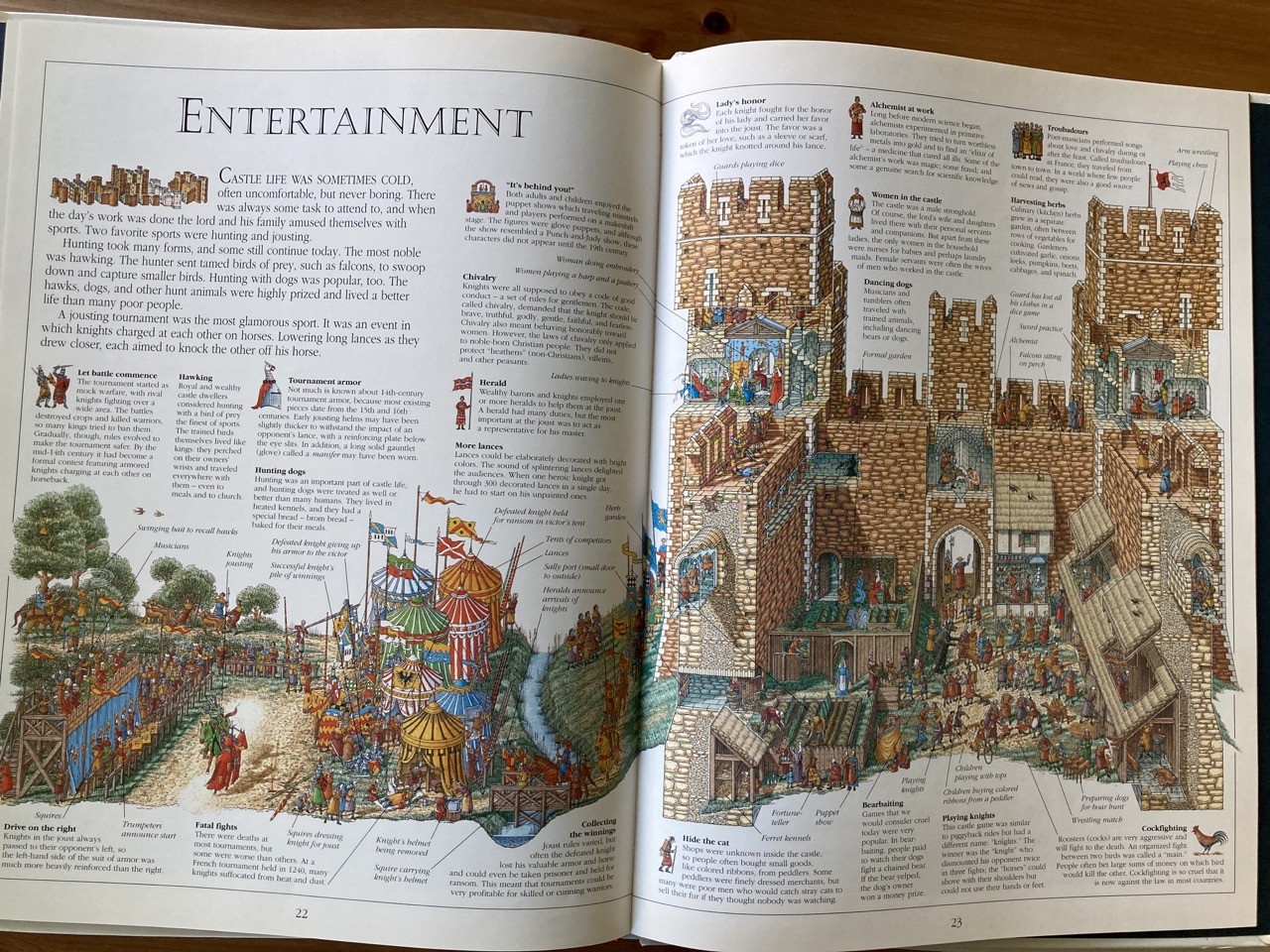
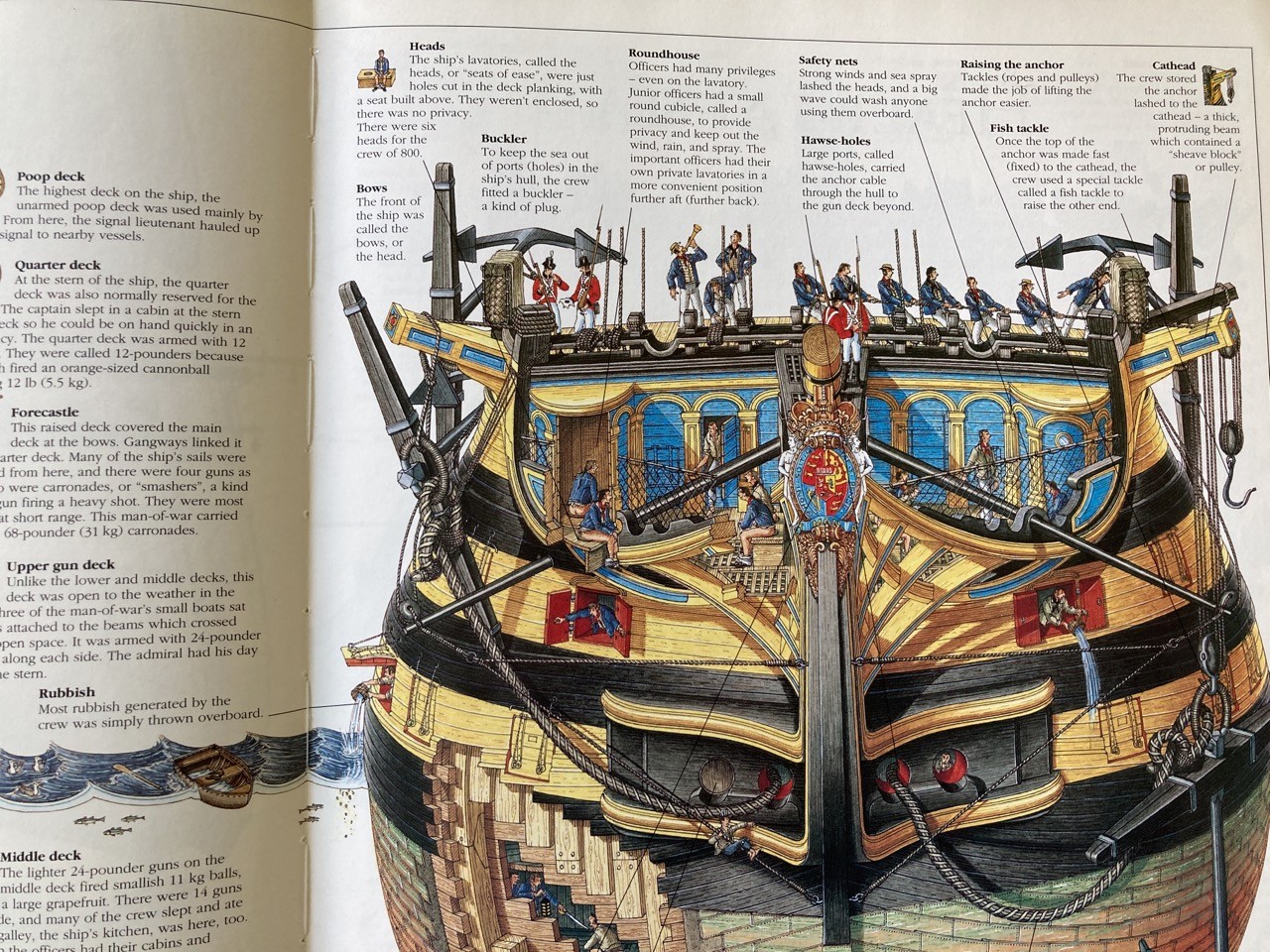
how could i forget these two absolutely hilarious and informative illustrated texts on medieval and 18th century life.

i’ve had them sitting on the shelves for years, and realized they make a compelling visual reference

#bookstodon #illustration #books

An Entertainment page showing festivities inside of a castle.
A page from Man-of-War showing men taking a dump in the roundhouse, and another man tossing their feces into the sea for fish to munch on.

path: 0 12399132 12418914 12435029, hotness: undefined, score: 1, children: 6

thanks for using Leebra!

go to feed...