
Announcing the Ladybird Browser Initiative
2 years ago by Diabolo96 to c/technology
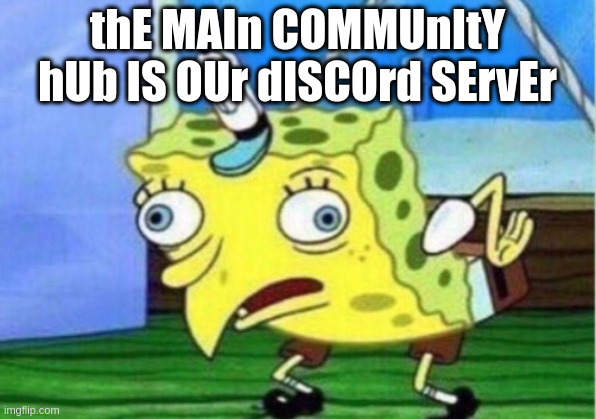
Im glad to see this. Discord is a nightmare. It's the same as a Facebook only group to me.
The website makes it sound like all of the code being bespoke and "based on standards" is some kind of huge advantage but all I see is a Herculean undertaking with too few engineers and too many standards.
W3C lists 1138 separate standards currently, so if each of their three engineers implements one discrete standard every day, with no breaks/weekends/holidays, then having an alpha available that adheres to all 2024 web standards should be possible by 2026?
This is obviously also without testing but these guys are serious, senior engineers, so their code will be perfect on the first try, right?
Love the passion though, can't wait to see how this project plays out.
W3C lists 1138 separate standards currently, so if each of their three engineers implements one discrete standard every day, with no breaks/weekends/holidays, then having an alpha available that adheres to all 2024 web standards should be possible by 2026?
Yes, that is exactly the plan: "We are targeting Summer 2026 for a first Alpha version"
a Herculean undertaking with too few engineers and too many standards
Yeah, as a layperson this is my take. If mozilla is struggling to stay in the game then I just don't really see how an unfinanced indie team has a shot.
Mozilla has loads of projects, not just the browser. I doubt more than a 30 work exclusively on the engine nowadays.
Even if that were true, and it seems unlikely, that's still an order of magnitude more than the ladybug devs.
It might seem that way but it's a fairly arrogant assertion. They're a sophisticated organisation with a lot of well experienced people guiding them. As an outsider it's easy to criticise their seemingly endless series of bad decisions, but I'm still confident that internally all of these decisions seemed like a good idea at the time.
Besides which, this would be a good reason to fork their codebase rather than starting from scratch.
Exactly. They have been working on Ladybird Browser for few years already, before it was announced as standalone product (It was a part of SerenityOS).
Sure, but an individual website may use only a few of those standards. Ladybird devs will pick a website they like to use - Reddit, Twitter, Twinings tea, etc. and improve adherence to X or Y standards to make that one website look better. In turn, thousands of websites suddenly work perfectly, and many others work better than before.
Ladybird is largely conformant to the majority of HTML standards now. It's about the edge cases (and where standards aren't followed by websites) and performance. This isn't a new project.
Andreas Kling, the founder and lead dev, has a massive love for Twinings tea and spent a few Dev logs working on improving their website with the end goal being ordering his tea from them :)
They've been at it for four years and they plan to have an alpha by 2026. Maybe wait how it actually turns out?
Wait, 1138? If there are any Star Wars fans in there, there won't be more.
Software nowadays is a lot more complex. You'd get nowhere using assembly. Are you also gonna call me lazy if I say making a smartphone from scratch is complicated? "But the Nokia 1234 only had 4kb of memory" Is what you will probably say.
You'd get nowhere using assembly because people wanted to keep improving technology.
The Nokia was actually build and freakin' rock solid. Then came smartphones because people wanted to improve. It sure wasn't easy and they didn't go Geez, a phone from scratch? Why bother?
I mean if they're gonna give money without demanding anything I'm sure no complaints from the devs.
Shopify or an exec there might find some value in avoiding Google owning the web, could maybe bring goodwill for the company, or they could just be looking for a write off.
I'm curious what issue you see with that? It seems like the project is only accepting unrestricted donations, but is there something suspicious about shopify that makes it's involvement concerning (I don't know much about them)?
They fired a lot of people and replaced them with AI: https://techcrunch.com/...
found this
Why? Shopify has been sponsoring stuff like community gaming events for a few years now.
It'll be interesting to see how this plays out. I've had more than a handful of people bitching at me that it's impossible to make a new, open web browser in this day.
I think it's less that it's "impossible" but rather that it's expensive.
Honestly we've in general shoved too much shit into the browser that's not strictly related to just browsing web sites.
And you "have to" support all the layers and layers and layers of added stuff, or you can't "compete".
But, at the same time, the goals of making a good-enough browser that mostly works and isn't completely enshittified and captured by corpo big tech interests is a very worthy project and 100% support what they're doing.
Pushing for bloated web apps instead of having optimized and perfectly functional websites was what killed it for me.
It was fine when it was contained to an actual web site instead of infecting desktop software too. To me, using JS for that purpose feels like using PHP to write a 3D video game.
I feel like the internet is such a lost cause at this point that it would be better to invest in other efforts like the Gemini protocol.
Gemini protocol
IDK, but I don't think that the problem is that any particular application protocol is bad so much as it is capitalists going to capitalist, and they've shit all over everything in the Quest to Make a Buck.
It's not like a new protocol, if it becomes as widely adopted, won't see the same vultures swoop in and strip mine any value they can find there, too.
A more lightweight protocol limits the attack surface for capitalism. The web sucks because basically anything can be wrapped in http, including ads, tracking cookies, data collection JavaScript, etc.
Gemini protocol only carries markdown
No, I'd have accepted too expensive as an answer. They were ready to die on the hill that no one could possibly create a new browser from specs.
My thoughts exactly.
Also nothing is stopping someone from forking an open browser and throwing money/bodies at keeping it up.
It's be a shame to lose free updates, but certainly not undoable.
or you can't compete
Nah nah fuck that noise. 'Jack of all trades but ace of none' or however the saying goes, is a shitty way to go about things. I don't have the biggest dick but I know my way around around the block, and I know I'm good at it. More specialized > the catch-all bitches.
Let the fucks with their special engine requirements eat shit. Standardize or write a fucking proper program (miss me with that "app" bullshit) or fuck right off. "everyone is special... exactly like you" now fuck off web dev. Your shit doesn't get a permit.
.....
I may have some... disputes with the way the web is done nowadays.
I could have been a little more clear: I don't think the whole must-compete-or-forget-it mindset makes any damn sense.
I'm more than happy to use software that does what I want/need (which, more and more, is simply just not fucking spying on, trying to sell things to, or otherwise annoying me) even if it's not like, the most bestest version of whatever.
Only 114 million words of spec!
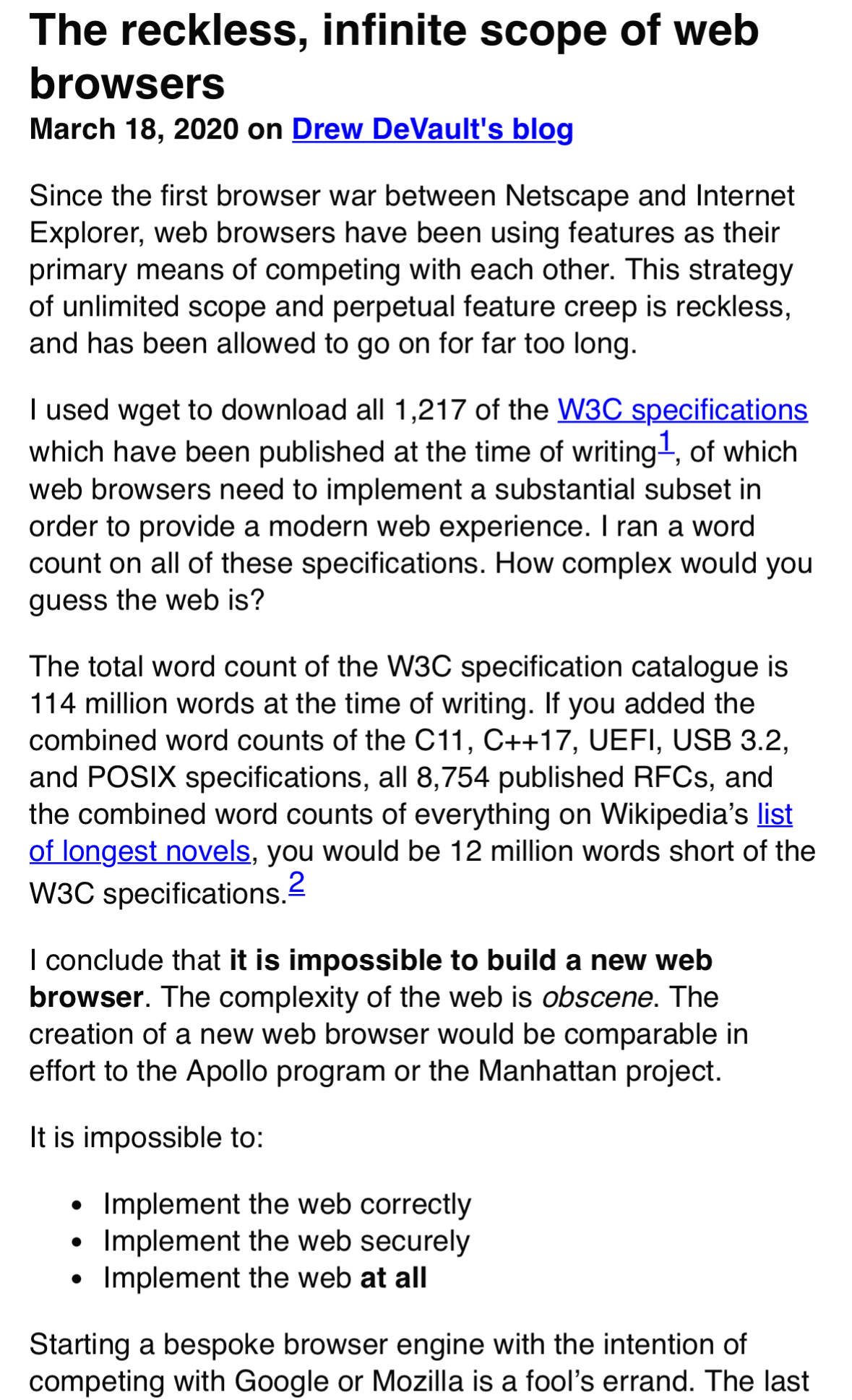
Interestingly the founder of the project seems to explicitly disagree with that article
Their rendering engine is already pretty solide (see penultimate video in their channel). Now that their "no third party code" restriction is lifted, they can actually focus on building a browser engine instead of recreating 30 years worth of technologies from scratch.
He says "powered by or funded by Google". Firefox depends on Google financially, most of the income of Mozilla comes from Google paying for being the default search engine.
They try to diversify their income (Firefox VPN, email alias service, etc.), but anything they try gets a huge backlash from the community, and still small compared to the the money from google.
Is this their way of asking Google for money?
Firefox gets tons of funding from Google, and their code is quite frankly humongous. From what I understand, it's extremely hard to get the gecko web view engine to work. In another browser, unless it's a fork of Firefox, unlike Chromium where you can just redesign an entire browser around it.
Neither Chromium nor Gecko have a stable public API. Companies are just willing to spend money rebasing every Chromium update.
C++
If they're starting a browser from scratch, why would they not have chosen Rust? Seems very short sighted to not have learned from Firefox.
They used c++ initially since it was spawned from SerenityOS, which was designed to be a mashup of win2000 and unix.
now that Ladybird is its own project, it's not constrained to that goal, and they have said they will incorporate modern languages.
Glad to hear that!
@asdfasdfasdf@lemmy.world There's Servo ( @servo@floss.social ), it's a browser engine written in rust
Yes, that's what I'm referring to. They could build on that, or they could write something their own in Rust. But I'd think building on Servo would be fantastic.
I know about servo. It was pretty much a dead project until they joined the Linux fondation last year and started getting some sponsorship. Since then, they being doing pretty good on there own with personal donations rising by around 20% each month, reaching more than 2000$ monthly. Wish them all the best!
Must be planning on actually shipping something
/s
Ship what, segfaults / invalid memory access? Lol
This you?
They’re making a new browser engine from scratch in an open way, absolutely amazing!
I do have several questions:
Why would they use BSD instead of GPL? If you care about open-source so much, why would you make it possible for a company to run away with your fancy new engine?
Why are they creating a new browser, when even firefox has to struggle to keep some semblance of market share? I get that not every project needs to aim to be “the biggest”, and that even a smaller project (in terms of users), can be fun. It’s just that writing a browser engine that can handle the modern web seems like an almost Sisyphean task; which makes me wonder what their motivation(?) is.
Why the FLOSS are they using closed-source proprietary discord as their main communication channel?
- (BSD vs GPL) Andreas stated on twitter that he wanted to give devs total freedom to use his work because when he worked at Apple he felt frustrated he couldn't incorporate some code/software into his work because of GPL.
- (Why?) The aim is not to create a chrome competitor, but to make a good enough, truly free browser that isn't either chrome or funded by chrome. A browser made for and by its user's.
- (Discord) Because of gen-z.
As someone who uses BSD licensed modified code at work and relies on it quite a lot, it's crucial to me choosing which projects I'm able to use in the first place.
Personally, I prefer a license that allows for commercial use in the way that companies need them to, and if my own work ever can provide a patch back upstream I'd be happy to do so, but most of what I do is just tweaking things that exist to suit my purposes which doesn't really help anyone but my business rivals which I personally am not interested in doing if I don't have to.
I prefer to have the freedom to do as I wish with the code, as compared to being bound to do as the author wishes and essentially just not using that code in the first place because I can't. I'm not in a position to change what I can and can't do because of the requirements of the business I work for, and I'm grateful to those that choose licenses that allow me to use their work.
They're creating a new browser because they want to. It started as an OS building project that the lead dev did to help stay sober.
They use discord because it's popular. Insert Ouroborus argument here, and at the end of the day it's still the most popular app.
They use discord because it's popular. Insert Ouroborus argument here, and at the end of the day it's still the most popular app.
Using this logic why shouldn't I just download chrome and forget this project exists?
Depending on your use case, maybe you should. If your use case is "using the internet today securely", then you definitely should.
I'm not trying to create a logical puzzle that teasing the right details out of will solve, I'm not even advocating for or against their decision, discord fuckin sucks shit and I can't wait for element to continue to mature towards enough feature parity that a switch is seamless so that I can actually convince my friends to switch too, I'm reporting a reality of life on the internet today.
I do not understand the urge to start from scratch instead of forking an existing, mature codebase. This is typically a rookie instinct, but they aren't rookie so there's perhaps an alternative motive of some sort.
Because there are only like 3 browser engines: Chrome’s Blink, Firefox’s Gecko and Apple‘s WebKit. And while they are all open source, KHTML, the last independent browser engine got discontinued last year and hasn’t been actively developed since 2016.
There’s need in the space for an unaffiliated engine. Google’s share is far too high for a healthy market (roughly 75%), WebKit never got big outside of Safari (although there are a few like Gnome Web, there’s no up to date WebKit based browser on Windows) and Gecko has its own problems (like lack of HEVC support).
So, in my book, this is exciting news. Sure it‘ll take a while to mature and it is up against software giants but it‘s something because Mozilla doesn’t seem to have a working strategy to fight against Google‘s monopoly and Apple doesn’t have to.
Also Gecko's development is led by people thinking that it being usable outside of Firefox\Thunderbird is a bad thing. There was a time when Gnome's browser was based on Gecko, not WebKit. And in general it's influenced by bad practices.
SerenityOS is an amazing project, of course. To do so much work for something completely disconnected from the wider FOSS ecosystem, and with such results.
So it's cool that they've decided to split off the browser as its own project.
Servo is going to fill that void
I meant alternative browsers, like vimb or surf, but on Gecko and not WebKit.
Mozilla doesn’t seem to have a working strategy
Guess they couldn't replicate the "own everything that people use to get stuff on the internet and make secret breaking changes to constantly mess up other browsers" strategy.
HEVC is almost entirely down the the licensing. This section of the wikipedia page details it pretty well.
The tl;dr is that the LA group wanted to hike the fees significantly, and that combined with a fear of locking in led to the mozilla group not to support HEVC.
And it's annoying at times. Some of my security cameras are HEVC only at full resolution, which means I cannot view them in Firefox.
They could, probably. My guess is, that it’s either a limitation of resources, the issue of licensing fees or Google‘s significant financial influence on Mozilla forcing them to make a worse browser than they potentially could. Similar to how Firefox does not support HDR (although, to my knowledge, there’s no licensing involved there).
The biggest problem most people have with Mozilla is said influence by Google, making them not truly independent.
If 50% of firefox users donated 2 dollars per year mozilla could work for people instead of Google or at least people AND google
Yea, but Webkit was forked from KHTML 23 years ago and Blink was forked from WebKit 11 years ago. In the mean time they all definitely evolved to become their own thing, even though in the beginning they were the same.
WDYM "independent" ?
Isn't mozilla / gecko more or less independent?
Seems a little idealistic.
If ladybird actually achieves any sort of userbase they would take the same deal in an instant.
webkit and blink are based of KHTML
Technically blink is based WebKit but yes. However, they were forked 23 and 11 years ago respectively, so it’s safe to assume they evolved into their own thing. But they probably do still share code, yes.
No webkit browser on Android either. If there was gnome web for Android id switch in a heartbeat
Does anyone know why there are barely any WebKit based browsers? WebKit is open source and at least Safari works really well. Is it hard to work with? Do people just hate Apple that much? Is there some limitation?
Because software monocultures are bad. The vast majority of browsers are Chromium based. Since Google de-facto decides what gets in Chromium, sooner or later the downstream forks are forced to adopt their changes. Manifest V3 is a great example of this. You can only backport for so long, especially when upstream is being adversarial to your changes. We need an unaffiliated engine that corrects the mistakes we made with KHTML/Webkit.
Why are open source software monocultures bad? The vast majority of non-Windows OSes are Linux based. Teams who don't like certain decisions of the mainline Linux team maintain their forks with the needed changes.
Manifest V3 is a great example of this. You can only backport for so long, especially when upstream is being adversarial to your changes. We need an unaffiliated engine that corrects the mistakes we made with KHTML/Webkit.
And we could get a functional one today by forking Chromium and never accepting a single upstream patch thereafter. I find it really hard to believe that starting a browser engine from scratch would require less labor. This is why I'm looking for an alternative motive. Someone mentioned licensing.
Perhaps some folks just want to do more work to write a new browser engine. After all Linus did just that, instead of forking the BSD kernel.
There is currently no implementation of web standards that is under a more permissive license than LGPL or MPL. I think that is a gap worth filling and if I recall that is what Ladybird is doing.
I guess Chromium isn't fully BSD. This could be the reason. Although I'd think reimplementing the non-BSD bits in Chromium would be less work than reimplementing all the bits, including the BSD ones.
Chromium and WebKit both still have bits from KHTML in them which is LGPL
Why is that a gap worth filling? There is no benefit to users as long as its free of a EULA they don't have to care either way. For those wanting to produce open source software based on same they already have all the rights they could need. The only party clamoring for permissively licensed software are companies intending to close off the source and sell other people's work.
I understand why they would want to do that I don't understand why anyone would feel the need to work for free for something someone else closes off.
There are some cases where it’s just not possible to release the source code, even if you wanted to.
For example, if you’re developing a Nintendo switch game, you aren’t allowed to release any code that uses Nintendo’s sdk, so that means you also can’t use any copyleft libraries.
Maybe MPL-licensed libraries would be ok though. Idk, I’m not a lawyer.
Why would open source code be released with the intention of helping people who wont or can't give back?
It's easy to understand when you think most comments are similar to yours and don't provide any insight as to why this might be a problem.
Maybe you could update your post and share your knowledge and experience with others, so that there are less people in the world who don't see the problem.
When trying to render a relatively simple page consisting few thousands of text lines in a table, any current browser will cause mouse cursor to lag for some time, then you'll discover it consumes at least 2 GB ~ 4 GB of RAM. YouTube lags like I have 2 cores instead of 16. Any electron app is either clunky or too clunky, also either hungry or too hungry.
I'm sorry but I don't have time to look up other cases.
Any intuition on why we'd expect opening the same page on a newly implemented browser engine that implements all equivalent standards and functions will consume less resources?
Ladybird was born from SerenityOS, which is a hobbyist unix-like (or POSIX compliant?) OS that simply aimed to do things "from the ground up". It just happened that they needed to make a browser, and the response was to make one from scratch.
From there it seemed to have brought a lot of attention organically to the point where it can stand on its own, but originally it was never intended to be a "third browser engine" from its inception.
That actually makes the most sense. So similar to how Linux was started.
Best of luck, I guess, but seems like a doomed project to me. Forking WebKit, Gecko, or even Servo would seem much more reasonable, and even that is a huge undertaking.
Contributing directly to Firefox and reducing the dependence on Google should be three best bet
you shouldn't use this browser the devs are transphobic sexist chuds
Hmm. I just read the github thread that this is about. The devs made a mistake on this; but it seems to me that there is a bit of an over-reaction here. The people in the thread seem to be discussing it calmly and politely; and the issue (i.e. use of pronouns in the build instructions) ends up being resolved. By contrast, the reaction outside of the actual thread... is extreme.
Like I said, this seems like an overreaction to someone making a mistake of ignorance & indifference. It wasn't an act of malice.
Appears to be fixed now: https://github.com/SerenityOS/serenity/pull/24648
they must be trying to go after the brave marketshare
Why don't ya'll contribute some meaningful code instead of finding ways to deny those who do
Please describe to me how someone who offered up changes to change “he” to “they” for them, and then the contributor getting pissy about “politics” is denying work.
All this because they won't change a "he" into "they" ? Who gives a fuck about such rampant whiteknightism ? Why does a browser even need to know your gender ? In what context even is there a pronoun in the user interface ?
You could find out the context by reading the title of the thread, but then you'd have less to bitch about, so I can understand why you chose ignorance.
Yeah, I saw this, and all my excitement for the project died. If it becomes successful, I might use it anyway though.
yuppppsies https://github.com/...
i like how they're like this isnt the place for personal politics while ignoring the fact that gendered readme files are patently stupid in the first place.
Brave?
Don't believe they're related
Brave is the one run by transphobes who also love crypto.
Kudos to them. Opera gave up on this dream being unable to accommodate all the nuances of web standards and accounting for out of conformance behaviours that many websites rely on the daily.
I reckon this browser will need to be at least on par with reasonably recent version of Firefox to see significant adoption.
I still mourn the death of Presto-days Opera.
I do too. What a joke the browser became after moving to Chromium... I remember it didn't even have bookmarks in the first version.
On the flip side I kind of understand the decision to pull the plug - if you've looked at Browser.js and think that potentially any site might need a fix to work properly...
Laaaaaaaaa^dybird.^
It would be nice if people read the post and the project before randomly making assumptions such as implying the project started from scratch yesterday or its run by some amateurs, this is a 4 year old project! It's founded by a former KHTML/Webkit developer for Apple!
"Ladybird uses a brand new engine based on web standards, without borrowing any code from other browsers." has the same energy as

Not really. They aren't inventing new standards. They are implementing an engine that confirms to existing standards.
Remind me in 2 years when this project becomes discontinued...
Good luck!
Not sure if you are trying to be funny, but if not: enlighten us?
Sure :)
There are a lot of downsides of C++ compared to more modern languages that make it not a great choice if you're starting a web browser from scratch
- Complexity of the language leading to increased bugs and slower development
- Manual memory management is error-prone and leads to issues like memory leaks or segmentation faults. Modern browsers need to handle large amounts of dynamic content, making memory management complicated
- C++ lacks some of the built-in safety features of more modern languages, which has led to the majority of security vulnerabilities found in major browsers. It's so bad that Mozilla invented an entirely new programming language just to deal with this
- Compared to higher-level languages, C++ can be slower to develop in, which may impact the ability to quickly implement new web standards or features unless you have a massive team
- While C++ is cross-platform, ensuring consistent behavior across different operating systems can be more challenging than with some other languages.
- Newer languages often provide built-in support for concurrent programming, garbage collection, and other features useful for browser development, which C++ lacks.
So tl;dr: a browser but in C++ will take much longer to develop, have fewer features, more bugs, less concurrency and and more security vulnerabilities
Thanks for laying out your concerns. As a C++ developer who does not know the other languages you speak of (I assume Rust, Go), I can agree to some of your points, but also some of them I see differently:
C++ can be complex, because it has a lot of features and especially the newer standards have brought some syntax that is hard to understand or read at times. However, those elements are not frequently used, or if they are, the developer will get used to them quickly & they won't make development slow. As a matter of fact, most development time should be spent on thinking about algorithms, and thinking very well before implementing them - and until implementation, the language does not matter. I do not think that language complexity leads to increased bugs per se. My biggest project is just short of 40k lines of code, and most of the bugs I produced were the classical "off by one" or missing range checks, bugs that you can just as well produce in other languages.
C++ no longer requires you to do manual memory management - that is what smart pointers are for, and RAII-programming.
I can't make a qualified comment on that, due to lack of expertise - you might be right.
You're somewhat repeating point 1) here with slow development. But you raise a good point: web standards have become insane in terms of quantity and interface sizes. Everyone and their dog wants to reinvent the wheel. That in itself requires a very large team to support I would say. As stated for point 1), I do not agree development in C++ has to be slower
True, as someone who just suffered from problems introduced on windows (cygwin POSIX message queues implementation got broken by Win10, and inotify does not work on Windows Subsystem for Linux) I can confirm that while the C++ standard library is not much of a problem, the moment you interface with the host OS, you leave the standard realm and it becomes "zombieland". Also, for some reason, the realtime library implementation on MacOS is different, breaking some very simple time-based functions. So yeah, that's annoying to circumvent, but can be done by creating platform specific wrapper libraries that create a uniform API. For other languages, it appears this is done by the compilers, which is probably better - meaning the I/O operations got taken into those language's core features
I am highly doubtful of people relying on garbage collection - a programmer that doesn't know exactly when his objects come into existence, and when they cease to exist is likely to make much bigger mistakes and produce very inefficient code. The aforementioned smart pointers in C++ solve this issue: object lifetime is the scope of the smart pointer declaration, and for shared pointers, object lifetime expires when the last process using it leaves the scope in which it is declared. For concurrent programming, I do not know if you mean concurrency (threads) or multiple people working on the same project. While multi-threading can be a bit "weird" at first, you have a lot of control over shared variables and memory barriers in C++ that might enable a team to produce a browser that is much faster, which I believe is a core requirement towards modern browsers
As for your tl;dr: definitely not "less concurrency", that makes no sense. The other points may or may not be true, keeping in mind the answers I gave above.
C++ is a very old, extremely complex language. There are arguably objectively better modern alternatives, such as Rust.
Well, it was more to recognize that there is no inherently better programming languages in theory, they all do the same stuff. And some languages are "better" at some stuff just due to the libraries available and nothing to do with the language itself. But yea I do think Rust is an objectively better language than C++.
Of course, but it still makes sense to think carefully about the advantages of disadvantages of the tools you use when starting any project.
Not everyone with the knowledge to identify this mistake is in a position to personally correct it. Do you have the time and resources to personally build a browser from scratch? No? Why do you assume a random commenter does?
It doesn't change the fact that Rust is similarly performant and much safer and will thus be faster to develop and less bug-prone. It's not a difficult assessment to make. If you want to explain why they're wrong you can talk about the issue on its merits, but you didn't choose to, presumably because you can't.
If were just a personal project that they're building entirely on their own then sure, go nuts and do whatever you want. But they're trying to gain adoption, asking for contribution, and wanting to replace other browsers. At that point it's no longer just a personal choice if you're asking the community to invest their time and money into it with you
Taken from the wikipedia page on rust:
On February 8, 2021, the formation of the Rust Foundation was announced by its five founding companies (AWS, Huawei, Google, Microsoft, and Mozilla).[36][37] In a blog post published on April 6, 2021, Google announced support for Rust within the Android Open Source Project as an alternative to C/C++.[38]
Four out of five founding companies are evil to the bone, with only Mozilla being somewhat reputable. That does not give me much confidence, sadly.
On November 22, 2021, the Moderation Team, which was responsible for enforcing community standards and the Code of Conduct, announced their resignation "in protest of the Core Team placing themselves unaccountable to anyone but themselves[39]"
How am I not surprised?
In May 2022, the Rust Core Team, other lead programmers, and certain members of the Rust Foundation board implemented governance reforms in response to the incident.[40]
At least that. However, I don't care enough for the time being to spend my morning on reading what exactly they implemented.
The Rust Foundation very deliberately does not control the development of Rust. There has been issues with the moderation team in the past but I think they're actually resolved today. And let me just assure you that Rust is not the only language project with problems and the fact that they have been talked about and discussed in the open and resolved is a sign of maturity and trust, not a bad thing.
The language choice was because Ladybird started as a component of SerenityOS, which is also written in C++. With this separation, they are free to gradually introduce other language(s) into the codebase, and maybe eventually replace C++ entirely, piece by piece.
In Hackernews thread about this, the head maintainer mentioned that they have been evaluating several languages already, so we'll see what the future brings.
In the meantime, let's try to be mature about it, what do you say?
The dev has 30 years of experience with c++ and a lot of it was on browsers.
He tried to incorporate rust with the help of "JT", one of the original rust designers/devs and according to Andreas it didn't work that well due to the web being too objet oriented or something like that. They both worked together (well, mostly "JT") to create a new safe programming language called "yakt" that transpile to c++, but the project is currently pretty much dead because nobody is really working on it anymore.
You're doubting someone's ability to create a web browser knowing that they specialize in browser development since the early 2000s?
If this isn't enough to have confidence in them then nothing will.
Using my decades of experience in how programming and compilers works and the fact Mozilla has used it to great effect and how it is being used for parts of the Linux kernel.... Yeah just a general statement it doesn't make any sense.
Maybe they aren't effective at designing software with the paradigms of the language or they don't like it but the given explanation doesn't track.
I'm not sure 10 years old are allowed on the internet. Isn't it time for Coco and bed?
I agree that Rust would be an interesting choice for this project but there's a reason why this particular project is done in C++
Servo exists
The project management may have some obvious problems (jOin dIsc0Rd sErVEr; w0rD "thEy" t0o p0liTicAl). But we really need an alternative to browsers funded by Google (Chrome and Firefox).
So I'll do my best to actually build from sources and see what can I help with. Attacking the author is helping nobody.
And for the folks who are saying "wHy n0t rUst", you can always show me the (rust) code.
And for the folks who are saying “wHy n0t rUst”, you can always show me the (rust) code.
https://github.com/servo/servo
I really wish they would publish flatpaks because I can't be arsed to either build the thing or get a non-standard precompiled binary to run on nixos.

Not very many, and many are not featured complete. There's really just fire fox and chrome. However there's a couple of wacky ones like mothra on plan9 but it can't do JavaScript and ignores some modern web practices. Then there are also terminal based browsers.
It's hard to understand the purpose of this. The difficulty of the project (i.e. complexity of the web) is the real problem that needs solving. We don't need another fork of the browser-verse. We need a fork of the web itself.
They have a fork of the web. Its called the dark web. They use it to sell hookers and drugs.
It's also used to buy baking pans, dove soap, coffee makers, and toasters. Xmrbazaar.com
I mean........yes?
Dark web should really be called dark or overlay Internet.
All dark "web" browser use the same rendering engines and same spec as regular ones.
Have you used Firefox recently? There are a few chrome only sites but I've been daily driving it for a few months and it's mostly upside
I can no longer play any podcast hosted on Apple podcasts, which is a distressing amount of them.
They work just fine in Chromium.
No clue, I guess I'm just not lucky. It doesn't work on either my phone or my desktop
Fair enough, I capitulated and I use spotify for podcasts now
The only reason I dont use spoitfy, which one particular show was available on both, is because it doesnt support my RSS feed.
As Firefox will introduce Manifest V3 which will make ad-blockers unusable, I hope they will not implement that as well ... But since this is so new, this will not have any add-ons at all for the foreseeable future
Lets hope they stay true to their words and do not deprecate Manifest V2 later, since firefox is an open source project, theoretically anyone could fork it and build this on their own, but I heard compile-times for firefox is long. And as complexity of the web increases maintaining your own forked web browser will become harder and harder. That is why projects like Ladybird are important imo.
As more and more webpages do not support firefox anymore (Notion did not work for me today) the web will become unusable in a dystopian Manifest-V3 only future.
that would just open them up to a massive anti trust lawsuit and they're already under pressure with that as it is
Stop spreading lies. Firefox will not deprecate the APIs that enable adblocking..

@lemmy.world
This is a most excellent place for technology news and articles.

Our Rules
- Follow the lemmy.world rules.
- Only tech related news or articles.
- Be excellent to each other!
- Mod approved content bots can post up to 10 articles per day.
- Threads asking for personal tech support may be deleted.
- Politics threads may be removed.
- No memes allowed as posts, OK to post as comments.
- Only approved bots from the list below, this includes using AI responses and summaries. To ask if your bot can be added please contact a mod.
- Check for duplicates before posting, duplicates may be removed
- Accounts 7 days and younger will have their posts automatically removed.
Approved Bots
go to feed...
@lemmy.world
This is a most excellent place for technology news and articles.
Our Rules
- Follow the lemmy.world rules.
- Only tech related news or articles.
- Be excellent to each other!
- Mod approved content bots can post up to 10 articles per day.
- Threads asking for personal tech support may be deleted.
- Politics threads may be removed.
- No memes allowed as posts, OK to post as comments.
- Only approved bots from the list below, this includes using AI responses and summaries. To ask if your bot can be added please contact a mod.
- Check for duplicates before posting, duplicates may be removed
- Accounts 7 days and younger will have their posts automatically removed.
Approved Bots
go to feed...
I want to follow updates from this project. They have a Twitter account but not Mastodon sigh
save