
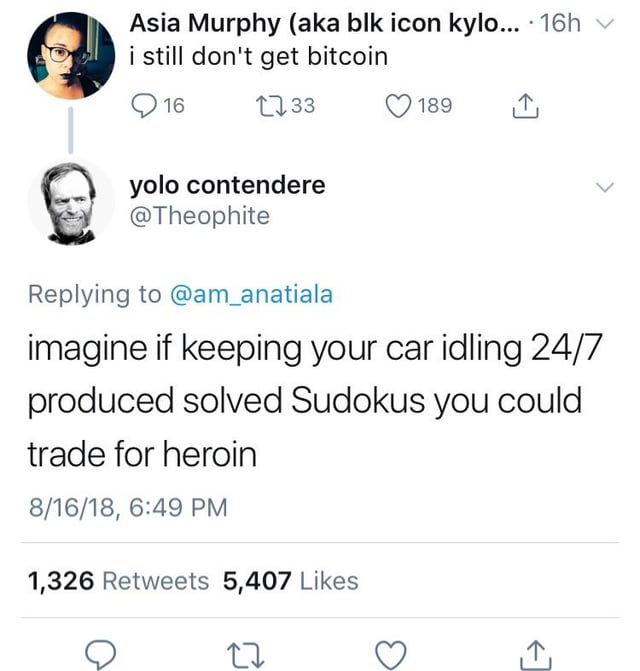
But what you said there is literally the end of my understanding of what crypto is. It has something to do with computers solving math problems, and somehow that’s worth money.
What?
But what you said there is literally the end of my understanding of what crypto is. It has something to do with computers solving math problems, and somehow that’s worth money.
What?
the problem with crypto is that when you try to explain it, it sounds so stupid that someone else thinks you have to be explaining it wrong
but if you want explanation, this one is fine https://ic.unicamp.br/... and this https://www.ic.unicamp.br/...
It's a speculative asset that fluctuates based on the whims of billionaire hedge funds and early crypto investors. There is zero value in owning it unless you got in early enough. And even then it's a situation of the last man holding the bag. Someone will end up losing their asses.
No, that's basically it.
The reason for all this work is basically the concept of a currency that isn't backed by and dependent upon governments while also being impossible to counterfeit, hence a lot of encryption because it fundamentally says that you can't trust the other computers that you're talking to. Everybody holds a ledger that says that you have $5, so you can't suddenly say that you actually have $10. And all the math is to prevent inflation by limiting the amount of currency that exists at any time. The more currency there is from solving the math, the harder the math gets to slow down the creation of new money.
It all falls apart, though, because the only value that crypto has is what it's worth in traditional fiat currency - the very thing that it's supposed to replace.
So it's just a bunch of computers doing a lot of math to make funny money that's supposedly worth something because...of reasons?
You know what a normal database is.
The Blockchain is a distributed database instead of a centralized one where normally people can verify that each other part of the database is correct.
Generally anything a distributed database can do, a centralized database in good hands can do better. Except for crimes. It's more difficult to get away with crimes when they can be shut down in one place.
Also it's harder to undo Blockchain/crypto stuff. They sell this as a benefit while the primary use is scams and rug pulls.
"The government can't get your money back." Yeah, gonna be hard to get back thr money you were scammed out of with a court order, isn't it.
They also try to sell it as anonymous, but it's very much not. Everything is on the record, so if they link you to an address (and they generally can), they can see every transaction you've ever made. There used to be services to obfuscate this, but the government has well and truly broken through those. They can find you of they want to.
Crypto is a an MLM for guys. You can make money, if you're lucky enough to be the scammer and not the scammee.
Fiat currency is just as silly. As is all money, really.
"I trade numbers for food. The numbers are accessible via a magnetic strip on some plastic in my pocket." or "I trade paper for clothing but the number of papers isn't as important as the number printed ON the papers." Both of these realities are absurd. :)
As a store of value representing labor rendered: neither of those are terrible systems and most people don't understand either of them anyway. Fiat seems "normal" because we grew up with it. That said: I'm no apologist. Popular crypto currencies offer little novelty for the layperson, no true improvement on the concept of currency generally, and cost orders of magnitude more to maintain their required infrastructure. I fail to see the appeal.
There are some projects which focus on the practical utility of decentralized currency (I remember thinking Nano (wikipedia.com) was cool back in the day) but they don't get the same kind of attention as meme coins because they can't be abused as easily. I've heard stories of these kinds of tools facilitating commerce in places where the local currency collapsed. Neat as that may be it isn't revolutionary... Still more convenient than bartering via cigarette though.
I'm gunna try to explain the basics of just Bitcoin here, its probably the easiest to understand out of all of them. It's all based on a mathematical function called the hash function. Basically the hash function can take in any input and produce a unique number between zero and a bazillion that represents it. Statistically speaking, the outputs of the hash function are random, and if you only have the output its impossible to find the corisponding input - it cant be reversed. When a transaction happens with a cryptocurrency its broadcast to the whole network, and made very public. All the information about it, the sender, the receiver, the amount, the time, and a few other things too, all that is sent around the network. That bundle of information is basically all a transaction is. But the process of validating it is what makes it real. Some people have computer programs that collect all of these transactions broadcast across the network, and they combine them into large chunks, known as blocks. Each block, along with all the financial data inside it, has an extra number attached to it known as a nonce. These people who listen for new transactions and later store them, take the block, and apply the hash function to it. If the output of the hash function is in a very small range - with is unlikely - a new special transaction happens, from no one, to the person who calculated the hash, minting new bitcoins (rn I think this amount is 3.125 Bitcoin but that might be outdated). (This is what Bitcoin mining is). If the output of the hash isn't in the range, they try again. The network automatically changes the size of this range to make sure that over a given amount of time the same number of bitcoins are minted, making Bitcoin free from spikes in inflation. Additionally, the network halfs the reward from mining a block about every 4 years, causing the inflation rate to drop over time. As this happens the network with settle on a fixed number of usable bitcoins, slightly less than 21 million. And that part of it makes its a viable alternative to gold, because while new gold is always being mined, its not much so overall gold has very low monetary inflation. But a large amount of bitcoins value stems from the fact that eventually Bitcoin wont have any at all.
I'd be more than happy to further explain how this stuff works, I'm no expert but I'm really interested in the math and economics behind it all. I really recommend reading the original Bitcoin paper, https://bitcoin.org/en/bitcoin-paper , its not a light read but it explains it all a lot better than I can. Have a nice day!
It's decentralized, so how do you prevent people from making up bullshit lies that didn't happen about where the money is? You do it by incorporating a difficult math problem. Then to incentivize people to actually work on that instead of just using the money, people who solve it get a reward.
I am not pro crypto, just explaining.
See, this guy gets it
Bitcoins got lower inflation than gold, that's a use case right there
Just a big lottery you'll never really win https://youtu.be/4DUkS98yw5Y
Yall seem to young to to understand crypto. Its original intent was to combat the crazy bad economic stuff from 2007. It’s not inherently a scam as a category. 2007s banking collapse was really scary when it happened if you were paying attention. It made 9/11 seem like NBD. Unfortunately not much has changed and you’ll probably get to see something similar again.
Yes. Absolutely. But I see where the appeal comes from. A few years ago I bought some Bitcoin for 50 Euro. A year later it doubled in value. That was nice. And that was moderate compared to when I first got Bitcoin and it was as cheap as dirt and suddenly it's worth 70k. With the world in the grips of the billionaire class people get desperate for even a chance at moderate wealth. It's a sad symptom of the fucked up world we're living in.
The relative value of your bitcoin changed, but the amount of bitcoin itself stayed the same.
Same happens with cash I guess, except it tends to be worth less over time.
The only crypto that makes kinda sense is the idea of a stablecoin (essentially a layer around a stable currency/reserve), but so far there's not really a good implementation of one.
All the big crypto coins are just more volatile stocks with shittier tax implications (assuming you don't try to skirt the law with it)
Public ledger blockchain is genius technology, whether you can imagine a use-case you consider valid is not a condition for it to actually be an amazing construction.

@sh.itjust.works
People tweeting stuff. We allow tweets from anyone.
RULES:
go to feed...
@sh.itjust.works
People tweeting stuff. We allow tweets from anyone.
RULES:
go to feed...
I understand that crypto is a scam that will rob millions of people of money they desperately need.
save