
pretty much the title.
mvirts 5 points 2 years ago
I for one think we need a register for each unsigned integer, why is zero so special? :P
Or if we can't get that, at least every power of 2 and power of 2 minus 1.
Maybe I can submit a proposal for risc-VI 🤣
PetteriPano 9 points 2 years ago
Maybe I can submit a proposal for risc-VI 🤣
No need! You can make your own custom extension! If the silicon doesn't support it, then you can provide firmware to emulate it.
caseyweederman 3 points 2 years ago
ARM is also reduced-instruction set but I don't know how they differ. Is the instruction set somehow more reduced?
MonkderVierte 3 points 2 years ago
Aren't they more like a hybrid instruction set and architecture?
hawgietonight 49 points 2 years ago
37.5 hour work week
JustEnoughDucks 3 points 2 years ago
We have 38h in Belgium, but if you work 40, you get 12 extra full days of holiday during the year (what I do).
A 32 hour work week with no salary cut will never happen, but that would be a dream
oceane 1 point 2 years ago
It may happen through union development, and free software development, i.e. whatever form of permanent democracy you prefer.
25% of any population being able to democratically vote for a strike and fully enforce it will de facto become the main political force in the country.
witty_username 43 points 2 years ago
First thing that comes to mind is RISCV. Although it's not new, it is gaining traction in consumer computing
TechnicallyColors 28 points 2 years ago path: 0 14683518, hotness: undefined, score: 28, children: 1
terraborra 12 points 2 years ago
I’ve recently switched to Fedora KDE running version 6 and HDR looks great. Well worth the wait.
comfy 18 points 2 years ago
JPEG-XL (someone already mentioned it as .jxl below) image files.
- competitive with AVIF compression levels
- not recycling video compression, so you get benefits like progressive loading
- JPEG transcoding - can take existing JPEG files (so much of the existing images online) and shrink their size by ~20% with literally no change to the presented image, and this is easily reverable. The amount of data this would shrink without risk of altering the data is HUGE.
There are a ton of other benefits but those are the three I'm most excited about.
Xavier 17 points 2 years ago
The Solid protocol specification or anything similar (it doesn't have to be that specific protocol).
For example, registering to a website or service actually creates a local secure database/bucket/pod where that website/service organizes/sort/manipulates our data and stores all generated modified data/metadata within our local personnal server, every time we interact with that same external website/service it gets access to the database/bucket previously created. (Ideally) no personnal data should be stored on external servers/machines outside our control and without our explicit consent.
Feathercrown 4 points 2 years ago
I hope this works out so much. Tim Berners-Lee even endorsed it! Unfortunately, a lot of these super cool ideas come with the limitation of needing a personal server. I think if we really want this stuff to happen, someone needs to start selling modem/router combos with a home server built in. You could add Solid, local media share, etc. by default, and it would be a great place to install Home Assistant or run a Minecraft server from.
Swedneck 1 point 2 years ago
My money is on IPFS, because it's so simple (like, in principle, obviously it's complex under the hood).
It's not fancy, it's basically a better version of torrent and only handles static data, but it does that really fucking well.
It takes any data you add to your node, splits it into small blocks, does a fancy hash of those blocks, and then builds a tree of pointers that point to pointers that point to the constituent blocks. This means that any identical blocks have the same address, and thus only need to be sent once! And the same goes for anything that ends up being identical in structure, it has the same address and only needs sending once, and if for example two people rip a copy of the same obscure DVD and host it on a node, they will both provide the data to downloaders despite never having interacted with each other at all!
This is of course massively boner-inducing for anyone who cares about archiving stuff.
In effect it does the same thing that HTTP or FTP or whatever does, but in a modern and fundamentally decentralized way. You don't care where the data comes from, you just request the ID from whatever nodes you can see, if they don't have it they forward the request to those they can see etc etc, if anyone has it they reply to you and start sending the data, and then you do some fancy math to verify that it's correct.
domi 16 points 2 years ago
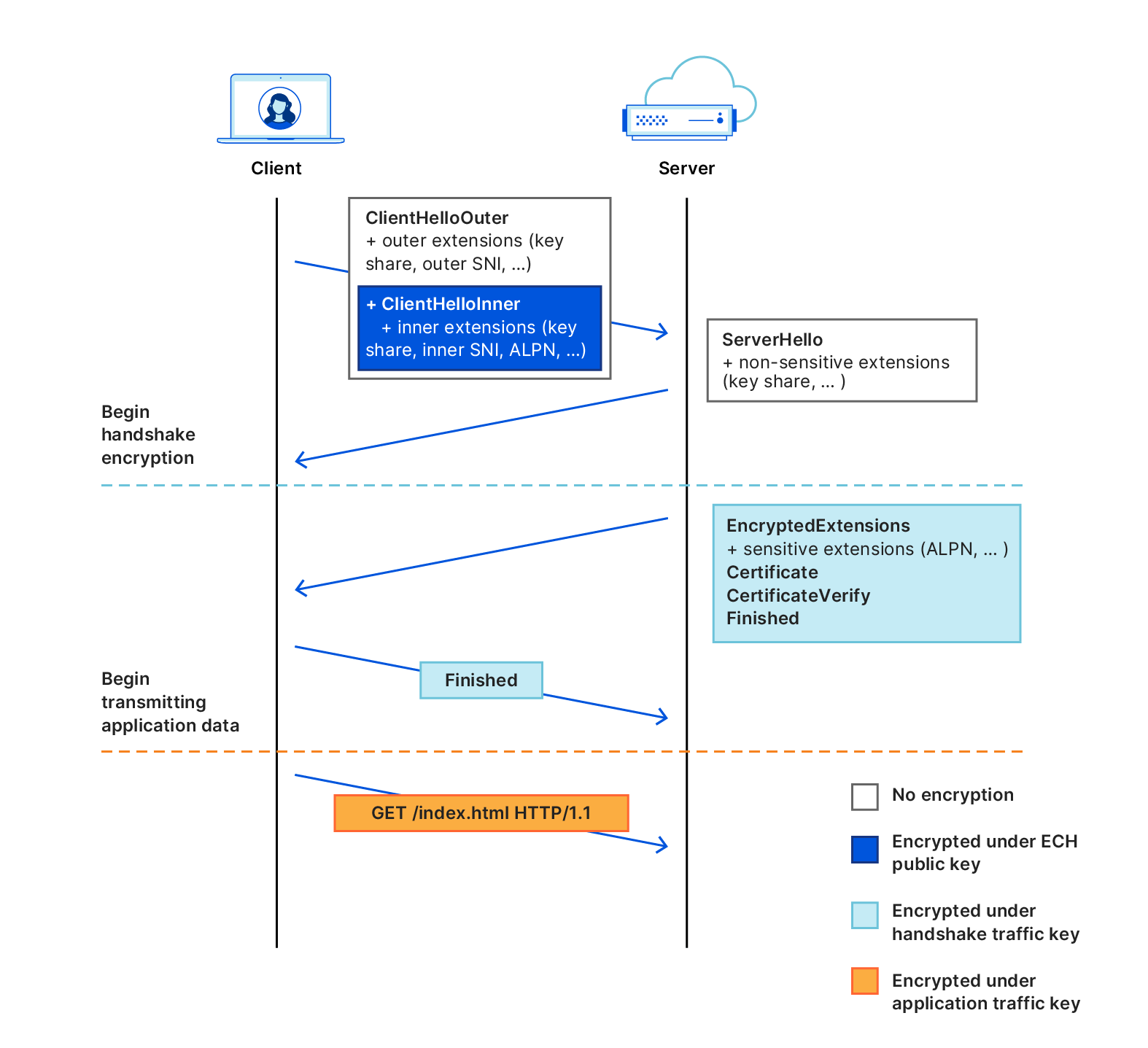
I want ECH (Encrypted Client Hello) to finally take off. https://support.mozilla.org/...
Implementation is still lacking unfortunately.
sga 3 points 2 years ago
i may be wrong here, but if i remember correctly, in ech, essentially our first communication is done with some central server (which as of now is mostly cloudflare) and then they make some connection with target server, and then a channel is established between us and target. my google-fu brought me this , which is basically this only
https://cf-assets.www.cloudflare.com/... (https://blog.cloudflare.com/...)
I am unfamiliar with QUIC, and quick search basically tells it is kinda like multilane highway for udp.
If I have to compare, (not a network engineer or a person who has studied networking, to me anything beyond the simple protocols seems magic), QUIC seems like a techt which is only used after you have made connection with target, so its implementation is google independent (they seem to be lead developers for this). Whereas in ECH, cloudflare are the primary devs, but also the holder for the public keys (someone else can also be the holder, but i dont know of any other provider currently, maybe my lack of knowledge here)
Essentially just an extension of your point that implementation is lacking
domi 2 points 2 years ago
essentially our first communication is done with some central server
No, the first communication is made with your DNS server to fetch the key for encryption from an HTTPS record. If a record with key is found it is used to encrypt the Client Hello, otherwise it falls back to the unencrypted variant.
Cloudflare is not involved, unless you are hosting your domain through Cloudflare of course.
I am unfamiliar with QUIC, and quick search basically tells it is kinda like multilane highway for udp.
QUIC is primarily used for HTTP/3. The protocol was engineered and proposed by Google, same as with ECH and Cloudflare.
khorovodoved 3 points 2 years ago
I doubt it. Today there is a huge trend towards censorship in the world. And ECH is exactly what a censor would not want. It is already blocked in Russia after Cloudflare enabled it by default and I would expect it to be blocked in the west "for anti-piracy reasons" very soon.
khorovodoved 1 point 2 years ago
Intensions do not metter in this case. It can be used for that and that's enough. If you block any connections that use ECH (by blocking cloudflare-ech for example) users will have no choice but to fallback to unencrypted CH.
rfr_Foglia 16 points 2 years ago
ActivityPub, I'm sick of corporate social media
terraborra 14 points 2 years ago
VRR that works with multiple monitors connected. Unfortunately that’s an Nvidia driver issue rather than a missing Linux protocol, so could be waiting a while.
ProtonBadger 15 points 2 years ago
NVidia 570 series drivers with Multi screen G-Sync (VRR) for Linux Gamers
terraborra 10 points 2 years ago
lol. I searched “nvidia 570 Linux” less than a week ago and nada. Just did it again based on you comment and it looks like it was released 2 days ago.
You’re an absolute legend! Thanks for the heads up.
forbiddenlake 4 points 2 years ago
Well, released is a strong word when it's not on Nvidias site. It was pushed to the cuda repos only, so far.
neatobuilds 7 points 2 years ago
CXL, being able to add like a ssd to a system and have it used for gpu and cpu memory sounds cool
cy_narrator 6 points 2 years ago
Being able to pinch to zoom on my laptop touchpad
chaospatterns 3 points 2 years ago
I'm on Wayland and KDE/Plasma. It worked on GNOME, but sadly not on Plasma.
cy_narrator 1 point 2 years ago
I am on Mint Cinnamon 21.3 and I cannot use Wayland
brisk 3 points 2 years ago
IndieWeb in general and the h-entry and WebMentions specifically.
Collectively they promise a highly personalised web experience that maintains ownership of your own content while encouraging socialisation across platforms, while avoiding the sustainability and scale limitations of activitypub.
I also want to see XMPP/OMEMO have a comeback.
brisk 1 point 2 years ago
What is "it"? Webmentions? Webmentions can be sent from anywhere, not just places you're actively monitoring. They can be used for example to create a comments section on your blog which amalgamates comments from various syndication points.
That is, you post to your blog, you post a link to your blog post to twitter/Facebook/lemmy etc, and comments or replies from any of those can show up on your blog itself if you so choose.
oceane 1 point 2 years ago
Alright, that's pretty cool, sorry – I thought it was a list of links automatically inserted in lieu of comments.
I've been trying to get into the IndieWeb for years, but I've been struggling to implement it. Doesn't it rely on a central server too? Can we use it in a fully e.g. decentralized or federated way – would it even make sense, or could we easily switch to another flagship server, as we did with the Freenode takeover?
Please feel no pressure to reply, I can do my own research ^_^
just_another_person 2 points 2 years ago
Care to elaborate?
MonkderVierte 2 points 2 years ago
Commonmark.
Swedneck 1 point 2 years ago
Basically everything from https://www.protocol.ai/work, bar the blockchain stuff which i can only assume they're doing to milk investors to fund the actually good projects.
libp2p abstracts away networking so you can simply point to a peer ID and the computer figures out how to connect to it (though you can of course specify how to connect if you wish), and it preserves connections across different networks among other stuff.
IPFS is basically just torrent but better in every way, foremost in that you can just slap some data onto an IPFS node and if anyone else happens to be serving the same data then you'll both automatically be valid providers, despite never having talked to each other in any way. No more needing to search out a magnet link, just seed whatever data you want and anyone requesting the data from the network will automatically find you.
AnnaFrankfurter 0 points 2 years ago
Obligatory https://xkcd.com/927/

linux
@lemmy.ml
68190
9482
5969
From Wikipedia, the free encyclopedia
Linux is a family of open source Unix-like operating systems based on the Linux kernel, an operating system kernel first released on September 17, 1991 by Linus Torvalds. Linux is typically packaged in a Linux distribution (or distro for short).
Distributions include the Linux kernel and supporting system software and libraries, many of which are provided by the GNU Project. Many Linux distributions use the word "Linux" in their name, but the Free Software Foundation uses the name GNU/Linux to emphasize the importance of GNU software, causing some controversy.
Rules
- Posts must be relevant to operating systems running the Linux kernel. GNU/Linux or otherwise.
- No misinformation
- No NSFW content
- No hate speech, bigotry, etc
Related Communities
Community icon by Alpár-Etele Méder, licensed under CC BY 3.0
go to feed...
RISC-V
I want open-source hardware
save