
Image transcript:
The "what if you wanted to go to heaven, but god said ____" meme template, but here it says, "What if you wanted to walk to get groceries, but city planners said DRIVE". The last panel is an image of a massive freeway full of cars.
[meme] Being forced to drive isn't freedom — it's a government-mandated lifetime subscription to oil
3 years ago by Fried_out_Kombi to c/fuckcars
Image transcript:
The "what if you wanted to go to heaven, but god said ____" meme template, but here it says, "What if you wanted to walk to get groceries, but city planners said DRIVE". The last panel is an image of a massive freeway full of cars.
I get you. I used to go to school with bike. Its a 30-40 min journey in one way. That was the best time in my life. I liked to see the sunrise, fell the wind, goig anywhere I want. I don't want a car too much stuff.
Believe it or not working at McDonalds in your "spare" time when you're already school full time and an athlete, isnt a whole lotta fun xD
And when there was something going in, they would ask if we needed a ride, bc plenty of us didn't have cars. Our idea of fun was like DnD or Risk on the weekends...
What I do wish is that I had found some kind of summer internship or something that could build my skills, because I was quite into coding as a hobby.
Here, now it's a proper lemmy thread:

Oh i have read the comments. Indeed.
I see the carbrains have found this post
I don't even follow this community, but it was top in top-6 hour
I cant imagine feeling the need to get angry over people wishing for a car free life.
A car free life is great for some, but there's no need to call people names if they enjoy driving. I'm sure I could come up with a bike/pedestrian/public transit version of carbrain, but someone has to stop the hate.
From my side of the fence, you identified the "angry" position as the one responding to an insult. That's trump-onomics 101: preemptively demean your adversary by name calling.
Yawn
You're commenting on a post in a community literally called "fuckcars". I don't think "stopping the hate" will be effective if you are saying that "the hate" is being given a name of "carbrain."
That's like being upset that I call every gun rights advocate a gun-nut. Guns and cars are tools. Cars are for transportation, not an identity. Guns are for killing things, also not an identity.
I like Fried_out_kombi's post https://lemmy.world/comment/4875407 about the fuckcars community. This isn't a community of hate and anger, but of development, ideals, and dreams. There is a balance to be had.
There are actually things I like about alternative transportation and close knit downtown city design. I visit those places frequently.
I live here on the outskirts in less dense residental areas and practicality means a car. I like light rail, I like trains, I like ferries, and I think cars are getting too heavy and big.
But I am a car person. I love the freedom; the control, the exploration, and act of driving; being one with a machine and working together.
I was brought to this community because Fuckcars is shitting outside the box into other communities to the determent of lemmy; you guys brought me here.
But I didn't bring hate with me; that's not why I'm here. But I do bring real world experience and I will speak my mind in this echo chamber if there glairing logical fallacies.
Or am I mistaken and this is a community of hate?
Lucky you. My closest grocery store is a 90 min walk, 54 min bus ride, or 12 min drive round trip. (According to google maps)
I actually did that loop once! Got a couple of the basic staples, a quick munch, and hiked home. My fingers were ready to fall off haha!
Think how awesome your drive would be if everyone else walked!
Yeah, walking definitely isn't suitable for everyone. What we need is dense communities with layered and diverse transit options. High walkability, abundant protected bike infrastructure, and accessible mass and local transit.
Walkability is a matter of urban design. Only 20% of the US lives somewhere rural; 80% live in a city, suburb, or small town. We're taking about how the 80% shops.
Walkability is about lot size, density in general, mixed use development (putting houses near restaurants and shops), parking minimums, that sort of thing.
Walkable areas tend to be connected by public transit. Look at Amsterdam - to get to work, you might bike to the train station, take a train, then walk or bike to the office. You don't have to walk clear across the city; public transit connects walkable spaces.
Compare that with American suburban design, where shops are put far from houses, on ugly-ass loud dangerous stroads with comically oversized parking lots. You don't walk anywhere because anywhere you'd want to walk to is incredibly unpleasant to exist in. People will literally drive in their car to a walking path or a gym treadmill.
A few ideas, which may or may not work out for any given situation:
For reference, I live in a country with decently well designed urban environments, and my nearest grocery store is less than 200m away by foot. I could just do all of my shopping there, but it's a bit more expensive, so I bike to a cheaper store that is 3.5km away, taking me less than 10 minutes. There I fill up a basket and maybe a pannier, which gets us enough groceries to last for a week or so.
If I need to transport anything larger, I primarily look to have it delivered, or as a last resort, I rent a car. Renting a car is almost never necessary, though.
Hey!
I can answer this pretty well as I grew up and lived in a pretty car dependant Minneapolis until I was 23, where then I moved to NYC with no car in 2018 and have lived here ever since.
The TL;DR to this question is that you transport everything in a grocery bag on person, but the longer answer is that your buying and cooking behavior changes.
Back in Minneapolis I relied on buying in bulk, since I wanted to limit the number of trips in the 15-20 min drive between my apt and the Costco. Variability with the weather affected this too, as I would buy extra if it was in the winter time. I'd make this trip by car around 2-3 times a month. This also affected my buying and cooking decision making as well. Buying groceries first then figuring out what I wanted to cook.
Once I moved to NYC, I would always have a grocery store several blocks away from me. At most being a short 5-10 min walk. This changed my habits as I always had a grocery store I could quickly pop in without having to think about traffic, my car, etc. So although I would go more frequently (~ 2 times a week), I would also find this a lot easier and would buy less.
Nowadays, whenever I think of wanting to cook something, I either head over to the store on my way back to the office, after the gym, etc. and then cook that very same day what I bought.
In my mind, that big fridge I used to restock with my Costco runs has been replaced by having that quick grocery store within walking distance.
Purely anecdotal, since I know some other people in the US may be living different than a single guy living in an apt in NYC, but this is also how it is in many cities I've traveled to in Asia and Europe.
I miss NYC for this reason alone, among a few other reasons. I used to walk and bike everywhere, didn't even need the MTA.
Thanks for the in depth answer! This has me wondering whether I can live without a car here in the bay already, but our infrastructure is not nearly as good as NYC’s. Anecdotally, things here are a lot more compact than Texas so I do find myself going out more for smaller trips anyway.
Curious, did buying groceries more end up costing more?
I lived in Boston for a while (with a car, but putting low miles on it)
Curious, did buying groceries more end up costing more?
When I switched from buying in bulk periodically to buying small more often, I can say that my first few weeks definitely cost more. I had a mindset about buying for X weeks out instead of X days out that took a bit to shake. In the process I realized how much food waste I was having by purchasing in bulk and not fully using everything, and I naturally switched to purchasing less at the grocery store. Both because it meant carrying less home but also because it was cheaper. Now I buy more or less exactly what I need and I can say on average my grocery spending is less now (avg monthly) than it was when I was buying in bulk.
Hmm on my end the answer is tough because it really matters haha
In Minneapolis I was exclusively going to Costco and Cub Foods. Costco, things were cheap in bulk, while Cub Foods you always had good deals in coupons.
Estimated bill from Costco being 80-100 every 2 weeks, Cub probably 60-70 every 2 weeks (this is in 2017, so pricing has changed quite a bit haha)
In NY, my bill shifted based on where I shopped.
When I lived in midtown Manhattan on 54th and 7th in 2018, I went to the Whole Foods in Columbus Circle and would leave with a bill around $60 a week. But back then when I first moved, I was also eating out a ton.
Nowadays, I live in LIC in Queens and go to some local grocery chains and cook a whole lot more. My weekly spend is around $120 or so a week. But I'm also cooking a whole lot more than I used to and eating out a lot less.
I forgot who said it, but someone said it best "if it weren't for rent, NY would actually be very livable cost-wise."
Hm so I’m American and haven’t really used public transport in this country. I have in some Asian countries like Singapore or Japan, where in the past few I’ve been specifically keeping an eye out for groceries and haven’t seen it. It doesn’t always seem feasible to have groceries though, sometimes trains are crowded.
I was more wondering if there were no cars at all, which I believe is the ideal. For environmental reasons I would say it’s best to reduce car traffic to near zero someday, though I understand this is not necessarily possible in America. In this situation there would be no taxis though.
Admittedly this question isn’t so much for myself, but it’s my understanding that many families have a single grocery buyer and lack the funds to buy smaller quantities more often. Bulk is usually cheaper. In the American culture of minimizing worker resources, I wonder if pay wouldn’t simply decrease if cars were no longer purchased, and they’d find themselves in the situation of equally low funds but no car. Maybe not the most rational concern but the American society is not overly reassuring.
Anyway as a person who needs to breathe and live on Earth I have a vested interest in a car free society, and am just wondering about the little details.
It really depends on where you live, the infrastructure and transit available to you, and any other circumstantial factors.
First off, a big part of what !fuckcars@lemmy.world wants to fix is the problem that many communities are simply designed with the assumption that everyone will drive everywhere, which often means most people aren't within walking distance of shops (because it's literally illegal to build grocery stores in many residential areas). It also often means very shoddy pedestrian infrastructure, sketchy (if even existing at all) bike infrastructure, and little to no public transit.
If you live within walking distance of a grocery store, you're in luck! Something like a granny cart (pictured below) can allow you take pretty heavy loads of groceries on foot.

If it's too far to walk but you have decent bike lanes or paths that you feel comfortable riding on, you can attach pannier bags and/or crates to a bike (an e-bike makes it even easier) to carry pretty big grocery hauls home.
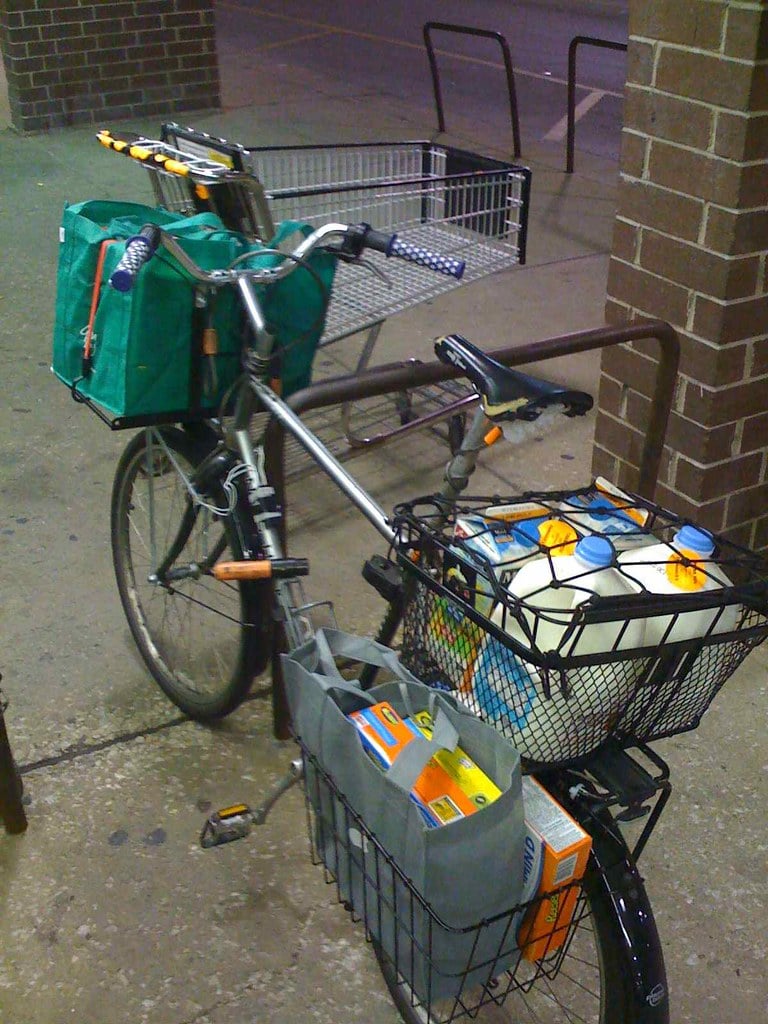
If neither walking nor biking are options but public transit is, you can take a granny cart on the bus or train easily as well. Of course, a limitation is none of these three options can take nearly as big a haul in one trip as a car can, but the idea is you can make smaller, more frequent trips. For example, I live a 5-minute walk from the nearest grocery store, so I can pop on over a couple times a week to get a few items, which is light enough to carry. Of course, if you need to feed multiple people and it's a kind of long, onerous journey to get groceries by foot/bike/transit, this might no longer be feasible, unfortunately.
If none of those are feasible, there's no shame in having to use a car. The villain here is the system that forces people to drive even if they'd prefer not to, not the people being force by circumstance to drive.
I do like the cart suggestion. In a more ideal world with completely walkable cities, perhaps even without cars, I still don’t see a great alternative for those who need to feed large families on a budget though.
At any rate, that’s not me, so I personally see the benefit. I like cars but I’d be cool with them primarily used for track days and have no love for regular traffic driving.
If you don’t mind my asking, what’s the preference for foot or bike traffic? I don’t particularly prefer walking or biking over driving. I see the environmental impact— and that alone is enough for me to agree— but I was wondering if there was an actual preference for walking
For me at least, I like the simplicity of walking. Since I'm near the closest grocery store, I can just put on some shoes, grab my insulated grocery bag, and pop on over. You feel the weather, have a nice little walk where you can stretch your legs and not deal with traffic or parking at all. It's hard to describe it, but being in a car just makes me feel disconnected from the world, like you're putting yourself in this pod, moving at high speeds with other pods, then arriving at your destination. By car, doing groceries feels like a chore to me, but by foot, it feels like a treat.
Plus, by not owning a car, I save so much money it's kinda insane. Sure, I don't quite get costco prices (although I'm not at all paying Whole Foods prices either), but I'm not paying outrageous sums just to fill up the tank with gas. Overall, I come out way ahead monetarily by living car-free.
No argument there actually. Having lived my first couple decades in Texas, the idea of a walk for fun or to get groceries in the oppressive heat was basically unthinkable. Now in the Bay, where the weather is almost always nice, I get it.
Actually, how would people in those climates do it? Same way?
The thing with walkable urbanized area is that you don't have to buy in bulk for groceries, because a grocery stores are just minutes away from home. I myself shop in a traditional market which is only 5 minutes bicycle ride away from home. Plus there are many convenience stores within 1km radius.
When the store is walkable, your bulk buying turns into one bulk item that you walk to and get.
Basically its the same way you get something bulk from your trunk into your house. Which is probably your hands and arms.
I used to take the subway to work, and usually walked past a grocery store or two - one downtown, and one a block from my apartment.
Because the overhead of shopping was lower (it was at most thirty seconds out of the way, on foot), I'd stop in a couple times a week, and picked up a bag or two of groceries that I'd just carry home by hand. It made it easier to be spontaneous.
For bigger trips, you could use a cargo bike or panniers. But I rarely felt the need. Buying in bulk was much less convenient than just buying an amount I could carry by hand, because it requires a special, deliberate trip.
I haven't seen this option mentioned yet but you can also order your groceries online, and have them delivered. That's what I do at the moment, because I live outside the city and my nearest grocery store is 2 km away. I could bike or hop on a bus, and I do sometimes, but ordering online is just really convenient.
I like the convenience too. It's almost "back to the roots" to the times when your local grocer/trader would deliver the goods to the local citizens, since he was the one with the car, though today this dude is replaced by a faceless webshop. And even though this option includes cars, it reduces the number on the road, since one delivery vehicle will (potentially, though not necessarily) replace one car for every household it's delivering to. This vehicle (theoretically, at least) drives the most time/fuel-efficient route, instead of every household driving to the store(s) and back again. Funny how this is moving traffic of the roads and turning it into digital internet traffic!
If i want to buy something. The closest shop is around 10 minute from my house. If I buy in bulk put everithing into my bicicle and walk home. Its just me not everyone want this I understand, but if we didnt have cars we just solve it in other ways
I mean it looks like you're already in the city so it looks like you don't have to walk far to get groceries
See, there's alot of major inconveniences with rejecting getting a car or other road legal motor vehicle. Not everyone lives in the city, therefore trying to walk or bike to places while living in a rural or even sub-urban area is not necessary ideal (if even practically possible). Having a car or bike or whatever to get you on the road efficiently lets anyone go wherever they need to go with practically and ease. Now yes I know public transport exist, but one: you are one their schedule and two: not many areas other than mainstream and urban and areas have full access to public transport.
You can have both. You can have a car and still be able to walk or bike to do small daily groceries, go to the pharmacy, get bread etc. I mean, not rural middle of the fields, but small rural villages where I lived in Germany were like that.
Only in the USA do you have to pick. The suburban sparwl with strict zoning is an abomination. All for the sake of property values.
As usual this has become yet another tribal issue where you either defend the car or defend walking and biking.
You can do both without your head exploding. I know. Shocker.
Nice if you can afford it.
"This is so cringe."
This is so cringe.
The point isn't to force people to walk to get groceries. Rather, the point is that many cities have made it essentially impossible to get groceries on foot, even for those who want to. For example, Euclidean zoning in the US and Canada makes it literally illegal to build grocery stores (or any other commercial spaces) in residential areas, meaning grocery stores will be way too far from where most people live to be practical to walk to. Similarly, parking minimums mandate each store have a large, arbitrary amount of parking out front, even if the store owner doesn't think they need anywhere that much parking. The effect of this is to needlessly spread out cities, yet again making it harder for people to walk to the store if they wish.
If you live in a place where it's practical, where local laws don't literally forbid it, walking to the grocery store in January genuinely isn't bad in the slightest. I live in Montreal, which gets pretty frickin cold in January, and yet everybody and their grandmas walk to the grocery store in my neighborhood. Why? It's a reasonably dense, walkable neighborhood with several grocery stores within a 5- to 10-minute walk of tons of people. I myself live a 5-minute walk from two grocery stores. For me, scraping ice and snow off a car just to get groceries would be 1000x more annoying than just popping on over to the store on foot.
Noni am correct. Explain to me how walking multiple miles in the snow is better than driving. Or do you want me to go to corner stores where everything is twice the price if a super market
Counterpoint: having a working car makes a human being have vastly more freedom to travel than not having a car.
Having a car means you can drive to anywhere that roads on your continent lead to, and even to places that don't have roads if your car is off-road capable. Without a car, you have to hire transport to get to anywhere you can't get to by your human body power.
I would never live without a car unless it was physically impossible. Law banning cars would not stop me, I would build my own fucking car if I had to.
You're arguing for having a car in a thread about needing a car
It's not about banning cars, it's about designing places to make them not necessary
Where I live you can walk to the local shops
Loads of people drive, but you don't have to. This is good.
Exactly. There's a pattern I've noticed of people interpreting "car dependency reduces freedom" as "car ownership reduces freedom". But the point you, I, and many others are trying to make is that building our cities in such a way that no one has a choice but to drive everywhere is counter to the idea of freedom.
Freedom is the freedom to choose how you want to get about your city and not be coerced into owning and maintaining a (rather expensive) vehicle just to get groceries. People want choices.
People interpret it that way because the community is called "fuck cars" and some users are very toxic and don't present the nuances very well.
A lot of people support better public transportation. But nobody is being won over to the movement with antagonism and name calling.
There's some good discussions too, I get it, but it's no surprise that misunderstanding occurs.
*had a car to drive anywhere*
*drives to the same 3 spots 99% of the time*
Explain that.
Not hard to explain at all. I am lazy and I enjoy the cool stuff I have at home more than I enjoy traveling frequently. But in my case it would be driving to the same 5 to 10 spots most of the time. I go to different cities to visit people or a dispensary with a better selection, etc.
It's pretty cool to have the option to do any of the above anytime I want.
It's too bad you don't have the freedom to rent a car...
I mean... I live in a 3 mile town. It's cold as fuck, I live North of a town called North fucking Pole.
I ain't walking for shit, sorry but my car is on half an hour before I even use the damn thing.
You want to fix infrastructure of America, cool. Maybe you'd get my vote. But these memes feel like bs marketing that simply does not apply to our current situation.
That's a very different experience then I had living in the cold as fuck.
When I was in Yellowknife, it was easier to walk or bike than to drive. Between plug time and idle time, you could just walk or bike faster. Plus you're not spending a fortune on hydro and gas for a short drive.
I mean, obviously Yellowknife is a pretty big city for the north; but if it's a 3 mi town then nowhere is more than a 40 minute walk or 15 minute bike away. If 3 mi town is an expression and not a size, maybe just take your sled?
Also a big part of me being in the north was embracing nature and the elements, I get that might not be why you're up there.
Finally, you're the 20 of the Pareto principle; if it's not about you, it's not about you.
Uh. I'd walk, because places this packed with cars typically have a convenience store on every corner block.
This is such a stupid argument, lol
They don't put roads like this to places with no infrastructure. They put it in places with lots of infrastructure, and they have to -- because businesses and people in the area need talent from a wide swath of land to fill out roles in companies, etc.
You ain't walking it if there is a freeway between you and the store. Even in large cities, walkways that cross major highways are rare.
Perfect example right here where I am. The nearest Del Taco is within a walkable distance; but it's on the otherside of the freeway. There is no walkable crossing to get over there. I have to drive, despite it being hella stupidly close.
Have you never heard of food deserts?
There are much more efficient ways to move all that talent:
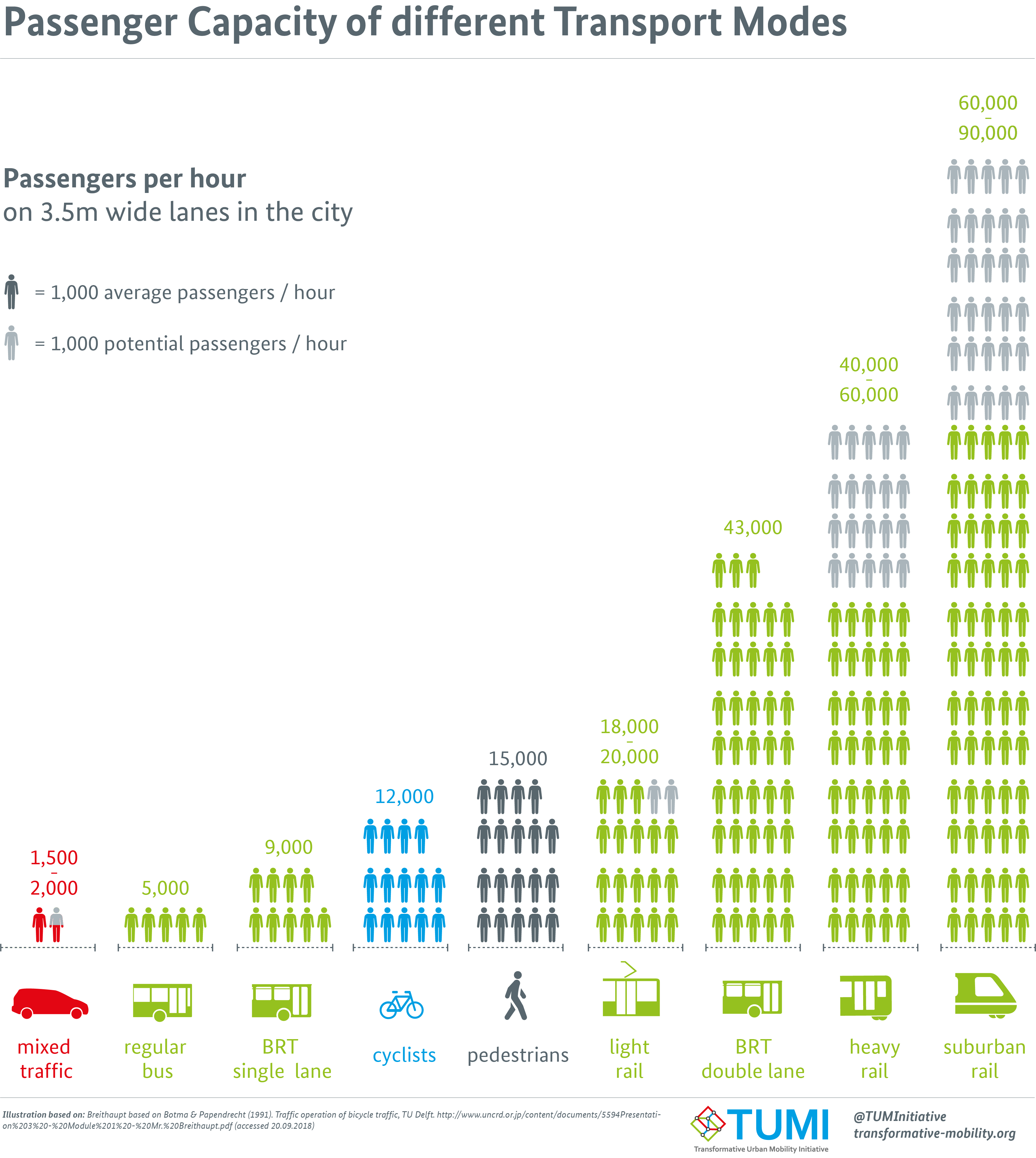
The first high-speed rail system began operations in Japan in 1964, and is known as the Shinkansen The busiest high-speed rail service in the world, carrying more than 420,000 passengers on a typical weekday
-- but your chart shows 90,000 per hour.
I'm gonna call bullshit. Biased source is still biased.
The chart isn't about high-speed rail. High-speed lines often actually have lower capacity than lower-speed rail. For one, many suburban trains are bilevel, which can almost double the capacity per train, whereas high-speed lines often aren't bilevel. Further, the higher speed doesn't actually mean you can move more passengers per direction per hour; you're still limited by how frequently you can run trains, as you need safe stopping distance between each train. Thus, high-speed rail can run faster, but it also needs much more space between trains. Typically the highest frequency train/metro routes can run trains every minute or two. A 2000-person capacity train every 2 minutes is equivalent to 60k passengers per direction per hour.
Last I checked, a day isn't 5 hours long.....
Let's give you a shot here and say they only operate 12 hours out of the day, that means the busiest train in the WORLD only does 35,000 an hour. But the graph is claiming 60-90k per hour.
If I can point out that very OBVIOUS bias/flaw in the chart, what is the reason I should take it seriously at all?
People like you should spend some quality time in a walkable city. I think you'd find a lot thaf you like!
i so wish i thought the koolaid tasted this good
Ableist garbage. Can we please ban this pathetic anti-car movement for being ableist? It's hateful and insulting.
My sister had her driver's license suspended for a while due to a medical condition, and her neighborhood's extremely car-dependent design made it completely impractical to walk to get groceries. The only thing that ended up working was getting an electric bike, but even that was still not great because there are absolutely no protected bike lanes in her neighborhood. No transit either.
When you advocate against ending car dependency, you're advocating for people like my sister to be stuck at home, unable to get groceries on their own.

If anything it's the car-dependent infrastructure that is ableist, as many people with disabilities cannot drive. I can't, and if I didn't live in a place where alternative modes of transport were a thing, I would either be stuck at home, or have to waste money on buying a specially made car.
Far from all disabled people use wheelchairs or have mobility issues. Some have problems with their sight, concentration, fine motor skills etc. which prevent them from driving safely. Even if you cannot walk or ride a bike, and have trouble getting on/off public transport by yourself, living in an environment that is walkable and bikeable usually means that it is also easier/safer to get around in a wheelchair or on a moped.
Stop trying to larp being an advocate for people with disabilities, it's pathetic and extremely disingenuous. If you actually were an advocate you'd know there are plenty of disabilities that disqualify people from driving and a lack of alternatives is the actual discrimination.
Seriously, you make me so fucking mad with this shit, it's the worst category of cowardice. Leave and don't come back.
It's not anti-car per se, it's anti-car dependency. In a walkable city, you still have the choice to have a car and drive places, but it's not a requirement.
This is a very good thing for many people with disabilities, myself included. Not everyone can drive.
@lemmy.world
A place to discuss problems of car centric infrastructure or how it hurts us all. Let's explore the bad world of Cars!
You may not agree on ideas, but please do not be needlessly rude or insulting to other people in this community.
Don't discriminate or disparage people on the basis of sex, gender, race, ethnicity, nationality, religion, or sexuality.
Don't follow people you disagree with into multiple threads or into PMs to insult, disparage, or otherwise attack them. And certainly don't doxx any non-public figures.
This community is about cars, their externalities in society, car-dependency, and solutions to these.
Do not repost content that has already been posted in this community.
Moderator discretion will be used to judge reports with regard to the above rules.
In the absence of a flair system on lemmy yet, let’s try to make it easier to scan through posts by type in here by using tags:
go to feed...
@lemmy.world
A place to discuss problems of car centric infrastructure or how it hurts us all. Let's explore the bad world of Cars!
You may not agree on ideas, but please do not be needlessly rude or insulting to other people in this community.
Don't discriminate or disparage people on the basis of sex, gender, race, ethnicity, nationality, religion, or sexuality.
Don't follow people you disagree with into multiple threads or into PMs to insult, disparage, or otherwise attack them. And certainly don't doxx any non-public figures.
This community is about cars, their externalities in society, car-dependency, and solutions to these.
Do not repost content that has already been posted in this community.
Moderator discretion will be used to judge reports with regard to the above rules.
In the absence of a flair system on lemmy yet, let’s try to make it easier to scan through posts by type in here by using tags:
go to feed...
This what I never understood.
Where I lived, in high school (age 15-16) everyone was expected to get a license and car ASAP. I was like, why? To get to your job. For what? To earn money to pay for the car, gas, insurance, etc.
So you want me to work a job I don't need to pay for the gas for a car I don't want, so I can be miserable in school?!
And if you looked at the driving records of my peers who had cars... Not pretty. A lot of totalled sports cars.
save