you should organize documents into them instead of throwing them all in “Documents” library and just using search.

you should organize documents into them instead of throwing them all in “Documents” library and just using search.
I’ve been interested in Zettelkasten for a few years, since I discovered Obsidian, but I’ve never been able to quite get the hang of it enough to make it stick
Obsidian user as well. I like to think of it that tags are folders.
When you put something in a folder, you have to choose one of the files identities. Tags more or less allow you to assign a file to any number of groups.
So if you're writing about an NPC in a DnD campaign, for example: That NPC will exist in a certain place. He will be associated with particular guilds and he will have certain moves that you might want to keep track of. You can later easily search by a guild or a move or a place and there will be a link to that NPC and others that share those indentifying characteristics.
A big advantage of zettelkasten is that you don't need to really worry about file management in the sense of needing to make exclusionary choices.
I appreciate this measured take. Whenever generational differences get brought up, they oftentimes seemed framed as if generations are biologically different creatures or willfully choosing to be stupid in some sector. In all, or at least must cases, it's what you suggest: people responding and developing based on what the environment has presented them.
Millennials grew up alongside modern computing (meaning the two matured together). We dealt with everything from BASIC on a C64 to DOS and then through Windows 3 through current. We also grew up alongside Linux
Only the oldest millenials did. When the youngest were born, the internet and Windows 95 were readily available and they were in middle school when the iPhone came out.
Yea, I'm a millenial, and I remember mostly only interacting with old Macintosh LCs in elementary school, and then Windows 95 and up after that. My uncle had an old Tandy computer running DOS, that I remember at least learning how to run a game on, but by the time I was interacting with a computer, regularly, Windows 95 and AOL were the most common thing.
We did have some DOS games on CD during the Windows 95/98 era, though. Lemmings always ran better if you dropped down to DOS and ran it from there instead of trying to run it through Windows, for instance.
Trouble is that there are enough millennials who also have absolutely no clue about computers. Between dude-bros who won't touch that nerd shit and girls who got told by their nerd boyfriend's that the computer will start to burn if they click anything besides their allowed icons a vast majority of people are glad if they know how to turn on the computer and print out their document.
Yes, there are probably a lot more computer literate millennials than in other generations. But even there it pretty much depends on family and friends. And in a pirate community on Lemmy most of the people will belong to the tech savvy bubble.
In our friend group even the most computer illiterate kid knew how to set up a LAN without a DHCP server. Their younger siblings had no idea a LAN was even a thing.
My wife's ex always told her that she couldn't understand how to work with a computer. Her older brother who works in IT wouldn't explain anything to her either. They were pretty astonished when they heard that she had installed a GPU by herself (which most people here know is trivial). Which gave her enough confidence to fix her VCR by herself.
They were pretty astonished when they heard that she had installed a GPU by herself (which most people here know is trivial). Which gave her enough confidence to fix her VCR by herself.
Anyone can learn any skill if they actually invest the time.
And regarding the older brother, you learn pretty quickly working help desk that users generally don't care what the problem is or why it happened. They just want to get back to work and not have it happen again. After a while you get conditioned to just be friendly and solve the issue without explaining what you're doing or why.
I thought this was going to be an American joke about automatics, but then realised that this is like when I explained to younger colleagues that I just drove my car home ‘crash gearbox style’ when the clutch failed, some were amazed that it was even possible. (Match the revs and feel the gear mesh) Edited to add: when I first tried linux on a pc with CRT monitor, to get a gui going I had to roll my own modeline. Bzzt, oh not that value, ctrl-c try another one. Such funsies
Adventurous young person, ready to be sent on a quest, is where you got filed in my head.
Sincerely,
~Lazy millenial wizard who wants help running errands.
Honestly I should have a bit of respect for zeds and alphas who grow up around locked black boxes and still despite that manage to come out the other side knowing how to use something like terminal or git.
I don't know how many time I answered the same thing to the exact same argument but here goes:
In short, it's most likely not true. You're implying the the millennials were generally more competent but it's very likely wrong, the vast majority of people in that gen had absolutely no clue what they were doing on a computer most of the time they just knew how to do a few limited things with them.
The apps didn't make the masses tech illiterate, the app adjusted to the existing ones and removed the stuff they couldn't never understand, like where to save a file to be able to find it later. (I've worked in a support call center and I can tell you with 98.5% accuracy that the lost file is in system32).
The gen-z has quite a lot of smart, curious tech savvy people, and a vast majority of tech-illiterate people, so did the millenial, and the X, and the boomers.
This whole generational superiority argument is just as baseless as it was when my gen was blaming yours for being lazy, not able to learn anything due to a short attention span and an obsession for brunch and avocado toast.
I actually hire engineers and I do notice that the zoomers seem to have less general computing and IT skills, though I think some of that has to do with how the curriculum has changed. Software engineering and CS is just way more specialized than it used to be and isn't just a slow evolution from computer engineering these days. So you don't get that broad computing background which starts with electrodynamics and works up through digital design, comms, networking, and ultimately software.
For my purposes, this knowledge is a big part of what differentiates a developer from an engineer (and proper computer science is a different thing entirely) which has made it really difficult to figure out what to expect from a software engineering degree.
Personally, I think both of these perspectives have truth to them but neither is the whole story.
True, there are tech savvy people in every generation, and the majority of each generation isn't necessarily tech savvy.
But it's also true that the tech savvy people today are growing up in a world where technology has been obfuscated and simplified whereas formerly tech savvy people didn't have a choice but to learn the ropes to be involved at all, which meant there was more need for Millennial tech savvy people to understand the basics, while there is no such equivalent need for Gen Z.
I agree, I think many are overselling the impact of that, but it has an impact nonetheless, however small.
I know this is true or I wouldn't have such trouble explaining to crypto (specifically NFT) enthusiasts why counting bits matters and how there is limited "space" inside an NFT for nothing but a simple URL. If you grew up in the 80's or 90's and were learning ANY amount of networking, counting bits for subnets in IPv4 was pretty much a requirement. Now a lot of networking is obfuscated and automated with IPv6, which is finally coming into its own, and a side effect is that understanding these limitations of the technology has flown out the window for buzzwords like "smart contracts."
You make the same mistake as the previous person. You take the exemple of the minority of people who cared to try to understand how computer worked and generalize it to the entire gen.
I have thousands of people in my office that prove everyday that millenial are for the most part tech illiterate and do not care about how thing works. I've seen the millenial arrive in the work env and the gen-z and there is absolutely no difference. Millenial were exactly as dumb (or as smart). If anything, I think gen-z are actually smarter because they come in not believing the corporate bullshit the X and the Y drank like cool-aid. But that's another topic.
In any case, all the stuff we had to go through didn't make us smarter, for every 10,000 of people of my gen who learned they had to edit autoexec.bat to launch a game, I'd bet that barely one knew what the heck himem.sys actually was. That didn't make them smarter, just monkeys who learned a trick.
So yeah, geeky gen-Z don't need to tweak as many parameters, they can directly launch fusion 360 and start designing parts for their 3D printers. Tech has moved on. Gen-Z geeks fiddle with other stuff than shitty windows drivers.
I'm sorry, but you're wrong. Relying on edge cases in either generation is pointless. Millenials had zero tech support to help them for everything you need to do on computers.
How to load a program: Nowadays - touch the icon on the screen. Millenials - Load"$",8 LIST LOAD"LEISURESUIT*",8,1 (wait 10 min.) RUN
How to install a game: Nowadays - Click BUY on game store and choose INSTALL. Millenials - Learn MSDOS basics, Type a series of 5 commands without typos
How to configure game settings: Nowadays - Play with volume sliders, Graphics preferences, and game difficulty. Millenials - Edit config.sys or autoexec.bat to ensure device drivers are loaded, load game, assign proper IRQ, DMA variables to get your SOUNDBLASTER card to play sound, select game difficulty
How to setup a printer: Nowadays - go to manufacturers website and download drivers, run setup.exe, plug in printer to USB port. Millenials - Check Device manager in Windows to determine COM port and other relevant variables. Set values in word processing software. Employ Minor in mechanical engineering to align or correct bad ink ribbon with perforated track runners. Repeat fixes every 5 pages ad nauseum.
All that BS and more required hours of research to learn how to do in an era where guidance was buried in some sketchy newsgroup where 'Rick Rolling' was seeing if you'd notice "Deltree c:" in the instructions, and not just a simple 20 second video on TikTok.
I work with children using Ipads and that one kid who doesn't get lost if the relevant icon is missing in the UI is the one I know is going to be trouble. They say average IQ increases by 3 every generation and this is the first one I don't think that trend will hold for because they aren't required to think at all ever.
Having to search out codecs even, that was a big thing back in the day. My entire school was passing around videos on floppies an cds and learning about codecs to play the Pamela Anderson tape it seemed like. Years after it was on vhs I think
Millenials - Load"$“,8 LIST LOAD"LEISURESUIT*”,8,1 (wait 10 min.) RUN
Even the oldest millennials were just toddlers when the C64 was relevant, so this is not a typical millennial experience at all. It's really a GenX thing... so once again we are forgotten.
I would say millennials' computer experience starts in the late DOS/Win3.11 era at the very earliest, but more typically in the Windows 9x and early XP era. So even IRQ/DMA/config.sys/autoexec.bat fuckery is not that typical.
I think your first paragraph only applies to US or US-like countries. I learned how to navigate unregulated Internet to download most things I could fit, and then expanded into more technical knowledge as I grew up. I know of the things you said in your first paragraph now, but I did not grow up beside them to have learned what I know today, or even what I knew back then. These computers were expensive (for us?) at first, so very few people had them, and then a few years later they were more abundant and easier for us to even have a chance to learn about them.
Your analysis fits neatly into what the book Because Internet describes as different waves of "internet people". First were geeks who went there before it was mainstream, second us millennials growing up as it is getting mainstream, alongside older folks forced to use it at work or voluntarily at home. Third wave are GenZ growing up when everything is easy already and, ironically, also even older folks now that it's accessible for them.
You say that like other generations don't also just save everything to the desktop.
It's not about generations at all. Some people who grew up with early computers may have used them but never really "got it".
Millenials grew up using BASIC on Windows 3?!
Millenials were teenagers possibly learning coding starting from 1995, the world was using C++ on Windows 95 at best.
Born in late ‘80, I’m borderline. A Xennial, I guess.
Just yesterday I was groping on Mastodon that so much of Linux is done via the command line, which messes me up because I’ve only ever really used OSs with a GUI. Sure, we had a family C64, but my brother would load the games for me. Then we got a ‘proper’ Windows PC, where I stayed until I got my first Mac in ‘07.
I’m not unfamiliar with doing stuff in Terminal, but all I really do is follow instructions I find online.
"Balance a checkbook" doesn't have to mean a physical transaction log. It just means keeping track of expenditures and deposits so that you know the money in your account is sufficient to cover your purchases. You'd be surprised how many people my age can't manage that. Also, at first, I read that as "Who owns a Chromebook?" lol.
Outside of using cursive for my signature, yeah, I've never used it in real life.
If you want to learn something you will.
True, but we learned computing because we had to.
I mean depending on the country you almost certainly learnt to drive in a roundabout (quadrupley so if you were learning in Milton Keynes)
You probably do not know b/c reddthat has downvotes disabled, but people are downvoting your comment.
I find it the height of irony that your comment, which is relevant and contributes to the conversation, is receiving the "*I* personally do not like this idea" treatment.
A comment that aims to provide a more balanced perspective, to round out the discussion beyond "things should be the way that I am most comfortable with", and offering not only logical facts but very relevant personal experience.
Reddit Lemmy can be so toxic sometimes. :-|
Yeah and let's not pretend that everyone back in 2002 was eMuling or torrenting and cracking videos games. I knew so many people who failed at ripping a CD to MP3 or copying it with a CD burner.
It's not just one generation receiving an education vs. another one that didn't. It's that the platforms the generations used are fundamentally different.
Gen X / Millennials grew up with Macs and PCs, computers that were fundamentally not locked down. You could install any software you wanted. You could modify the OS in many ways. DRM wasn't really a thing in general, and there were almost always easy ways around it.
Gen Z / Gen Alpha grew up mostly with cell phones. The phones they had are much more powerful than the PCs from 20-30 years ago, but they're incredibly locked down. The only applications you're allowed to use are the ones that Apple / Google allow on their app stores, unless you root your phone which is a major risk. It's very hard to even load up your own audio files, movies or images let alone "dodgy" ones. DRM is everywhere, and the DMCA means you risk serious prison time if you bypass access controls.
Gen X / Millennials grew up at a time when there were still more than 5 tech companies in the world, and the companies out there competed with each-other. There were plenty of real standards, and lots of other de-facto standards that allowed programs to interoperate. Now you're lucky if you can even use an app via its website vs. using a required app.
It's not just a difference in education. It's that companies have gained a lot more power, and the lack of antitrust enforcement has made for plenty of walled gardens and "look but don't touch" experiences.
I could swear there was a wildly similar version of this particular comic that was even more on point with reference to assembly call codes.
I blame google for the demise of well-organized folders. Their approach to email was "chuck it all in one big folder named Archive, and you can search for it using keywords that you will definitely remember when you need to find it again!"
It's a useful tool, but paved the way for the current state of affairs where people get overwhelmed by their email because they have 150,000 unread emails in their inbox and as a result, don't read an email until you tell them the entire contents of their email via the inferior messaging platform known as texting.
Twenty years ago when I was 13, I started doing web stuff. This was back when everything was super simple, so everything to get a webserver up was super manual. I'll mention port forwarding at my current job and there's this slice of people that are 28-40 years old that know what I'm talking about.
I'm slightly younger than that even, currently finishing up my master's but have been working as a backend dev for a couple of years.
I've learned an order of magnitude more about networking from just being in the vicinity of my girlfriend (who is a network technician) than from uni, and it's definitely already paying off.
folder
Directory?
Directories predate them however per Windows a directory is a type of folder that points to a location on the file system - a list of network printers are a folder but not a directory
I've tried watching it about 5 times and get to different points before I burn out.
It has sparked an interest in the works of R.D. Laing for who Lain is named in reference to.
A Psychologist who was active in the 60's and is famous for their work with schizophrenics; I've been curious if their work may give a bit more context to understand Serial Experiments Lain
When I spent a few years teaching in the local school, one thing I taught was a class on Design and 3D printing. The VERY first thing I always had to teach was "how to use a mouse" before I could even begin to start teaching CAD modeling.
I swear, smart phones and touch screens are a curse and pox on humanity.
I'm an older GenZ born in the late 90s and I've had to show a few younger peers how to torrent recently.
The idea of you needing a "special" program just for downloading a file seems to throw some of them off.
I do know a few young people are tech/programming wizards but "generally tech savy" people seem to be declining. It's either you're really into it or barely know anything outside popular apps.
One other thing I've noticed, People just seem to be more paranoid about downloading stuff not already installed on their devices. Which its good people give at least a bit of a shit about security but convincing people Firefox isn't a virus gets a bit annoying (Yes I've had that conversation).
People just seem to be more paranoid about downloading stuff not already installed on their devices.
I see this as a natural byproduct of Google, Apple, et al. "Walled Garden"
They want you to consume only from them and only what they approve of. Granted Apple is far more on the latter side than Google but even Google fought tooth and nail to keep Epic from having their own store.
I don't interact much with people who are younger than me but I feel like the age of tinkering might not be as strong with them as it was for me. PCs were the predominant form factor and you could literally take it apart and put it back together with just a screwdriver. You can't do that with laptops or phones at least not without a lot of other specialized tools. This isn't their fault either since device manufacturers have really tried to make it difficult to do anything that they don't control.
Hell chrome is the best example of this. Google, whose business is selling your personal data for ads, is preventing the use of ad blockers. Firefox is mostly developed by Mozilla with a small handful of volunteers. It's already showing signs of enshittification. We don't have a viable third option.
It will only be a matter of time before these tech companies start having brain drains due to their own greed.
They want you to consume only from them and only what they approve of
Not just that, I remember when app stores were new and people clamoured to be on them AND those app makers would often move to ONLY being on the app store, with anything downloaded off-store being a scam
So a lot of people grew up to use these devices at a time where downloading something off the web was more likely than not to be malware, giving them the ick on the idea as a whole
Fuck, I'm from the time a bit before all of that and even I have a goddamn hard time downloading shit that's available off-store on someone's website out of pure paranoia from those days
I'm an older GenZ born in the late 1900s...
FTFY
EDIT:
Many of my Gen-X colleagues in tech (looking at you Stanford alumni) have been really into making sure their kids got into math, science and tech from an early age. So I think tech is going to be like medicine or law. Households with one or two parents in tech are more likely to produce tech savvy children by default. Everyone else will require effort.
Why can't browsers treat torrents as just another protocol for downloads, so that if you haven't got a default set for torrent out magnet mimetypes, it just downloads it in the included download manager?
Because then your browser would itself have to be a torrent client.
The way torrents download is fundamentally different from how a standard http download works, which is why they have a specialist implementation. Browsers dont want to bother bringing a whole load of new code and associated bugs into the browser to do a job which isn't really connected with the browser's main responsibility, which is browsing the web.
Just because torrents come from the web shouldn't make it the browser's responsibility to deal with them.
You just reminded me there actually was a browser called Torch that could download torrents like a normal download. It was basically just Chrome with a built-in torrent client.
I remember trying it out when it first came out in 2012. It never caught on and looks like the last release was in 2020.
Opera had torrent support at the time I stopped using it, I never heard they had discontinued that feature but I'm assuming they did, both because it probably would have been mentioned in this comment chain already and also because making that decision should have been inevitable. I never used bittorrent before joining oink, I think I remember on joining thinking I would just use opera and then installing utorrent after finding out client whitelisting was a thing. Maybe I was already on oink when opera added the feature and I thought I'd try it because I was already using opera. Maybe this is all a fever dream, who can really say.
This would be terrible, because any website could potentially make you a seeder for „illegal“ content while normally browsing the web without a VPN. Meaning, your real IP address may accidentally be recorded by some lawerers and you'll get a fine for whatever you accidentally shared (very dangerous, depending on country).
There are already solutions for webtorrents, but at least these scripts can be blocked.
The idea of you needing a "special" program just for downloading a file seems to throw some of them off.
Just call it an "app," that'll shut 'em up.
I think the gap stems from need. Most people only learn what they absolutely need to. My sister and I are just 3 years apart in age. Yet I am pretty familiar with tech, while she knows next to nothing. I was always there to fix whatever broke. Even now she knows that if she needs to watch something, she can just ask me to add it to my Jellyfin server. I often have to remote into her system to fix stuff.
I know about Jellyseerr, but I find it not worth it since there are very few people that send me requests. Messaging apps are enough for that.
I'm in this picture and I appreciate it.
It’s like cars. Almost everyone has one and can drive it but don’t know how it works. Computers have become that. There are some who know or have an idea of how it works and others who can use it but have no idea.
Yeah but cars have become increasingly more complex over the last 20 years. You basically need an EEPROM arduino kit these days just to get the fucking diagnostics out of the car, because someone decided that analog circuits were just too much bulk
I think their metaphor is referring to ease of use and the knowledge required for use. I have a few personal anecdotes as examples.
I'm an eighties kid. My first PC was a Commodore 64 and my first car was a 1966 VW Bug. Neither was reliable nor easy to use. I had to learn to utilize interfaces that were more finicky and complex than modern equivalents, and I spent a great deal of time learning how to make them work when they glitched out or were broken. The alternative was not having them at all. It was hard to get BBS advice when your PC took a dump and no one else you knew had one you could use, and then where would you get car advice? Certainly not from my dad!
A kid growing up with an Apple anything and driving a 20 year old car doesn't face the same kinds of difficulties. Many things just work more reliably and aren't as difficult to use. One can easily buy gaming systems now where we often had to build our own to get what we wanted. My buddy's 23 year old daughter had never even heard of CLI. That's all I had!
It doesn't make one generation better than the other - younger people today are skilled in ways I could have only dreamed of. We just have different opportunities for excellence.
The expense of tools, equipment and supplies can be a huge barrier to car maintenance but there is so much legitimately free software for computers (even ignoring the pirated stuff) that people never had so much opportunity.
If is like learning another language or a musical instrument, people have to be committed and practice to get good and few people can make the effort. Businesses have trained people to seek instant gratification from fast food, social media, tik tok, gambling, loot boxes, and consumerism in general because short lived and unfulfilling experiences produce an endless monetization opportunity. The rare people with the discipline and support to focus their efforts have massive advantages with access to information and tools which were very difficult in the past. There are some prodigies out there in a sea of mediocrity.
The best pirates are librarians with legit ethics.
Preserve human knowledge and make it available to everyone.
I hate that you are right about mostly just greedy dipshits pissing in the high seas without contributing.
We should have taken up arms after Aaron Swartz...
I agree with the sentiment that it's very easy to underestimate the harm done by the loss of a major site or scene group, but I'm not sure I really agree with much else you've written here. In particular:
And it’s due in part how most of the pirates just take and take, but never give back. On r/piracy and sometimes on here, people are making posts wondering where they can get free stuff and how they can get free stuff. They don’t care about the technicalities, they don’t care about the cause of piracy, they don’t care at all. It’s always “give me free shit, thanks, bye”.
The people making those posts have minimal exposure to piracy. This is getting your feet wet. For me, contributing my share is saying that I think these users deserve access. Yeah, they wouldn't have a place on a private tracker, that's not a problem because they're not on a private tracker, and if they join one they won't stay for long if they neglect seeding.
I'm sure a lot of these people will continue their lives without seeding or contributing. I won't say I endorse that, but I'm cool with it, and even if I wasn't I still don't think an argument can made that the harms of any hypothetical injustice here outweigh the benefits from a single dedicated pirate that began their journey this way.
I care about uploader counts, about seeder counts, about the wellbeing of the people who maintain the infrastructure. I'm invested. I don't care about download counts. Looking at an unseeded download as a loss in seeder count makes exactly the same amount of sense to me as looking at a download as a lost sale. I think it's morally right to support pirates who will not end up contributing, and beyond that I think treating them with kindness a net plus for the cause, because less than 100% of them will just say “give me free shit, thanks, bye”.
To complete if you share back and join or multiple private trackers you can get all latest contents.
I remember learning the whole torrenting process after years of irc, newsgroups and p2p clients. It took a bit of time but, man, was I passionate about dumping everything I could on to SuprNova way back.
Anymore, I only package and share on private trackers, its just too much of a risk to seed out to public ones. And being completely honest, the majority of my dl's are coming from newsgroups again. It's just a simpler process and I don't feel the leech anxiety.
That said, I also keep an eye out for requests and try to fill bounties whenever I can.
I can't even tell you what us Gen Xers did because I am not sure if the statutes of limitations have run.
Vaguely, it involved ftp and file repositories hosted unwittingly by large companies plus restricted IRC channels to discuss the locations of such places.
I remember installing a keylogger on the school library computers, then "accidentally" disconnecting the dialup internet and asking the teacher to type the login credentials again. I bet the ISP was confused when they saw so many concurrent logins after hours, all playing Quake and downloading huge files.
I miss my college days, Terabytes upon terabytes of "Linux ISOs" accessible via the blazing fast internal university network. And the IRC channel, where I learned what trolling was, but never learned to not feed the trolls.
Linux came out after I graduated. In my era I had 100s of 3.5inch floppy disks to hold the plunder from sailing the high seas.
Unless you killed somebody, the statutes of limitations have run.
I still remember the "dumb" tech was AOL warez chatrooms where you interacted with a chat bot to get an email with lists of scene games, movies and other stuff in the traditional multi-RAR parts, and you'd individually request them a few at a time to be emailed. Then you'd move to IRC when you found out could be done faster, or BBSes.
I've probably forgotten most of how things worked.
I truly hate that phones don't readily have file browsers and folders, and when you do add them, they aren't effective. Mostly that would be useful when moving files between phone and computer. It's not simple even to get the computer to mount the phone's drive, probably because everyone is fine with having all their files "in the cloud."
Super annoying because all the earlier smart phones did have all that, even early Android. The OSes just keep getting more dumbed down and locked down to the point that I went from a phone enthusiast to despising all smart phones.
Not only that but the physical phones themselves are dumping features while charging the same or often increased prices...
My current phones literally being held together with tape but wanting a current phone with an SD card and headphone jack has seriously limited my options.
There's torrent clients on Android. You don't need a computer
Torrenting on Android does exist, but it's such a battery suck that seeding is unsustainable unless your mobile device is plugged in all the time. Which makes it not-so-mobile.
And then there's mobile plan data limits.
The only correct answer
No most millennials are also too lazy because they stopped giving a shit about computers when it stopped being a requirement to use the internet like 10-15 years ago because smartphones.
Most who did haven't in at least a decade, and wouldn't unless you put a gun to their head.
For some reason the vast majority of people seem to just want to ignore the machines that literally run our society, and its fucking maddening.
FFS the amount of people who I work with in IT and even then don't really give a shit about they're daily computing is absolutely fucking baffling.
Its really just a smattering of people from all ages who actually know how to use a computer because they're actually interested in doing so.
I'm in this comment, and I don't like it. I still fix "computers" for a living, but when I get home, most days, the last tech I want to interact with is anything more complex than my phone.
I almost clarified "in external form", but you'-e really hit the nail on the head.
I like to think I know how to use a computer, but I mostly use my phone for private stuff. I have a few things running on my PC, but they're all online now in my local network and they have a mobile website through which I interact with them. Even my TV runs a frontend for things on my computer. Computer stuff has become an even broader spectrum of devices and skills than it used to be 20 years ago.
Some people just stick to the ez pz apps and don't care about their privacy or to understand what they're working with. With modern phones and pc's that treat people like toddlers, a lot of people don't develop skills further than that
Without seeds, torrents become almost useless, and many pirate sites offer rare and hard-to-find movies/animes whose torrent versions never download because their seeds are practically extinct forever. So I don't think this is a weak complaint. If torrents didn't have this weakness I would always choose to use them but...
Usenet is awesome, but the fact that you have to pay for Usenet access defeats the main purpose of pirating for a lot of people.
Don't get me wrong, it is super cheap(60$-100$/year?) and worth it to pay for Usenet from what I understand, but as a poor kid that discovered torrenting out of necessity, paying for Usenet back then would've been out of the question. I imagine most Gen Z kids feel the same about it at this point in their lives.
Especially if you buy access via 2 providers on different backbones. Haven't had a single failed/incomplete download since.
Honestly as a German, torrenting seems to be way too risky. Internet providers will immediately cave when they are contacted about an IP adress they control and there are multiple law firms whose only business model seems to be sending out c&d letters.
Hats off for our poor German friends. It's definitely not easy over there, but if you do the private torrent tracker + VPN combo, you can be relatively safe.
Rightsholders have seeders sitting in public torrents to grab IPs to sue about. Private trackers are essentially a "club" that only invites known users, (friends of friends) and as such, fewer (not zero) rightsholders are able to join, and as such, fewer instances of being referred to a lawfirm simply because there isn't anyone in the swarm who is a rightsholder who only wants your IP... because they don't invite those kind of people most of the time.
Rightsholders like how hanging fruit like public torrents. Private trackers help take a lot of the stress away.
However, I don't know how it works in Germany so maybe rightsholders over there are more zealous.
VPN?
In Canada, they can send those letters but not much else.
In Germany, those letters come with a fine, which they can sue you over, if you don't pay.
Yikes :( that's brutal. You could use a seedbox and encryption? I think that would mostly circumvent that issue. If storing it locally isn't a concern, then just hosting it on the seedbox and connecting services like Plex to it works as well.
Idk, being born in the early 2000s didn't make torrenting any harder. Dare I say, it was the opposite: in the 10s, when I got into all this this, there already was a bunch of well-established trackers with tons of content one could use without fear of downloading a piece of malware instead of a new shiny game, for example.
This is 100% not true as I have personally had several times where I got ransomware (though still the thing I wanted to download somehow?) in late 2000s / 2010s. Hasn't happened a single time since, even downloading the most sketchy torrents. For a lot of younger people, if they want to torrent something they're not looking at trackers or much of anything, they just want the download. Windows defender used to be complete trash at preventing viruses so you'd need to know to download things like malwarebytes and be a lot more wary of what you download, and even if the torrent is 100% legit you'd have random registry/driver/software issues. Now these issues are rare unless you're downloading some custom software or a much older game.
The one thing I would say was a lot easier back then is it would say "xyz free download" and it actually would be the thing itself instead of random bloatware.
If you had real shitty internet back in the day (read 56k modem) and you liked to play russian roulette you would dump satellite traffic with a skystar2 DVB-S card. You never knew what you'd get realistically, found some true gems underneath mountains of coal in the day of (still) unfiltered internet.
Yep, used Skygrabber, you could filter out files depending on extensions, filenames etc and could narrow out what you wanted. Still had no real way of knowing what you'd end up with as you were effectively just passively listening on the satellite traffic. It was wild as you could fill out a 40 gig drive overnight without issues in the era where people were downloading a MP3 album for hours.
I was barely aware of the existence of pirate streaming services until they started cracking down on them. I torrent everything and run my own media server. (Millennial)
It was the goto streaming site back then. We all learned out lesson once it was down. I looked it up and it was online from 2008 to 2011, feels longer for me but I was torrenting alot before that. German law is strict on torrenting so streaming is the way to go here.
so i do torrent stuff when i want to keep it, but the vast majoriy of my media i just stream from whatever shady site i happen to find it on first. it’s too quick and easy.
protip if you ever have trouble finding anything, just use yandex. russia doesn’t give a SHIT about copyright violations or DMCA complaints.
はい、そうです。
and you don't seem to understand...
A shame, you seemed an honest ma~~n.
The switch from using shit like Napster/LimeWire/eDonkey/etc to BitTorrent was fairly easy. It was the lack of the torrent app itself not having a file search in it that made things feel like they went backwards.
Before Napster and the rest, you'd do a web search for "warez" and sift through shady sites to find a working download link. After Napster, you'd just search for what you want in the app. I know there are torrent apps that do this now, but I don't know how wide of a reach they actually have. I still just go to a tracker's website and find things to magnet link.
eDonkey was an easy way to share something with a group of friends via P2P!
generation "doesn't want to deal with petabytes of hard drive bullshit just to watch a show"
Streaming sites are illegal? How could I have known that??
As part of Gen Z I do not approve this message. When I was young I would stream movies from stream sites (to be fair I had no money to have VPN to torrent etc) but I have not visited one of those for like 5 years now since I learned more. Now not all gen Z is tech smart I see it in my friends and family members close to me age who are.... Dumb and worse they don't care to get better and think it's fine and that is what the problem is imo.
i don't get this 'generation gap' thing. There are also Milennials who are just as clueless.
You can always dive into the whole private tracker, sonarr/radarr + media server setup if you want superior quality or just to host your own files. But if you are happy with what streaming sites/apps provide that is fine too.
I for one am glad that piracy is easily accessible by anyone who has access to the internet.
You are like the .01% good job.
Zoomer tech literacy is on average almost as poor as their actual literacy.
Zoomer here. The problem is really much worse than the meme suggests, and it isn't really a generational gap at all.
The computer power user is a dying breed.
Today's average computer user on windows, macos, or (heaven forbid) chromeos, knows nothing about software. They don't even know what software is. They can't install a program except through an app store. If you ask them which browser they use, they'll probably say "google." Furthermore, many perfectly functional people don't use any computer except their phone.
The tendency toward user-friendly systems is fundamentally a good thing, in my opinion. It has advanced the democratisation of computing and its advantages. But on the flip side, it has left a huge swath of the general public totally reliant on systems they neither control nor understand in the slightest.
I use Arch, btw. I put my own computer together - I bought and assembled the hardware components, I performed a minimal, headless installation of my operating system, and I meticulously scripted every personalisation of my window manager (I use dwm).
To me, computing comes easily, as second nature. I used so many systems from such a young age that I simply intuit the design language of user interfaces, whether I've used them or not. To me, they seem painstakingly designed to make this easy. Yet, because of my computer literacy, I am often called upon as tech support for my family and friends, from zoomers to boomers, and most of them seem like helpless infants when it comes to technology.
This is because the average user doesn't have to know or care what their system really does or how it really works. So, by the path of least resistance, a user learns the bare minimum to get what they want from their system. I'm not sure of anything that could change this reality.
As I said, it's not a bad thing that most of the population can now access the advantages computing delivers. But I do see this state of affairs as brittle and concerning, where people depend utterly on software they don't understand. This is often propriety software made by profit-driven corporations. The average user doesn't know or care that they don't actually control their software - because they don't need to. They don't know or care that their data is being tracked and sold, that their computer will update itself without permission or install programs they can't vet, and that alternatives to this exist.
FR, younger generations don't have to fix anything / solve any problems on their PC; any problem they're likely to run into is an abstracted error within Google Docs, within their browser.
Yeah, Google Drive is huge because it just works and millennials are more comfortable going to a Google owned platform than doing something that seems sketchier.
I don't know, but in France people got scared by "HADOPI" which was a government organization to find people sharing files, and like they were sending you e-mails if caught! And if caught a second time, BAM a paper letter! Scary! Then I think there was something like cutting your internet, not sure it ever happened.
I just don't use torrents anymore, I use xdcc. I used to torrent, but there is so much ransomware, ISP threats, malware, ect. I still use torrents for official things like Linux Isos or Gimp though. Gen z here
Phones (and tablets) changed the way people use devices. It's neither better or worse imo, I use both methods.
Yo Gundam Wing was sick, sweet music
Gundam 0083 has even better tunes. The music and animation of that one slap so hard you almost don't notice the garbage plot lmao
I forgot to mention, Serial Experiment Lain was sweet too, though it's been like 20 years since I'd seen it
does the rest of gen z not know how to torrent? i thought everyone did
Not exactly, first of all, this is pretty divisive which I dislike, a lot of late Gen z can and has torrented and used ddl sites. It's early Gen z and Gen alpha that is hopeless.
thanks for using Leebra!
go to feed...

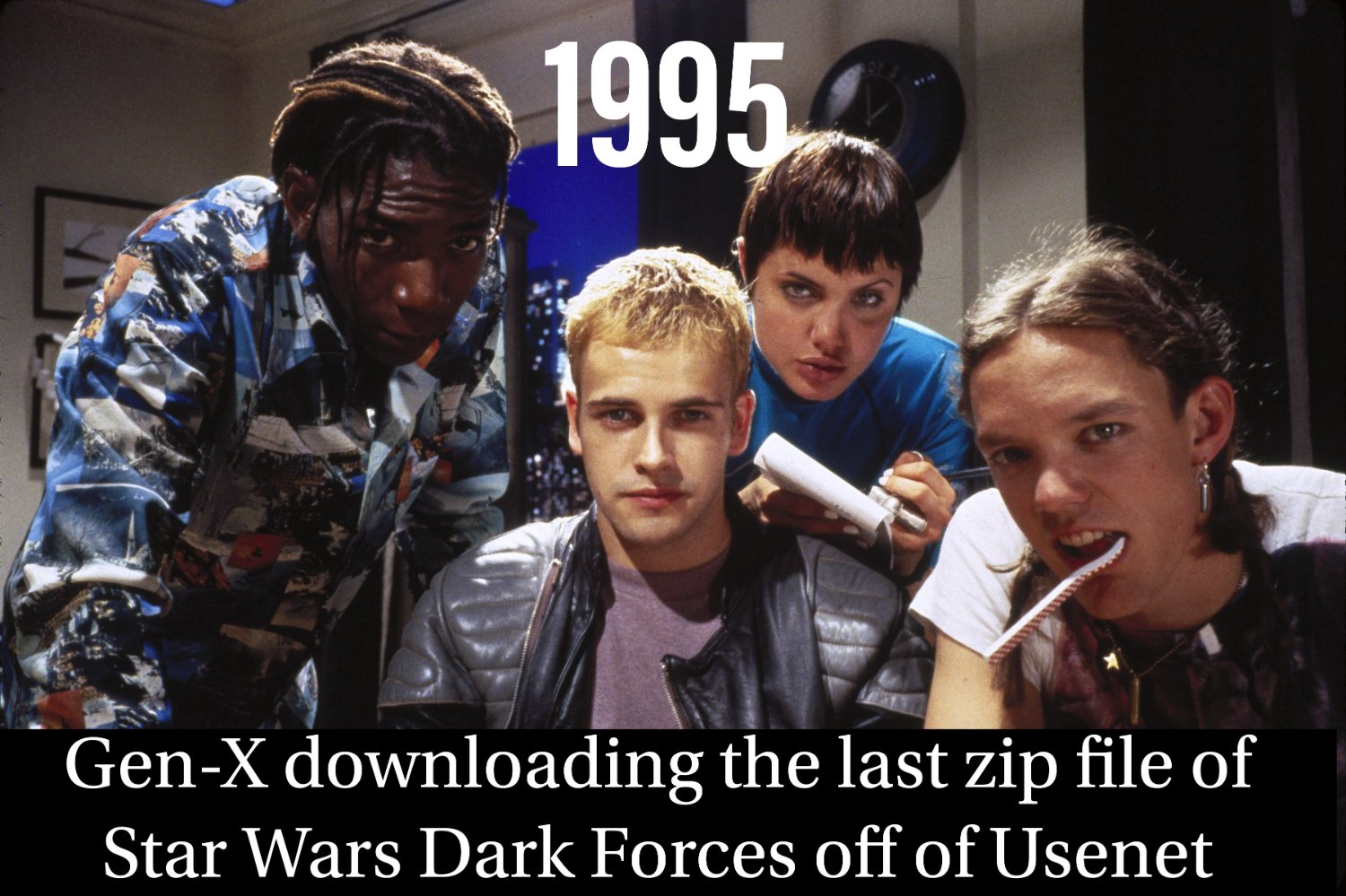
I think it's more a generational gap in basic computer skills.
Millennials grew up alongside modern computing (meaning the two matured together). We dealt with everything from BASIC on a C64 to DOS and then through Windows 3 through current. We also grew up alongside Linux. We understand computers (mostly) and the (various) paradigms they use.
Gen Z is what I refer to as the iPad generation (give or take a few years). Everything's dumbed down and they never had to learn what a folder is or why you should organize documents into them instead of throwing them all in "Documents" library and just using search. (i.e. throw everything in a junk drawer and rummage through it as needed).
As with millennials who can't balance a checkbook or do basic household tasks, I don't blame us for not learning; I blame those who didn't teach us. In this case, tech companies who keep dumbing everything down.
save