
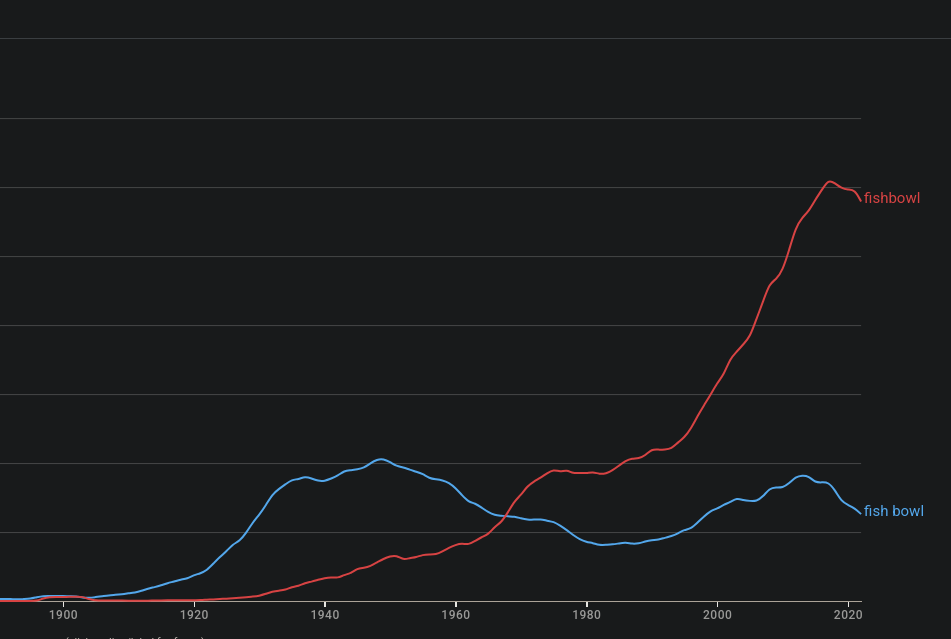
One of my frustrations with English is that spaces in compound nouns are arbitrary. We have fishbowl but also fish tank.
Do Germans have a long convoluted word for when somebody asks something and you first say "What?" but then immediately answer their question anyway as if your mouth was quicker than your brain?
5 days ago by LouNeko to c/asklemmy
schipelblorp 36 points 5 days ago
schipelblorp 13 points 5 days ago
What would you call this?

schipelblorp 8 points 5 days ago
Wikipedia explains "the rules."
Tap for spoiler
They're more suggestions.
Orthography: open, hyphenated, or solid (closed up)
English uses many open compound nouns, a large subclass of which, by convention in accepted English orthography, are not closed up (not solidified) and are sometimes optionally hyphenated in attributive position (that is, when functioning as a noun adjunct). Examples are high school, kidney disease, and file format. Although some other languages would close up these nouns' components (for example, German usually does so), English has a tendency whereby it closes up only certain ones, usually only ones in which the head noun is monosyllabic (and even within that category, only sometimes, and in a way that is not fully standardized). For example, data set and dataset, or file name and filename, are accepted alternative forms, but file format, data format, and data analysis, which have multisyllabic heads (format and analysis), can only be spelled as open in accepted English orthography. This pattern holds for countless nouns with few exceptions. For the class with monosyllabic heads, there is a tendency that "compounds tend to solidify as they age,"[5]: 368 which is how a term such as data set becomes dataset, pin-up becomes pinup,[5]: 368 coal mine becomes coalmine, bottle cap becomes bottlecap, and so on. Such alternative forms usually continue to coexist in accepted use; style guides often convene on preferred dictionaries as a way of achieving consistency, by declaring that the headword form there will be the default styling for each such term.
flandish 1 point 5 days ago
i too remember getting a fishbowl in the 90’s at applebee’s in the mall, then going to a movie, and then hoping by the time your movie was done you’d be sober enought to drive home.
DougPiranha42 3 points 5 days ago
Pink Floyd:
How I wish, how I wish you were here
We're just two lost souls swimming in
a fishbowl, year after year
Running over the same old ground, what have we found?
The same old fears, wish you were here
MrOtingocni 4 points 5 days ago
Wow, I actually learned something today.
ExtraJudgement 2 points 4 days ago
Mostly true, but in standard German one would normally vocalize "Schlafsack" without any audible pause between the f and the s.
If you were to pronounce "Schlaf sack", there would generally be an expectation of a glottal stop an audible stop between the f and the s (dialects excluded).
So while, yes, compound words in German are written without spaces, that's not just a writing difference.
FishFace 1 point 4 days ago
This is the same in English between "sleeping" and "bag". The pronunciation of "ing ba" in "sleeping bag" is exactly the same as the pronunciation of "ingba" in "dingbat".
In German, just the same: there is not generally a pause between words written separately: there's no gap that you can find on a spectrogram of a recording of someone saying, say, "brauner Sack" between the two words.
I think people are surprised to hear this, so one explanation for what you wrote is that you genuinely believe in speech there is generally a tiny pause between words, that you don't find within words. It's difficult to find a good citation for this because it's a fairly basic fact in linguistics, in spite of how surprising it may be; the best I came up with was this Duolingo post
But you may already be aware of that and be getting at something else: in German, "Schlafsack" is a word that will be understood by anyone if you say it in the normal way. To get someone to understand that you're saying the two words "Schlaf Sack" next to one another without understanding "Schlafsack", you need to do something to make it clear, otherwise they'll understand the normal word. And one way to do that would be to insert a tiny gap. This is different though: in English if you wanted someone to understand "sleeping bag" not as the thing you use while camping but, perhaps, an anthropomorphic bag that is having a nap, you need to employ something similar. So this is not a difference between the languages.
ExtraJudgement 2 points 4 days ago
In German, just the same: there is not generally a pause between words written separately: there’s no gap that you can find on a spectrogram of a recording of someone saying, say, “brauner Sack” between the two words.
At the cost of appealing to authority: As a native German speaker, I can absolutely hear the glottal stop a stop between two separate words. It exists. It can also often be found between consecutive vowels within a word, but not necessarily between consecutive consonants like in your example. There's a reason why it's in the IPA. It's also e.g. the basis for the "gender not-really-neutral" dialect of German, which injects an additional glottal stop into a word (like Bürger:innen, which is pronounced like Bürger innen, not like Bürgerinnen).
FishFace 1 point 4 days ago
Paradoxically, non-native speakers tend to be better at analysing this kind of thing ;) German for sure does not have a glottal stop between most words. "Das Kind" is /daskınt/ not /dasʔkınt/.
I'm not sure if I've misunderstood you and this isn't what you're saying happens...
givesomefucks 2 points 5 days ago
would be a rule about writing things down.
Which really explains most of the weird things with English...
English isn't a "real" language, it's a hodgepodge peasant language that was completely unsupervised by any sort of written down words let alone rules. Like, shit just wasn't even really written in English, everyone educated enough to know how to write, knew "proper" languages and used them. It's why English words are used for animals rich people ate (pig, cow, deer) and French was used for what rich people ate (pork, beef, venison). English just didn't need a word for eating them as food, because no one who spoke only English could afford it. Meanwhile the simple chicken was called chicken regardless of if it was in a coop or in soup.
It was only standardized with the early use of the printing press by Dutch workers who didn't know English, but still felt the need to edit what they were printing. That was like 1470ish, and written old German has been traced back to like late 700s with a consistent usage. So even though English is standardized now, it's built on an absolutely nonsensical foundation. While other European language had educated people building logical systems.
It just seems weird to people who only know English and assume it's actually normal because they learned as a baby how to speak it.
Also the reason any random American can make decent money teaching English to foreigners, it's almost impossible to learn all the random shit intentionally.
schipelblorp 5 points 5 days ago
Also the reason any random American can make decent money teaching English to foreigners, it's almost impossible to learn all the random shit intentionally.
The reason English speakers can make decent money is that English is a high-demmand language and people naively value native speakers.
Untrained native speakers of any langauge are fucking horrible teachers because they can't explain anything to you. All they can say is, "I would say this in this situation, but can't tell you why I'd say that in that situation."
Please, don't pay an untrained native speaker for anything but conversation practice.
FishFace 2 points 5 days ago
The idea that English's orthography is crazy because it came into written use late doesn't really hold water. The ancestors of Modern English have all been written down for many centuries, even though post-1066 no-one was using it for a good while at court.
It's more that English as a whole is split between a Germanic and Romance ancestry, with the orthography of both sources being represented, while standardisation took place right around the time of a huge shift in pronunciation - the great vowel shift - fossilising an orthography that represented a bygone pronunciation.
In fact I think more can be blamed on English writing being standardised early than late, and then not keeping up with changes in pronunciation: the infamous cluster used to represent a pronounced /x/ sound - compare English night with German Nacht, or knight with Knecht, or freight with Fracht. All these spellings were standardised from a language that pronounced this consonant! If English really standardised late, then the likelihood would be that these words would not have a (written) consonant where the pronunciation doesn't have one.
givesomefucks 1 point 5 days ago
It’s more that English as a whole is split between a Germanic and Romance ancestry, with the orthography of both sources being represented
It's way more than those two...
a huge shift in pronunciation
That has absolutely nothing to do with grammar, just spelling...
Like, you seem to be solely focused on spelling.
And that's my entire point, you don't notice the other shit because it's "normal" to you. That's why you'd be paid money to "teach" English...
The rules are so convoluted and nonsensical (the adjective order is a great example) that even native speakers are often unaware of the rules, we just follow them without understanding them.
You can't teach a non native speaker all the rules, it's too much to remember. They need that whole "immersion" thing everyone says but never understands. They need to figure it out thru trial and error and learn it subconsciously otherwise they'll always be focused on translating into English and abiding every rule and remembering each exception.
That's also why you see internet comments of absolutely perfect classroom English, where the writer constantly apologized for their poor English. Textbook can be learned, but authentic English speakers rarely speak/write how we were taught, and that is what wealthy foreigners want their kids to learn, how the language is actually used.
That is nowhere near as big of an issue with any other language.
Because English isn't consistent or logical. There's a shit ton of exceptions to every "rule" and users constantly change things.
Getting deeper into how language influences our thoughts, and the rise of English could explain "the Americanization" of the world just because of how disorganized it can be leaving room for cheating and the importance it puts on the individual and capitalism:
Studies in psychology have found that bilingual people respond differently when they complete tasks in different languages. For example, one study randomly assigned bilingual people in India to complete a work task in Hindi or English.[10] Social norms were more effective at motivating people to work longer in Hindi, whereas payment was more effective in English, which is similar to results when people work in their native languages in the United States and India. Another study randomly assigned bilingual managers in Hong Kong to rate the importance of different values in English or Chinese.[11] When surveyed English, managers in Hong Kong rated conformity and tradition as less important and rated achievement and hedonism as more important.
It's a fascinating topic, but I fully expect it to be one of those things no one's heard of before, so people with no idea what is going on will reflexively defend English as a language.
Which ironically enough, they likely wouldn't experience that response if their native language wasn't English, even if someone was critizing their hypothetical native language.
FishFace 1 point 5 days ago
I'm talking about orthography because the thread is about how language (German originally) is written - i.e. orthography. You didn't mention anything about grammar until this latest comment; your previous comment mentioned orthography and vocabulary. All I did was continue talking about what I was already talking about.
The rules are so convoluted and nonsensical (the adjective order is a great example)
The adjective order is an old, overblown meme. The meme came with a ready-made exception ("big bad wolf") which is no less of an exception for the fact that it came with ready-made excuse ("ablaut reduplication").
Did you notice that "old, overblown meme" violates the order (opinion follows age)? That's because it's overblown.
Did you know that other languages have adjective orders of various specificity and rigidity?
Yes, it's a fascinating topic, and yes, there are many markers of non-native English speaking which are impractical to teach. But it sounds like you're trying to steer the conversation somewhere I don't want to go, and I'm not going down there. As soon as you start categorising languages as "real" or "not real" you're on your own. Your misunderstanding of the Sapir-Whorf hypothesis, likewise.
schipelblorp 4 points 5 days ago
Stereotype?
Stereo type?
Stereo-type?
chickenf622 1 point 5 days ago
Would that end bit basically translate to "if I may"/"if you will"? I know a more literal translation would be "if I may ask/request". Mein Deutsch ist mittelmäßig und ich brauche mehr Übung.
a_jeering_serpent 4 points 5 days ago
What? No say the exact same words again. What’s a singdis? Audio process singdis order? Audio processing disorder! Oh, I have one of those! Why? What’s up? I wasn’t listening.
username_1 10 points 5 days ago
What?
Oh, why do you care? You wouldn't be able to pronounce it anyway :)
FritzApollo 2 points 5 days ago
Mundschnelleralsseele?
ExtraJudgement 7 points 4 days ago
Mundhirnverbindungslatenz.
lokalhorst 5 points 5 days ago
Dumme Angewohnheit.
Zwuzelmaus 2 points 5 days ago
I call it in a neat & translateable manner:
Some do their thinking 5cm behind the forehead,
and some do it 5cm before.
SubArcticTundra 2 points 5 days ago
Ooh I've had this happen
mojofrododojo 1 point 4 days ago
ya, da sperkenzspleitzchenraufmoderhausen
FritzApollo 3 points 5 days ago
Some bastard dialect between English and Frisian haha.
BeMoreCareful 0 points 4 days ago
Shaddenlisten

asklemmy
@lemmy.world
41806
9878
8963
A Fediverse community for open-ended, thought provoking questions
Rules: (interactive)
1) Be nice and; have fun
Doxxing, trolling, sealioning, racism, toxicity and dog-whistling are not welcomed in AskLemmy. Remember what your mother said: if you can't say something nice, don't say anything at all. In addition, the site-wide Lemmy.world terms of service also apply here. Please familiarize yourself with them
2) All posts must end with a '?'
This is sort of like Jeopardy. Please phrase all post titles in the form of a proper question ending with ?
3) No spam
Please do not flood the community with nonsense. Actual suspected spammers will be banned on site. No astroturfing.
4) NSFW is okay, within reason
Just remember to tag posts with either a content warning or a [NSFW] tag. Overtly sexual posts are not allowed, please direct them to either !asklemmyafterdark@lemmy.world or !asklemmynsfw@lemmynsfw.com. NSFW comments should be restricted to posts tagged [NSFW].
5) This is not a support community.
It is not a place for 'how do I?', type questions. If you have any questions regarding the site itself or would like to report a community, please direct them to Lemmy.world Support or email info@lemmy.world. For other questions check our partnered communities list, or use the search function.
6) No US Politics.
Please don't post about current US Politics. If you need to do this, try !politicaldiscussion@lemmy.world or !uspolitics@lemmy.world
7) No Hit-and-Run questions.
Please don't delete your post for no apparent reason. If you plan on deleting a question later, say so in the post, or if you feel that you have a good reason to remove it, message a mod beforehand. It's not fair to the ones who took their time to answer, and it's not in the spirit of the community.
8) No Bots.
Posts or comments from bots, LLM's, AIs, Neural Networks, Transformers, or Marvin the Paranoid Android are not welcome in AskLemmy. Real humans only please.
Reminder: The terms of service apply here too.
Partnered Communities:
Logo design credit goes to: tubbadu

go to feed...
asklemmy
@lemmy.world
41806
9878
8963
A Fediverse community for open-ended, thought provoking questions
Rules: (interactive)
1) Be nice and; have fun
Doxxing, trolling, sealioning, racism, toxicity and dog-whistling are not welcomed in AskLemmy. Remember what your mother said: if you can't say something nice, don't say anything at all. In addition, the site-wide Lemmy.world terms of service also apply here. Please familiarize yourself with them
2) All posts must end with a '?'
This is sort of like Jeopardy. Please phrase all post titles in the form of a proper question ending with ?
3) No spam
Please do not flood the community with nonsense. Actual suspected spammers will be banned on site. No astroturfing.
4) NSFW is okay, within reason
Just remember to tag posts with either a content warning or a [NSFW] tag. Overtly sexual posts are not allowed, please direct them to either !asklemmyafterdark@lemmy.world or !asklemmynsfw@lemmynsfw.com. NSFW comments should be restricted to posts tagged [NSFW].
5) This is not a support community.
It is not a place for 'how do I?', type questions. If you have any questions regarding the site itself or would like to report a community, please direct them to Lemmy.world Support or email info@lemmy.world. For other questions check our partnered communities list, or use the search function.
6) No US Politics.
Please don't post about current US Politics. If you need to do this, try !politicaldiscussion@lemmy.world or !uspolitics@lemmy.world
7) No Hit-and-Run questions.
Please don't delete your post for no apparent reason. If you plan on deleting a question later, say so in the post, or if you feel that you have a good reason to remove it, message a mod beforehand. It's not fair to the ones who took their time to answer, and it's not in the spirit of the community.
8) No Bots.
Posts or comments from bots, LLM's, AIs, Neural Networks, Transformers, or Marvin the Paranoid Android are not welcome in AskLemmy. Real humans only please.
Reminder: The terms of service apply here too.
Partnered Communities:
Logo design credit goes to: tubbadu
go to feed...
German compound nouns are just written without spaces. There's no grammatical difference between "Schlafsack" (= Schlaf "sleep" + Sack "bag") and "sleeping bag", except the way they're written down. In English we analyse a "word" as "a thing you write down with spaces on either side", which is valid as a definition or as an analysis, but it's not what we really think of when we talk about words, which we think of as something more fundamental.
If, tomorrow, we decided in English to write compound nouns without spaces, the language would have suddenly gained thousands and thousands of words, yet the only real difference would be a rule about writing things down. Spoken English would be exactly the same, so nothing fundamental about the actual bits of English would have changed.
save