
I mean, have you met people? They could be completely serious when posting that lol.
I mean, have you met people?
I mean... I try not to
Same same. Also for like the same reason.
[edit: To be clear, I assume the part that OP is not sure if it's satire or not is "or switching to a more privacy-conscious browser such as Google Chrome."] The emphasis in
Firefox is worse than Chrome
is in the original. To me that clearly implies that they are of the opinion that in general Google & Chrome are worse on privacy than Mozilla & Firefox. The comment at the end is just tongue in cheek snark alluding to the fact that in this particular case google did better for privacy in Chrome than Mozilla in Firefox.
or switching to a more privacy-conscious browser such as Google Chrome.
The updates don't sound like satire. Some of this is crazypantsrants
I haven’t looked into the technicals much further than the support page.
The way i read it, it sounds like the companies will get some general data if their ads work without a profile about you being created. I would be fine with that. What I don’t like is the lack of communication to users about it being enabled.
PPA does not involve websites tracking you. Instead, your browser is in control. This means strong privacy safeguards, including the option to not participate.
Privacy-preserving attribution works as follows:
- Websites that show you ads can ask Firefox to remember these ads. When this happens, Firefox stores an “impression” which contains a little bit of information about the ad, including a destination website.
- If you visit the destination website and do something that the website considers to be important enough to count (a “conversion”), that website can ask Firefox to generate a report. The destination website specifies what ads it is interested in.
- Firefox creates a report based on what the website asks, but does not give the result to the website. Instead, Firefox encrypts the report and anonymously submits it using the Distributed Aggregation Protocol (DAP) to an “aggregation service”.
- Your results are combined with many similar reports by the aggregation service. The destination website periodically receives a summary of the reports. The summary includes noise that provides differential privacy.
This approach has a lot of advantages over legacy attribution methods, which involve many companies learning a lot about what you do online.
PPA does not involve sending information about your browsing activities to anyone. This includes Mozilla and our DAP partner (ISRG). Advertisers only receive aggregate information that answers basic questions about the effectiveness of their advertising.
This all gets very technical, but we have additional reading for anyone interested in the details about how this works, like our announcement from February 2022 and this technical explainer.
Telling advertisers to fuck off works if your goal is to create a niche product tailored to people who care deeply about privacy already. But Mozilla is very much all about trying to make things better for everyone on the internet, regardless about their opinions (or lack thereof) on privacy and ads.
Mozilla has recognised that advertising isn't going anywhere, so there's two options:
- Reject ads wholesale and become irrelevant.
- Push for a better alternative that can improve privacy while still keeping the engine that drives the internet intact.
What other major player would ever push for privacy preserving attribution? Hint: no one. While I get that many people here want 0 ads (myself included), PPA is a great step in the right direction, and could have a huge positive impact if it's shown to work and other companies start adopting it.
And guess what? You can still turn it off, or use adblockers. Unlike Chrome, Firefox won't restrict you in that regard.
This was not about "making things better for people on the Internet," it was about a few individuals enriching themselves.
Mozilla Corp is fully owned by a non profit, so there's no owners getting rich off of any excess profits.
Saying ads are here to stay so you have to accept them or die, is an absurd false dichotomy
I'd love for nothing more than for there to be a viable alternative!
Telling advertisers to fuck off works if your goal is to create a niche product tailored to people who care deeply about privacy already.
Reject ads wholesale and become irrelevant.
Absolute nonsense. How does rejecting ads or even including a default adblocker make Firefox any less relevant? I would hope most people would be more than happy to use a platform free from ads.
Have you used the Internet before? Or used it without a clue how services are usually paid for? You sound a bit clueless. The day they do that, a lot of websites stop working and nagging the user to turn off adblock, which I see all the time (as an advanced user who expects it). If I was a normie who didn't understand this it might be quite confusing. This is obviously the reason basically no mainstream browser has done this or would do it.
If a revenue stream breaks just with one browser, deny access of this browser.
This obv. would render firefox impractical over time and therefore irrelevant.
Yes, there are free websites and apps. But you may have to ask yourself why or how these sites keep going.
So while yes - ads can be shown - the user decides if he wants to engage further with the site at hand.
There are ad blockers as plugins for firefox.
My point is: We shouldnt point at mozilla and blame them. They try to align interests I suppose. And I trust them with the anonymous data - I could even check it within its sources if I wanted.
Because Firefox is funded by ads, whether it's the PPA ads outlined in this post, or search referrals from Google. Default adblocking would kill the revenue stream. Maybe Firefox could continue on with volunteers and donations, but not anywhere near its current staffing level. Eventually the engine would fall further and further behind and fewer and fewer people would use it.
To clarify.. Making a browser is relatively easy and there's lots of successful projects that do so without significant revenue. But making a rendering engine is really fucking hard and requires a ton of money to maintain.
Thank you for a thoughtful post with citations and quotes. After reading the whole page by Mozilla, it seems like they're taking steps to show advertisers how they can get what they want while preserving people's privacy. I can live with that. They're trying to build a win-win scenario.
I'll still block ads. I'll still reject cookies, but I feel like it's a reasonable feature THAT I CAN SHUT OFF. I'm still in control of my browser! Great!
It appears in the release notes, though. Previously you would have been tracked. Now they try to anonymously return data to the tracker. So I do not see a reason to uncheck that flag.
Admittedly I am interpreting this feature from my gut. And you provide the sources I would have asked for. Appreciated.
It looks it it would be fun to mock the report generation API, and returns tons of garbage data (possibly negative numbers).
including the option to not participate.
Which is useless if you're not informed about it.
Given that it collects no additional user data, and the API in question is a new standard that will require sites to opt in, I think making it an opt-out is sensible. I guess they could make a popup about it, but I really think this concern is baseless FUD from people who haven't read the details.
Let's be real, there's no way PPA is going to be as valuable as the data that can be gathered by state of the art ad tech. So the ad companies that adopt this will be making a compromise to do so. How is this tech making their lives easier?
Also they have no incentive to develop this tech, so why would they? It's not like Mozilla is doing work for them that they would have done anyway. If anything they're probably worried that the tech will take off and then legislation will follow to force them to use it.
I personally am fine with making it opt-out, but I think it should be handled differently. This technology requires users trust, to have any chance of being successful. Enabling it without informing the user is not the way to gain it.
I would have put a little pop up explaining that they are trying to create a privacy preserving technology to measure ads with the goal of replacing privacy invasive technology. If the user doesn’t like it, it can be disabled in the settings afterwards.
I agree with this. I understand that the majority of users also don't read release notes and some don't even install add-ons, with this being enabled by default this would provide them with a more anonymous ad experience.
Here's a take by a Mozilla employee :
- Mozilla has been ad funded since 2005
- Browser development is not sustainable by just donations
- Transparency is most important
Mozilla has been ad funded since 2005
It was funded through a deal with an ad company. It did not become an ad company itself until much more recently. jwz had a succinct and memorable response to the the absurd idea that really it's been ad-funded all along and that this makes things okay:
You are just another of those so-predictable people saying, "The animal shelter has always had a kitten-meat deli, why are you surprised?"
Yes, Mozilla started making absolutely horrific funding and management decisions many years ago. Today, they have taken this subtext and turned it into the actual text.
Browser development might not be sustainable with user donations, but it sure as hell is sustainable when you get 400 million bucks by Google every year.
Yeah. I want to donate directly towards the development of FF, but I can't. I know several other people who of a similar disposition.
« Ad funded » ? Don't they mean « Google funded » ?
Is this "feature" enabled mobile yet?
Yeah I couldn't find it either. Thanks for your help!
Just a taste. We can stop at any time.
It's better to apologize than to ask permission, right babe? Right!?
Here's the page about it:
https://support.mozilla.org/...
Read that instead of someones rant about it, which imo seems a bit obtuse.
This sounds fine, I've no problem emitting telemetry as long as it is 100% anonymous and can't be traced to individuals
Well I do have a problem with that. Since we don't see eye to eye, dont you agree then that it should have been opt in instead of a hidden opt out?
Let's be honest, opt in telemetry features will collect so little data they might es well not exist.
Considering that ot is supposed to reduce user tracking by tracking ads directly, it's a net gain for everyone.
I do agree with that :)
Same, although I have lingering paranoia that any data recorded by this might be traced back to me by making inferences when combined with other data; however, unlike the OOP, I will say I don't really know what I'm talking about.
No lol, I just didn't notice and also didn't expect it to be there. :|
Here's the information about it. It's anonymous and It can be turned off https://support.mozilla.org/en-US/kb/privacy-preserving-attribution?as=u&utm_source=inproduct
As someone who works on data anonymization, I never trust anonymization.
That somehow makes it better?
Edit typo
The problem is supporting ad networks.
Edit: /s because apparently it wasn't obvious. Anonymous is obviously better.
Mozilla has to generate enough revenue to continue developing their products somehow. It would be nice if donations were enough to cover those development costs but that simply isn't the case. Because of this the ad networks are a necessary "evil".
Most data can be de-anonymized with some clever tricks. I don't know about Mozilla but the others definitely try to keep it just anonymous enough to later be correlated with the rest of your profile.
Edit: typos
Anonymous data collection at scale is a myth.
Anonymous data collection on me when assembled will say that I'm a 40-49yo unmarried college-educated male working in one area in a certain industry and living in another area.
Only one person meets all those criteria, and it's me.
The issue is that I already knew about cookies. I don't want my browser to phone home (or anywhere else) without my consent.
Cookies are a non-issue. They store data only locally and can be edited and removed at will. With third party isolation on by default there's really no reason to worry about them much anymore. And if you do just install cookie auto-delete to clean things up.
This variant is definitely worse because the data is no longer just local.
That's part 2
I keep hearing Tor is the thing now.
and ungoogled-chromium for the chrome fans 👍
Is it tracking you or tracking ads? If it was the latter and it is made public, that is information I'm sure we would all be interested in
Seems to be the latter.
Noice
I guess librewolf is the future
No telemetry though which is the big one
IMO, that's splitting a hair.
For a browser that supposedly respects user privacy, the fact that this is opt-out rather than opt-in really leaves a bad taste in my mouth.
I'm going to reconsider my monthly recurring donation to Mozilla, especially if they keep this up.
Adjust isn't google adservices. The difference is staggering, actually, and way more than a hair's split on identifying information not being included.
I can't help but see it as the foot in the door.
I understand that Mozilla needs money, but I can't make everyone who uses Firefox commit to donating money to keep them from having to do things like this to stay afloat. But them going down this path makes me not want to donate at all.
I hate to break it to you but you aren't a significant source of income for Mozilla. You are the product not the customer.
I never said I was, just that I wanted to support the browser that respects my privacy, and this move is making me reconsider it.
As long as it's open source someone will be able to find a way to turn it off, either by an addon or by patching and compiling the source code.
I see this as them giving companies a more privacy-preserving alternative to tracking. And just another privacy setting to opt out for us.
Instead of a reactive social media post, here's how it works.
The only real alternative to this conflict of interest between companies and customers is an independent browser.
it's like a drizzle is a dryer alternative to a thunderstorm
surely I'd prefer none, but if I had to choose...
Moot point. Librewolf won't exist without Firefox.
For everyone trying to find the setting— On my android phone, there's a setting called "data collection". Mine were already all off, so idk who it affects
WTF... i thought this was just click bait but went to check on my phone as i am not at my PC right now
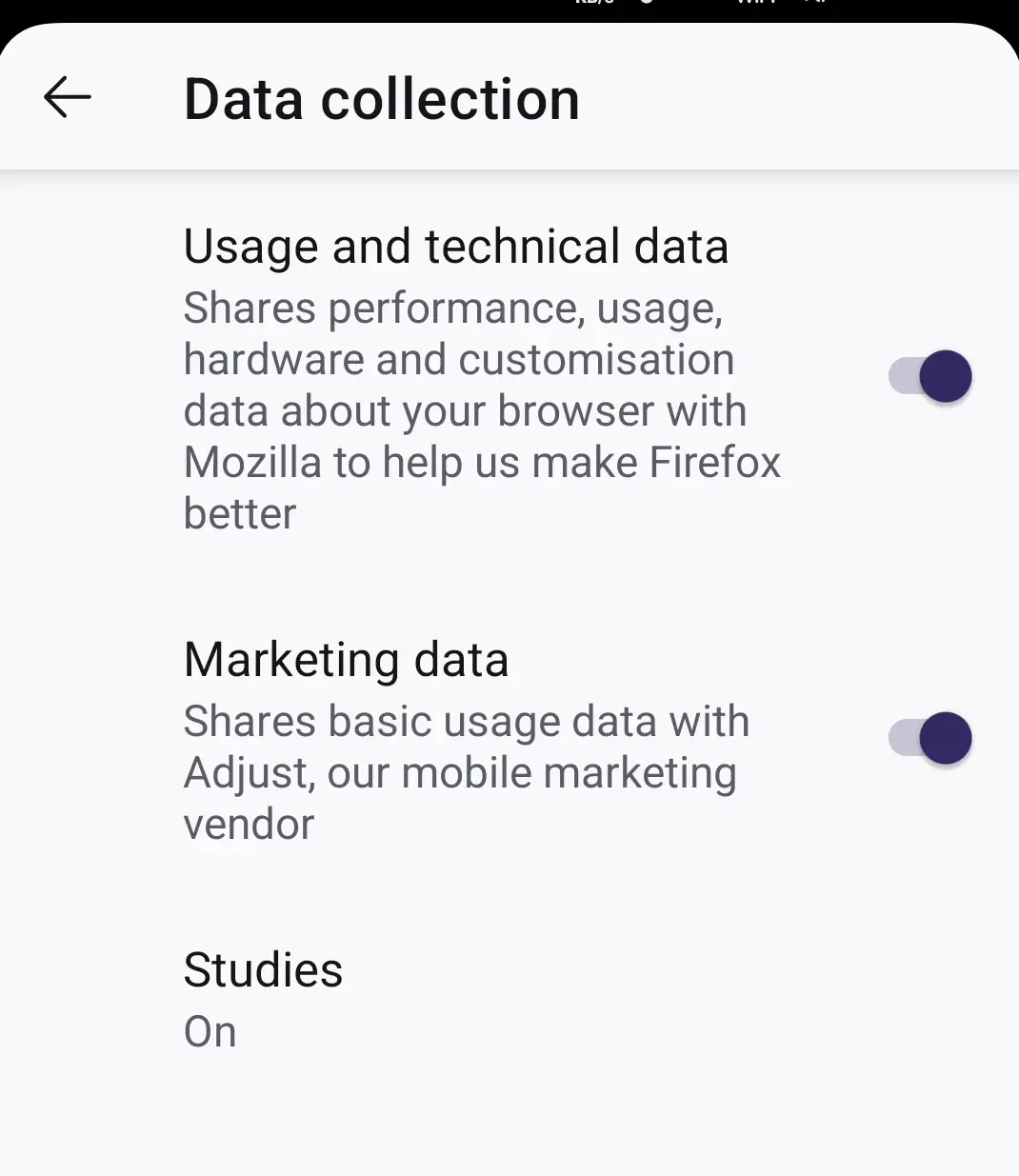
Idk what 128 is on a phone, but my galaxy s21 had everything still off. Guess I'll have to keep an eye on it
build number (version) of Firefox, which is the software in question.
"Galaxy S21" is the model name for a physical Samsung phone, which isn't relevant to the topic.
Oh, heard that. I'm on 128 on my phone too and they were all disabled
I'm using Mull.
These are old options. I checked these off long ago.
Use Mull
Here's the info about it: https://mzl.la/3AcmG8q
This almost sounds like a hoax. But assuming it's true... Install LibreWolf. It's Firefox without the infuriating Mozilla stupid.
why are you doing this to me?!
well at least there are good forks for the browser out there. how long until they start going chrome route?
Feels like google realized that once normies realize how shiti they are, they will run for firefox which by then hopefully will be a properly gutted front end for an ad company.
now
No. This is a privacy-protecting option that gathers no additional information about you or your hardware.
The other link posted in reply is overblown fear-mongering from Mozilla's single biggest hater because they bought an ad company.
A single number per ad campaign of how many times an ad view resulted in a visit or purchase.
Mozilla's announcement about it explains it pretty well: https://support.mozilla.org/...
Then why aren't they putting it up front and shouting from the rooftops about the new "privacy protecting feature"?

In which version is this?
I am on flatpak 128 as well and it isn't there
What’s the behavior before this option was added? Would websites track you or not?
They definitely didn't just stop tracking you because this option exists.
Safari refers to it as "Privacy-Preserving Ad Measurement", and Chrome includes an option as part of its "Privacy Sandbox." Please have the decency to do a basic google search before being an asshole :)
Chrome's privacy sandbox is a very different protocol from Mozilla's PPA protocol. I haven't read about Safari's variant so I don't know if that's a copy/paste of Chrome's or it's own protocol
The big difference between Privacy Sandbox (previously Topics API and before that FLoC) and PPA is that Google's "solution" still tracks the user while Mozilla's just tracks the ads and gives aggregate data to the advertiser
So.... finally Mozilla has slowly but surely going into the dark side huh...
I'm not surprised anymore, they even had telemetry code inside android apps from waaay back then (although seems for debugging purpose)
In the end I'm not justify all company bc they need money for survive & exist, although i don't like the way they do it
Mull or Fennic although Fennic needs a lot of settings changed for privacy
Mozilla has been bad actors since at least 2017, they implemented a piece of malware called Cliqz on a small number of German user's installs that recommends various services based on browser history (aka tracking and advertising); so I'd hardly call this a new development, or Mozilla "just now" falling to the dark side (and that's not even mentioning pocket and DoH to cloudflare, which are still enabled by default).
Whatever it is, it's been around for at least 3 years.
I've read up on how it works and it says it's tracking how well or badly ads perform when shown to me. That's tracking ads, otherwise called ad tracking.
What now?
It's tracking how well ads perform without tracking individual users. Tracking ads isn't the problem. Tracking users is the problem. Before this the only way to track ad performance was by tracking users. This is a way to track ad performance without tracking users.
And they wonder why their market share is decreasing.
The only major browser that actually seems to care about their users is Vivaldi, sadly.
Name anything Vivaldi specifically (not Chromium-wide) has done to screw over their users. I can't name a single thing, while I can name many Anti-User things Firefox has done.
Unfortunately, open-source becomes nearly meaningless when the cost to produce a fork becomes so prohibitive and the open-source project starts acting like a for-profit company.
I can say the same thing about Librewolf, as they haven't done anything to screw over their users either.
Vivaldi just does not have strong ad-blocking, fingerprinting protections, or privacy a preserving measures in general. Here is a comparison between some browsers: https://privacytests.org/
Here is some reading for you (if you want):
https://privacytests.org/vivaldi.html
https://avoidthehack.com/review-vivaldi-browser
- Main dev of open source Ladybird browser not liking homosexuals or whatever:
Community: Boo!
- Mozilla acquiring an ad tech company and implementing it now:
Community: well, they have to (and whatever).
I sense some mental dissonance.
I would call it a vocal minority
Could you send some evidence
No i can't. All i know is that there was some uproar about this a week ago.

@lemmy.ml
A place to discuss privacy and freedom in the digital world.
Privacy has become a very important issue in modern society, with companies and governments constantly abusing their power, more and more people are waking up to the importance of digital privacy.
In this community everyone is welcome to post links and discuss topics related to privacy.
Some Rules
- Posting a link to a website containing tracking isn't great, if contents of the website are behind a paywall maybe copy them into the post
- Don't promote proprietary software
- Try to keep things on topic
- If you have a question, please try searching for previous discussions, maybe it has already been answered
- Reposts are fine, but should have at least a couple of weeks in between so that the post can reach a new audience
- Be nice :)
Related communities
much thanks to @gary_host_laptop for the logo design :)
go to feed...
@lemmy.ml
A place to discuss privacy and freedom in the digital world.
Privacy has become a very important issue in modern society, with companies and governments constantly abusing their power, more and more people are waking up to the importance of digital privacy.
In this community everyone is welcome to post links and discuss topics related to privacy.
Some Rules
- Posting a link to a website containing tracking isn't great, if contents of the website are behind a paywall maybe copy them into the post
- Don't promote proprietary software
- Try to keep things on topic
- If you have a question, please try searching for previous discussions, maybe it has already been answered
- Reposts are fine, but should have at least a couple of weeks in between so that the post can reach a new audience
- Be nice :)
Related communities
much thanks to @gary_host_laptop for the logo design :)
go to feed...
...... I don't know of this is satire or not.
save