
[This comment has been deleted by an automated system]
Kernel upgrades are very... Painful.
[This comment has been deleted by an automated system]
so you never caught a team of government officials in your living room brute forcing your bootloader at 4am as you got up to use the bathroom, huh. Lucky guy.
Your government doesn't just hit you with a wrench?
I’m an engineer with trade secrets on his laptop. I’ve heard of dozens of people getting laptops stolen from their cars that they left for like ten or fifteen minutes.
The chances are slims, but if it happens I’m in deep trouble whether those secrets leak of not. I’m not taking the risk. I’m encrypting my disk.
It’s not like there’s a difference in performance nowadays.
TPM's not going to help with that situation, though, right? Either you're typing in your encryption password on boot (in which case you don't need TPM to keep your password), or you're not, in which case the thief has your TPM module with the password in it.
It's 30% legitimate concern over a non-negligible risk of government overreach, 70% having fun pretending to be James Bond.
I mean, i do have some stuff that i encrypt, but encrypting the folder or packing it on a small partitiin and encrypting only this fs after booting makes more sense to me.
I'm still on the hunt for a desktop Linux distro that has no security features or passwords. My usage for this may not be common but it can't be rare enough that there are zero options
Ubuntu, no encryption, select boot to desktop by default when the system installs.
Like, really?
TPM bad, put your secrets on a proper encryption peripheral, like a smartcard running javacardOS
TPM will turn into cpu-bound DRM, the more you use it, the more this cancer will grow
[This comment has been deleted by an automated system]
You are only seeing what TPM is now. Not what TPM will become when it become an entire encrypted computing processor capable of executing any code while inspection is impossible.
Imagine denuvo running at ring level -1
Trusting some obscure hardware might be a bad idea then.
Why do you need full disk encryption in your day to day life? Are you a secret agent? I feel like that would give you our though.
It's not a matter that I would have nothing to hide, this defense is stupid. It's a matter that you should use a security adapted to your need, because the cost doesn't offset the benefit otherwise. And with disk encryption you will far more often be sorry than happy if you're a normal person.
People are imperfect. People have left laptops full of personal and/or commercially sensitive data on trains or planes, had them stolen from cars and houses etc. Full disc encryption is a defence against data breaches especially for computers that are not bolted down. Or it might be as simple as a person not wanting the embarrassment of their porn stash being found.
I mean I generally agree with you, but the SteamDeck runs on an AMD processor with a fTPM that Valve slowly added support for.
It seems unlikely Valve will ever make Windows the primary OS for their devices. And they'd lose a lot of user support if they ever required the TPM for their own software, so hopefully they wouldn't risk it.
Why does everybody seem to think that userspace attestation is the only use for the TPM? The primary use is for data to be encrypted at rest but decrypted at boot as long as certain flags aren't tripped. TPM is great for the security of your data if you know how to set it up.
Valve is never going to require TPM attestation to use Steam, that's just silly. Anti-cheat companies might, but my suggestion there is to just not play games that bundle malware.
But with a reason, I'm sure. There's no reason for the everyday consumer to need one, other than Microsoft wanting more control.
TPM actually provides some useful components to isolate encryption outside of Ring 0, which is a trust win. But any technology must be weighted against its power to oppress.
Sure, but does a grandmother's Solitaire & Facebook PC really need quick encrypting and decrypting? Anyone not dealing with sensitive info doesn't need one.
I'm sure you'll be ok sending me your social security number, home address, bank login details, credit card number, a copy of all the files on your hard drive...
I mean, you deserve no privacy right?
Sadly, I agree. I'm at the point now where as long as I'm not trying to game I can thrive on Linux. But even then I spend way more time than necessary getting things to work that do so out of the box on Windows. We have a long way to go before legacy apps is the only reason to run it.
Personally I found the time I saved from not having any control over my system has more than made up for tinkering that I have to do to get things running. My laptop would regularly become unusable for 20+ minutes on windows because of disk performance issues, and I as the user had no means to prevent windows from running the service that locked everything up. That along with other times windows just decides your use case is less important have added up to far more time then having to debug a game here and there
TPM is pretty important in any modern OS.
Sure you don’t need it. But it’s not 2013. It should be standard along with FDE
And now Imagine Linux had actually more market share on the Desktop. But for that, Linux needs at least a little more software support to be reliable for other people. And that software is usually not open source. Maybe with Flatpak, it will finally get somewhere in that regard, if there's enough interest from people.
Most people are unable to administrate their own systems, therefore GNU/Linux--an operating system built on empowering developers and administrators--is basically unimaginable.
Microsoft and Apple have co-opted the admin duties for users, and that's why people use their operating systems. It spares them from the disaster we all saw and experienced in the Window XP days--but that comes at a price.
It's not software support, it's not anythign to do with Linux. It's a computer illiteracy problem.
Android could, in some respects, be considered linux's biggest success story among regular users and that's because Google co-opts admin duties.
its not about the software support.
its because people are lazy to learn. most people dont even know that an OS can be different.
for them windows is defacto THE PC.
Most people dont want an OS to be different. They are happy if it boots up and does what they want to do. It's not lazy, it's an active disagreement with the premise.
This is why nobody upgrades to Windows 10 from 7, or to 11 from 10. Security risks and lack of features aside, their OS just works for them.
These things are only a concern to enthusiasts.
It's also why, as shitty behavior as it is, MS getting aggressive about upgrading to 10/11 is a net good, from a security standpoint.
I am intentionally ignoring the "10/11 is just spyware with an OS bundled in" thing in the above statement.
Realistically windows is really good at repairing itself (or just getting it to a state where its usable again, to most users would be 'repaired').
Until linux has some sort of system like this, its just not worth the headache to 99% of users. The linux errors aren't even that descriptive when they happen, and could be cause by like anything.
100% Agree.
It will never be the year of the linux desktop, until linux is easy to use and easy to troubleshoot and fix.
and let me tell you, every minor problem requiring some kind of arcane terminal ritualism in ancient enochian that only veteran sysadmins know, is not, and will never be, easy to use or troubleshoot.
Timeshift
Sorry but that's just wrong. Enough people simply don't even consider Linux because their needed software doesn't work + there's no equivalent alternative. And my PC/OS is not a hobby or a Ideology. It's a tool that I use to work with.
Is it really wrong? Do you have numbers? I think the most people claim above is at least plausible. It surely fits my personal experience, but that is of course not worth much.
I would argue that most people use their PC for web browsing, light photo editing and personal office stuff and maybe gaming (at least outside work) and those people are not affected by "the software I need does not work and there is no alternative".
I think it's more that there's a perception of things not being compatible with Linux nowadays. A lot of the games that didn't work 5 years ago now do, and I'm still seeing people complain that games like Halo Infinite don't work on there when they actually do.
The only things I can think of that aren't compatible and required for some tasks are Photoshop and professional CAD/CAE software. For >90% of the population Linux should be able to handle everything they need
Linux still has too many issues, for example...
- Fedora doesn't provide binary drivers even if they exist, you need to get a pluggable wifi usb tool that is supported and install the repositories and configure binary drivers to get wifi working on a huge amount of laptops.
- Ubuntu does provide binary drivers but the configuration tool can just crash by itself a lot of the time and just fail to load the driver.
- Ubuntu's desktop sometimes just crashes.
- Fedora uses some strange memory compression driver to handle its paging file and this can sometimes just crash the OS entirely by itself.
These are major issues that shouldn't be issues, they should either have been fixed as a priority for the crashes or have some kind of workaround that doesn't require owning specific USBs that regular people just won't have. There's no reason for the memory compression thing either, it probably doesn't do that much for performance overall but random hard-locks are a huge negative. Linux is its own worst enemy on the desktop.
Sometimes the issues with WiFi chipsets is not the distro but the manufacturer. Debian for instance now includes non-free firmware on its installation ISO image, but some manufacturers do not allow the distribution (e.g. Broadcom) of firmware, so Debian can't legally include them. And unfortunately the manufacturers don't make it easy to "just download the firmware" so you can put it on the USB stick so the installer can see them. (Literally the only issue with putting Debian on my old 2013 Macbook Pro was the Broadcom firmware - but fortunately, having a Debian desktop I could install the firmware downloader there to get the two files the installer needed).
This is not a fault of the Linux distro, but a fault of the hardware manufacturer. Unfortuantely, like the smell of piss in a subway, we all have to deal with Broadcom.
Based linus. Kill it, it's pointless
I've had a weird system-wide stutter for months and the usual googling and troubleshooting didn't help.. omg. This might be it. Thank you Linus and thank you op.
I had it on my main Windows PC for a long time. I use this PC for music production and it was infuriating - the sound would just cut out intermittently like the computer couldn't keep up. I tried lots of things, including an expensive CPU upgrade. In the end Asus released a new BIOS for the motherboard to address this AMD stutter, and that fixed it.
Which AGESA version?
I don't really know anything about that. Currently HWiNFO64 shows Microcode Update Revision A201025 and SMU Firmware Revision 56.74.0. I don't know whether those are the numbers you're asking for, or what they were while it was still having problems.
I always just kill my TPM chip. It's so obvious tpm will be used in the future for application offline DRM. They will executed encrypted operations under the TPM veil and decompilers will become unusable.
How do you kill your TPM chip?
Level 1, turn off in bios
Level 2, desolder from motherboard
Level 3, remove cpu pins related to tpm
Level 4, decap cpu, laser off tpm bus or blocks
Thank you, the best I can do is level 2 (once I learn how to solder)
Disable it in the bios
Or depends what they mean by security service support. Presumably some kind of external (usb ?) device ?
Non-AMP link: https://www.theregister.com/...
The wonders of modern technology!

Honestly, I go watch this video from time to time whenever I need a lift.
Relevant: 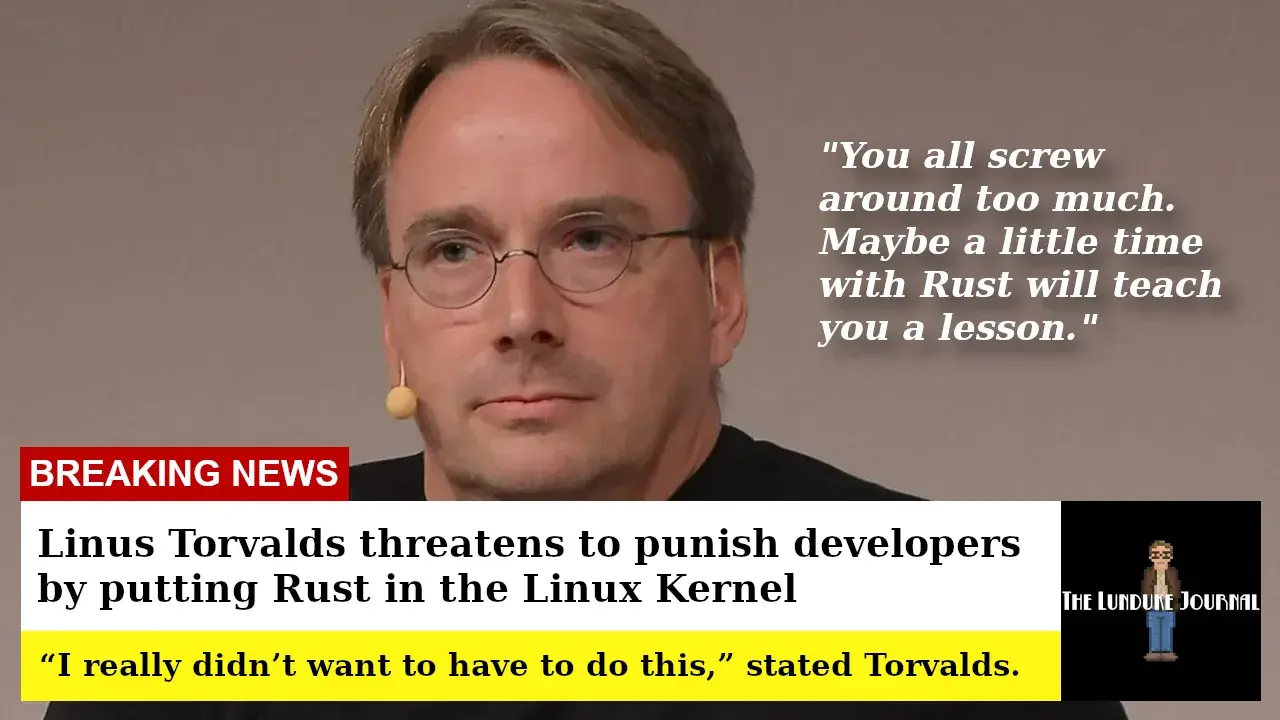
😂😂😂
I agree. If it doesn't work, disable it until it's fixed
good thing my Ryzen 1000 series motherboard doesn't even have TPM....I need to upgrade lool
How much of a slow down are we talking about
Oh I disabled that a while ago because their hardware random number generator always returned 0xfffff...
Honesty, hardware random number generation seems sketchy. Something you'd expect government backdoors to be in.
the module can cause intermittent stuttering, depending on which Ryzen processor you're using. It appeared when the fTPM was in use, it would access its flash storage via a serial interface, and when doing so, held up activity by the rest of the system.
of course it waste of time, even the AMD don't care about that so why need to care? From this, I don't think to ever buying machine with AMD proc on it.
What is that needle with a ball stuck onto it? In the photograph. Someone please help.

@lemmy.ml
From Wikipedia, the free encyclopedia
Linux is a family of open source Unix-like operating systems based on the Linux kernel, an operating system kernel first released on September 17, 1991 by Linus Torvalds. Linux is typically packaged in a Linux distribution (or distro for short).
Distributions include the Linux kernel and supporting system software and libraries, many of which are provided by the GNU Project. Many Linux distributions use the word "Linux" in their name, but the Free Software Foundation uses the name GNU/Linux to emphasize the importance of GNU software, causing some controversy.
Rules
- Posts must be relevant to operating systems running the Linux kernel. GNU/Linux or otherwise.
- No misinformation
- No NSFW content
- No hate speech, bigotry, etc
Related Communities
Community icon by Alpár-Etele Méder, licensed under CC BY 3.0
go to feed...
@lemmy.ml
From Wikipedia, the free encyclopedia
Linux is a family of open source Unix-like operating systems based on the Linux kernel, an operating system kernel first released on September 17, 1991 by Linus Torvalds. Linux is typically packaged in a Linux distribution (or distro for short).
Distributions include the Linux kernel and supporting system software and libraries, many of which are provided by the GNU Project. Many Linux distributions use the word "Linux" in their name, but the Free Software Foundation uses the name GNU/Linux to emphasize the importance of GNU software, causing some controversy.
Rules
- Posts must be relevant to operating systems running the Linux kernel. GNU/Linux or otherwise.
- No misinformation
- No NSFW content
- No hate speech, bigotry, etc
Related Communities
Community icon by Alpár-Etele Méder, licensed under CC BY 3.0
go to feed...
TPM is basically never for your benefit. It's becoming a requirement because Microsoft is going to one day say "you can only run apps installed from the Windows Store, because everything else is insecure" and lock down the software market. Valve knows this which is why they're going so hard on the Steam Deck and Linux.
save