
imagine how much farther ahead we would be in safety and efficiency if it was made priority 50 years ago.
we still have whole swathes of people who think that because its not perfect now, it cant be perfected ever.
So uh, turns out the energy companies are not exactly the most moral and rule abiding entities, and they love to pay off politicians and cut corners. How does one prevent that, as in the case of fission it has rather dire consequences?
Since you can apply that logic to everything, how can you ever build anything? Because all consequences are dire on a myopic scale, that is, if your partner dies because a single electrician cheaped out with the wiring in your building and got someone to sign off, "It's not as bad as a nuclear disaster" isn't exactly going to console them much.
At some point, you need to accept that making something illegal and trying to prosecute people has to be enough. For most situations. It's not perfect. Sure. But nothing ever is. And no solution to energy is ever going to be perfect, either.
An electrician installing faulty wiring doesn't render your home uninhabitable for a few thousand years.
So there's one difference.
The risks are lower in literally everything else...?
Because the energy industry is historically the one lobbying governments for less regulation. Also, has there ever been a nuclear project in the history of mankind that didnt result in depleted Uranium leeching into local watertables and/or radioactive fallout? Your comment is basically tacit acceptance that people are going to act unethically, which, in regards to nuclear power, is bound to have human consequences.
I mean it's not the companies operating the facilities we put our trust in, but the outside regulators whose job it is to ensure these facilities are safe and meet a certain standard. As well as the engineers and scientists that design these systems.
Nuclear power isn't 100% safe or risk-free, but it's hella effective and leaps and bounds better than fossil fuels. We can embrace nuclear, renewables and fossil free methods, or just continue burning the world.
The worst nuclear disaster has led to 1,000sq miles of land being unsafe for human inhabitants.
Using fossil fuels for power is destroying of the entire planet.
It's really not that complicated.
Don’t push nuclear power like it’s the only option though.
Where I live we entirely provide energy from hydro power plants and nuclear energy is banned. We use no fossil fuels. We have a 35 year plan for future growth and it doesn’t include any fossil fuels. Nuclear power is just one of the options and it has many hurdles to implement, maintain and decommission.
The problem is its potential for harm. And I don't mean meltdown. Storage is the problem that doesn't seem to have strong solutions right now. And the potential for them to make a mistake and store the waste improperly is pretty catastrophic.
How do you get the uranium or thorium? Generally, it has to be mined. Are we using nuclear powered mining equipment? No. We use fossil fuel powered mining equipment. Then we use fossil fuels to power the trucks that take the depleted nuclear product to the storage depot, which is powered and requires employees who drive there using fossil fuel powered vehicles, using fossil fuel powered warehouse equipment. When does nuclear power phase out the fossil fuel power? Are we going to decommission oil and coal production facilities? Or are we just going to use nuclear to augment the grid?
While that's true, we still have for example safe air travel, although I'm pretty sure companies would be happy to ship their passengers minced to maximize their profit.
Also, thorium reactors would be a great step forward, unfortunately its byproducts can't be used for nuclear weapons, so their development was pretty slowed down.
I’m pretty sure companies would be happy to ship their passengers minced to maximize their profit.
That actually sounds more comfortable than normal airline travel
Also there was that german experimental Thorium reactor that was so mismanaged, it made Burns' Springfield power plant look well handled. I think that scared a lot of people off of Thorium for a long time.
Source: Lived right next to that reactor during my childhood.
If only we had a non fossil energy source we could safely export to developing nations instead of ICE technology.
(Intenal Combustion Engine)
Easy. Have nuclear power plants operate as government run and backed corporations (what we’d call a “Crown Corporation” here in Canada).
That way you can mandate safety and uptime as metrics over profit. It may be less efficient from an economic standpoint (overall cost might be higher), but you also don’t wind up with the nuclear version of Love Canal.
Make them live on site?
And we would be expecting these corrupt Cost cutting types to warehouse nuclear waste for hundreds if not thousands of years while requiring regular inspections and rotation of caskets periodically while also maintaining the facilities. All of that for a product that doesn't produce any value, it just sits there and accumulates.
And where does it get stored? Right now almost 100% of waste is stored on site above ground because they really have no good solution. People will say things like "its just a little bit of toxic waste" or "its cool because we could use it in process we don't have yet but might in the future" and all I can think of is how this was the same thinking that got us into our dependence on our first environmental catastrophic energy source. I'm not confident we that scaling up to another one will end well.
Right now almost 100% of waste is stored on site above ground because they really have no good solution.
You mean there's so little they don't even need a dedicated facility for it, and it's safe enough that people are willing to work where it's stored? Sounds great!
Try to arrange the incentives in such a way that if the plant melts down, the company that owns it loses money.
I think it's fine to think of it as imperfect, even if those imperfections can never be truly solved.
We only need nuclear to bridge the gap between now and a time when renewable CO2 neutral power sources or the holy grail of fusion are able to take the place the base load power that we currently use fossil fuels for, and with hope, that may only be a few decades away.
The estimates I’ve seen project the world population will hit a peak before long, and gradually decline. It’s because of birth rates declining as development/education/wealth rise in a region.
Plus looking that far ahead, humans will probably have technologies that we today don’t even know are possible. If we had all the energy and high tech new materials we needed, many more options become possible.
Eco-fascist outcomes come from Eco-fascist methods. How do you propose to accomplish this degrowth without subjecting the world's population to genocide and privation?
Human nature is to strive, to fight for a better life for themselves and their communities. The preservation of agrarian lifestyles and "harmony with the planet" a bunch of backwards romantics push is not more important than the betterment of the species, no matter how much people cry about it.
If people need to live in dense cities, then they will live in dense cities.
How is degrowth realistic at all? And how does degrowth happen in a way that isnt billions of people starving to death?
Perfect or just secure is even more expensive, that is the problem.
If I recall, 50 years ago we didn’t have the technology/understanding of nuclear fuel enough to make as much as we can now. When I did a school paper on the subject like 20 years ago, they were saying nuclear wasn’t sustainable because we didn’t have enough fuel.
My understanding is that that has changed recently with breakthroughs in refinement of fuels.
One reason it wasn't made a priority 50 years ago is because Jimmy Carter - a nuclear submariner who understood the risks and economics - decided it wasn't a good idea.
This is a man who was present at a minor nuclear accident, who helped create the modern nuclear submarine fleet, acknowledging that nukes weren't going to help during the height of the Oil Embargo.
That is factually false information. There are solid arguments to be made against nuclear energy.
Even if you discard everything else, this section seems particularly relevant:
The long lead times for construction that invalidate nuclear power as a way of mitigating climate change was a point recognized in 2009 by the body whose mission is to promote the use of nuclear power, the International Atomic Energy Agency (IAEA). “Nuclear power is not a near-term solution to the challenge of climate change,” writes Sharon Squassoni in the IAEA bulletin. “The need to immediately and dramatically reduce carbon emissions calls for approaches that can be implemented more quickly than building nuclear reactors.”
Wealer from Berlin's Technical University, along with numerous other energy experts, sees takes a different view.
"The contribution of nuclear energy is viewed too optimistically," he said. "In reality, [power plant] construction times are too long and the costs too high to have a noticeable effect on climate change. It takes too long for nuclear energy to become available."
Mycle Schneider, author of the World Nuclear Industry Status Report, agrees.
"Nuclear power plants are about four times as expensive as wind or solar, and take five times as long to build," he said. "When you factor it all in, you're looking at 15-to-20 years of lead time for a new nuclear plant."
He pointed out that the world needed to get greenhouse gases under control within a decade. "And in the next 10 years, nuclear power won't be able to make a significant contribution," added Schneider.
Long lead times against nuclear have bee raised for the last 25 years, if we had just got on with it we would have the capacity by now. Just cause the lead time is in years doesn't mean it isn't worth doing.
when is the best time to plant a tree? 30 years ago. When is the second best time? now.
As others pointed out, to build that many nuclear power plants that quickly would require 10x-ing the world's construction capacity.
My counterpoint is that if we had "just got on with it" for solar, wind, and battery, we would have the capacity by now and the cost per kwh of that capacity would be approximately half as much as the same in nuclear. And we would have amortized the costs.
No it wouldn't. China laid more concrete in 5 years than the entire world did in 100 years. I highly doubt that converting the entire world to nuclear is going to use that much more concrete. I mean hell, they laid like 15 or 20,000 miles of high speed rail in just a few years. They built like 300 million apartment units.
Long lead times, cost overruns, producing power at a higher price point than renewables, long run time needed to break even, even longer dismantling times and a still unsolved waste problem. Compared to renewables that we can build right now.
Did you read the quote? 15-20 years, as in decades before 1 nuke plant is built. I agree in that politicians of the past should have led us to a more sustainable and resilient energy future, but we're here now.
Advanced nuclear should still be 100% pursued to try to get those lead times down and to incorporate things like waste recycling, modularity, etc., but the lead time in decades absolutely means nuclear power might not be something worth doing.
The IPCC puts the next 10-20 years as the most important and perilous for getting a hold on climate change. If we wait for that long by not rolling out emission-free power sources, transit modes, or even carbon-free concrete, etc., then we might cross planetary boundaries that we can't come back from.
Nuclear is a safe bet and bet worth pursuing. I would argue that, along with that source from the IAEA, old nuclear is note worth it.
How much concrete does it take to build a nuclear plant? Concrete production is currently 8% of global emissions, so if you have to scale up construction capacity 10x for the next decade, don't you end up destroying the environment with concrete before they are even operational?
https://en.m.wikipedia.org/...
the largest fission plant was literally working 5 years after construction started
fission plants are just more expensive now because we don't make enough of them.
I guess safety standards changed but even wind power kills more people per watt than fission so ¯\_(ツ)_/¯
Nuclear could've easily worked if people didn't go full nimby in the past few decades
Sorry. How does wind power kill anyone? Okay, every once in a while you hear about a technician falling off a windmill, but are there any fatalities in regard to the effects of wind power?
Fewer people die to nuclear than wind power.
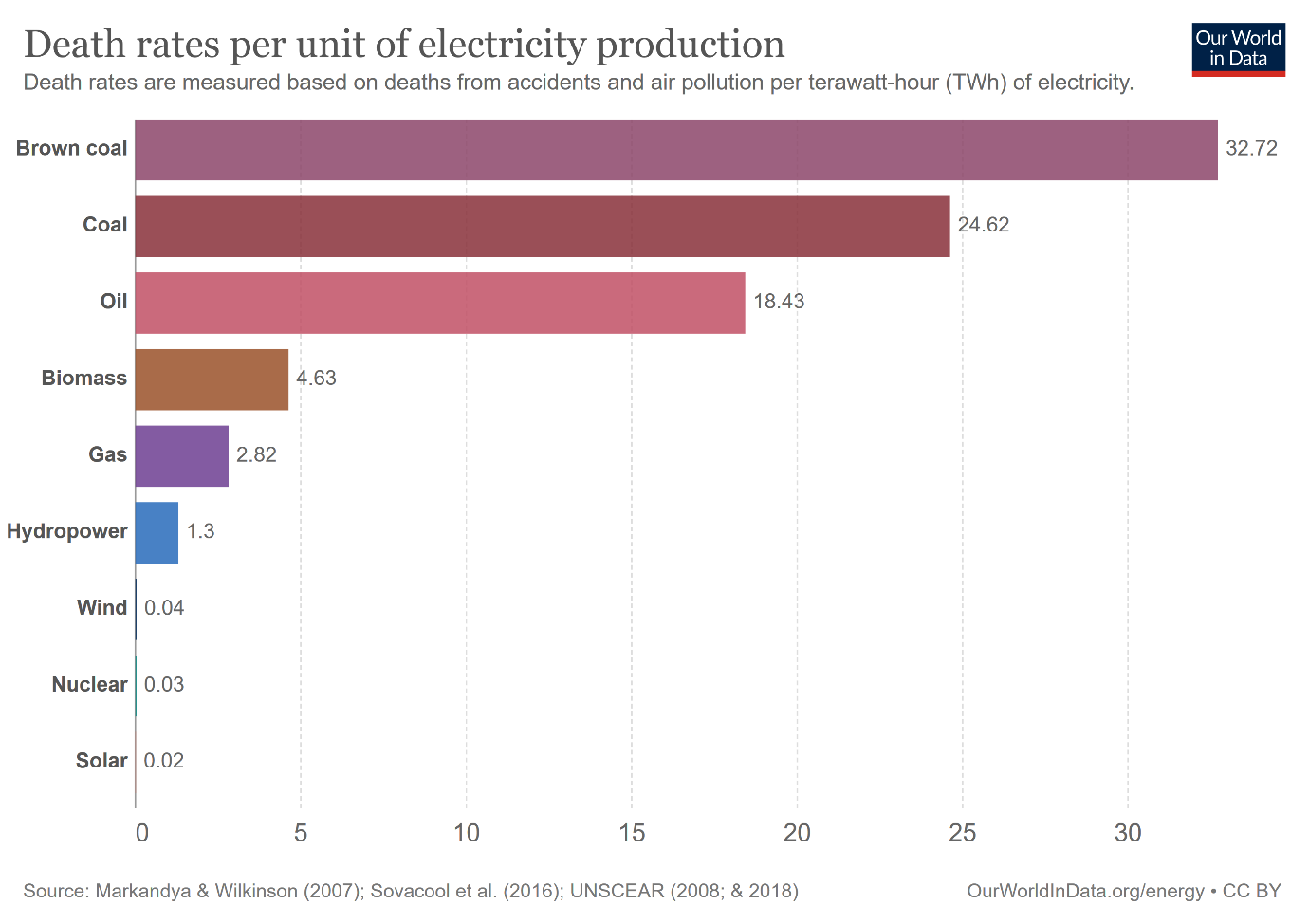 https://ourworldindata.org/...
Nuclear is scary because you hear about it, not because it is actually deadly.
probably technicians falling off is the biggest thing
I’m sick and tired of “pro-environment” useful idiots shilling against nuclear power
You know that the idea we should be investing in nuclear is being pushed by the very same people who for decades were telling us we didn't need to worry about climate change, right?
They're trying to get "useful idiots", as you so eloquently put it, to also support nuclear energy, rather than going all-in on renewables.
The "useful idiots" in this scenario are not the people opposing nuclear. They're the ones suggesting it's actually an economical idea, and in so doing either explicitly or (more often) implicitly suggesting that we shouldn't invest too much in actual renewable energy.
It's not just construction workers, it's the management, it's the regulators, it's the suppliers, and the design and engineering teams. Most countries have lost all of that capability apart from places like South Korea, Finland, Russia, France and China.
China currently has 22 nuclear reactors under construction, 70 in the planning phase, and they currently operate 55. Well that is less than the United States, they will surpass the US soon. They seem to have figured it out.
If we hadn't of had Luddites getting in the way of nuclear power for half a century then we wouldn't have this issue.
I think this insults Luddites. Luddites are not stupid to get in a way of nuclear power.
There are solid arguments to be made against both nuclear and renewables (intermittence, impact of electricity storage, amount of raw material, surface area). We can't wait for perfect solutions, we have to work out compromises right now, and it seems nuclear + renewable is the most solid compromise we have for the 2050 target. See this high quality report by the public French electricity transportation company (independent of the energy producers) that studies various scenarios including 100% renewable and mixes of nuclear, renewables, hydrogen and biogas. https://assets.rte-france.com/...
Those aren't arguments against nuclear power; those are arguments against the incompetence of entities like Southern Company and Westinghouse, as well as the Public Service Commission that fails to impose the burden of cost overruns on the shareholders where they belong.
I should know; I'm a Georgia Power ratepayer who's on the hook paying for the fuck-ups and cost overruns of Plant Vogtle 3 and 4.
It would've been way better if they'd been built back in the '70s, since all indications are that the folks who built units 1 and 2 actually had a fucking clue what they were doing!
Oh, I didn't know we invented Prince 2, another thing to apologise for...
Well it's being built by the French 😄
But Europe or America the story of the same. Cost overruns and other issues mean nuclear is running out of steam. We are at the end of the age of nuclear... Until fusion comes along, apparently only 20 years away
Your arguments didn't actually invalidate the comment you replied to. They are just arguments against nuclear being a short-term solution.
We need both, short and long term ones. Wind and water cannot be solely relies upon. Build both types.
That is true, building a nuclear power plant doesn't help. The problem is how many we closed down in a panic, in particular after Fukushima. We could make great strides towards cleaner energy and cutting the actually problematic power plants (coal, gas) out of the picture as we slowly transition to renewables-only if we had more nuclear power available.
Of course, in hindsight it's difficult to say how one could have predicted this. There's good reasons against nuclear energy, it just so happens that in the big picture it's just about the second-best options. And we cut that out first, instead of the worse ones.
"We should just go nuclear, renewables aren’t viable" is just the next step in the ever-retreating arguments of climate change denial. First climate change wasn’t real. Then it was real but not man-made. One of the popular tactics today is to push nuclear, because they know how effective it can be at winning over progressives to help with their delaying tactics.
So… climate change deniers want to delay action on climate change. So they push for nuclear because it has long lead times and that forestalls action?
Come on man. That’s a pretty ridiculous theory. Climate change deniers are out there yelling “drill baby drill” not going undercover as nuclear advocates.
He's completely right, and I don't get why more people don't see that. As an example, here in Denmark, the leader of the far right populist party is both the one saying climate change would be a good thing since it means warmer summer weather as well as constantly bringing up nuclear energy any single time someone starts talking about climate change. It's honestly so transparent. I used to see the same thing all the time on Reddit, and now I guess it's Lemmy's turn for this shit.
because it has long lead times and that forestalls action
I won't profess to know for sure what their reasoning is. I suspect it's a bit of that, and also a bit of hope/expectation that the fossil fuel industry will be well-situated to pivot into nuclear in a way that they can't as easily do with renewables. The more centralised nature and heavy reliance on large-scale resource extraction is very similar. But they actual explanation isn't what's important.
What's important is the simple fact that the biggest climate change deniers are now trying to promote nuclear. If you want to refute the claim, you need to explain that better than I can.
- Example one.
- Example two. This is the one that was very widely reported about in the news, and which first twigged me to this conservative strategy.
- Example three.
It's been a decade since a report came out recognising nuclear as too expensive to be viable, and that the best economic decision is to go all-in on renewables. In that time, the price of nuclear has not changed (really, it's likely gone up, with how much construction in general has gone up, while the technical side of it has not changed), while the cost of renewable energy has continued to go down.
I'm not ideologically opposed to nuclear. But the evidence clearly tells us that it's just not a reasonable option. At least not unless the long-promised affordability improvements from SMRs actually end up realising themselves. Or fusion gets to the point where it can be used for energy generation.
Thank you. The pro-nuclear bullshit from Reddit seems to be spilling over.
It's literally on every social media platform. 100% psyop.
I'm not sure how much is a psyop and how much is people who thought (with some merit) that nuclear was a good idea 30 years ago and haven't updated their thinking now renewables and storage have nuclear beat on price and speed of construction.
The daft thing is that even if another Chernobyl happened (unlikely given superior technology and safety standards) it wouldn't be anywhere near as damaging as climate change.
The radiation would only affect a small area of the planet not the whole world, and technically radiation doesn't even cause climate damage. Chernobyl has plenty of trees and plenty of wildlife, it's just unsuitable for human habitation.
The daft thing is that even if another Chernobyl happened (unlikely given superior technology and safety standards) it wouldn’t be anywhere near as damaging as climate change.
Here's my favorite way to put it: because of trace radioactive elements found in coal ore, coal-fired power plants produce more radioactivity in normal operation than nuclear power plants have in their entire history, including meltdowns. And with coal, it just gets released straight into the environment without any attempt to contain it!
And that's just radioactivity, not all the other emissions of coal plants.
This is a fun fact but I don't think it matters, no one is getting radiation sickness from coal smoke. Don't misunderstand me, I'm not saying coal smoke is healthy, it's fucking awful and causes way more deaths than nuclear power plants.
Federation of American scientists (FAS) believe that the number is actually calculable:
"The quantity of radioactive material liberated by the burn- ing of coal is considerable, since on average it contains a few parts per million of uranium and thorium"
"Per gigawatt- year (GWe-yr) of electrical energy produced by coal, using the current mix of technology throughout the world, the population exposure is estimated to be about 0.8 lethal cancers per plant-year distributed over the affected population."
"Table 7.2 summarizes these data. With 400 GWe of coal-fired power plants in the world, this amounts to some 320 deaths per year; in the world at large, some plants have better filters and cause less harm, while others have little stack-gas cleanup and cause far more."
https://rlg.fas.org/mwmt-p233.pdf
That's about the number of people who died from Chernobyl, every year. From the radiation from coal power plants.
It's not meant to be "fair;" it's meant to shock people with how ridiculously bad burning coal is. Think about it: it's crazy that a trace-element unused byproduct of coal production is a pollutant being produced on the same order of magnitude as the thing in nuclear power that's actually producing all the power. Until people read it, they'd probably guess that coal either produced no radiation at all, or many orders of magnitude less than nuclear, but nope. And on the other end of it, if that tiny fraction of coal's pollution output is enough to rival all of nuclear, I think it helps put a finer point on just how much worse all the rest of it is.
I totally agree that current nuclear power generation should be left running until we have enough green energy to pick up the slack, because it does provide clean and safe energy. However, I totally disagree on the scalability, for two main reasons:
Current nuclear power generation is non-renewable. It is somewhat unclear how much Uranium is available worldwide (for strategic reasons), but even at current production, supply issues have been known to happen. And it goes without saying that waiting to scale up some novel unproven or inexistent sustainable way of nuclear power production is out of the question, for time and safety reasons. Which brings me to point 2.
We need clean, sustainable energy right now if we want to have any chance of fighting climate change. From start of planning of a new nuclear power plant to first power generation can take 15 or 20 years easily. Currently, about 10% of all electricity worldwide is produced by about 400 nuclear reactors, while around 15 new ones are under construction. So, to make any sort of reasonable impact, we would have to build to the tune of 2000 new reactors, pronto. To do that within 30 years, we'd have to increase our construction capacity 5 to 10 fold. Even if that were possible, which I strongly doubt, I would wager the safety and cost impacts would be totally unjustifiable. And we don't even have 30 years anymore. That is to say nothing of regulatory checks and maintenance that would also have to be increased 5 fold.
So imho nuclear power as a solution to climate change is a non-starter, simply due to logistical and scaling reasons. And that is before we even talk about the very real dangers of nuclear power generation, which are of course not operational, but due to things like proliferation, terrorist attacks, war, and other unforseen disruptions through e.g. climate change, societal or governmental shifts, etc.
It is somewhat unclear how much Uranium is available worldwide (for strategic reasons), but even at current production, supply issues have been known to happen.
Nuclear fission using Uranium is not sustainable. If we expand current nuclear technologies to tackle climate change then we'd likely run out of Uranium by 2100. Nuclear fusion using Thorium might be sustainable, but it's not yet a proven, scalable technology. And all of this is ignoring the long lead times, high costs, regulatory hurdles and nuclear weapon proliferation concerns that nuclear typically presents. It'd be great if nuclear was the magic bullet for climate change, but it just ain't.
I thought thorium was way less problematic from a nuclear proliferation perspective, that the risk was largely constrained to dirty bombs?
We'd run of our uranium that's economical to extract using current technology and at current prices. All known mineral reserves could power the world on exclusively nuclear energy for several thousand years at least.
All known mineral reserves could power the world on exclusively nuclear energy for several thousand years at least.
You got a source for that? Because the one I linked says that we run out of known Uranium deposits by 2100 at current usage rates. Our known Uranium deposits run out mid-century if we use nuclear to follow the IEA Blue Map plan to reduce carbon emissions by 50%, and we run out of even speculated deposits by 2100 under that scenario. Where are you getting "several thousand years" from? Is Thorium part of the mineral reserves to which you're referring?
Small nitpick, but Google says that there are 57 nuclear reactors currently under construction worldwide in 2023. 22 of them are in China alone.
That's an oversimplification to the point that it is wrong. Nuclear power is not the only form of clean energy like that at all. It can not be scaled in this situation to save us, because it takes too long to build them.
It takes 6 years on a fast paced build. If we had started when we knew of the problem, we could have avoided some of the problem. It is the only energy source we can scale up in that way, however. Every other energy source takes longer for less yield with current technology.
If we stared when we knew of the problem
Sadly, humanity had other things to do :(
Ain't that the truth. We could've just been naked eating fruit and making art all day, but instead we have anxiety and loans.
If we had started, but we didn't.
It is not the only source like that at all. It is way easier, cheaper, faster and sustainable to build windmills where the is constant wind, solar cells where there is a lot of sun, hydro where there is... Energy sources should be built depending on the locality so they complement each other.
This kind of talking in absolutes like some of you are doing is just plain wrong and it does disservice to advocacy for nuclear power.
The best time to plant a tree is 20 years ago, but the second best time is today. We can't let what we should have done stop us from doing what should be done.
And for other sources, wind and solar are great sources of energy that should be a supplement, but sometimes the wind doesn't blow and the sun doesn't shine, and we don't currently have the battery technology to store energy on the scale to handle those fluctuations. We need a stable backup, and nuclear is by far the best clean and stable energy source.
I'm all in favor of going apeshit with renewables, but I was under the impression that with current global energy usage, it would take renewables on a scale that is basically impossible to accomplish, if we wanted to drop carbon and nuclear as the backbone of global power production. Or at least that's what Sabine Hossenfelder told me on YouTube.
I think you are vastly overestimating the productivity of renewables right now. They are a smart investment to augment what we have, but to take non-renewables offline and to build enough renewables to reach the levels of modern nuclear, we will need an additional decade... Assuming the tech in renewables continues to make massive gains. There just aren't enough skilled workers, and you can't run these people non-stop to produce enough windmills to meet demand.
Renewables are only 20% of the US total, nuclear is 18% (and the US is the highest producer of nuclear worldwide at 30% of the world's total), and the remaining ~60% is fossil fuels.
Just like assuming a perfectly spherical cow, or a frictionless surface, you can completely ignore the economics, the massive cost and schedule overages to make nuclear work.
Flamanville-3 in France started construction in 2007, was supposed to be operational in 2012 with a project budget of €3.3B. Construction is still ongoing, the in-service date is now sometime in 2024, and the budget has ballooned to €20B.
Olkiluoto-3 is a similar EPR. Construction started in 2005, was supposed to be in-service in 2010, but finally came online late last year. Costs bloated from €3 to €11B.
Hinkley Point C project is two EPRs. Construction started in 2017, it's already running behind schedule, and the project costs have increased from £16B to somewhere approaching £30B. Start up has been pushed back to 2028 the last I've heard.
It's no different in the US, where the V.C. Summer (2 x AP1000) reactor project was cancelled while under construction after projections put the completed project at somewhere around $23B, up from an estimate of $9B.
A similar set of AP1000s was built at Vogtle in Georgia. Unit 3 only recently came online, with unit 4 expected at the end of the year. Costs went from an initial estimate of $12B to somewhere over $30B.
Note that design, site selection, regulatory approvals, and tendering aren't included in the above. Those add between 5-10 years to the above schedules.
So even if I follow your logic, that nuclear plants will get cheaper and faster to build, wich I'm not, you still have to build the first generation of plants slow and expensive. So we either wait 15 years to get better at building those plants, or we just build renewables right now.
So we either wait 15 years to get better at building those plants, or we just build renewables right now.
We do both. This isn't a binary choice.
Except throughout the history of nuclear power it has always gotten more expensive, regardless of time period, learning curve, adoption curve, or any other variable you care to consider. Solar, wind, and batteries have always gotten cheaper and continue to do so.
Is there some reason for that? What makes nuclear power fundamentally different from all other human undertakings?
Yes that is exactly what would happen. To do that though, you really need state funding, state approval, and a secure supply chain as well as experienced engineers, management and construction and supply chains.
I think this is the most overlooked aspect, besides it never being in time to do any good for the crisis we are in now.
I believe, the increasing cost and loss in efficiency compared to alternatives will always be an issue for NE to be out-priced by solar and wind (Dunai, 2019; WNSIR, 2022). These cost will eventually come back to the end user.
Most definitely the reason why nuclear advocates want the government to give securities and don't dear to be the entrepreneurs they claim to be (NOS Nieuws, 2018). Please give me some welfare state, but I'd rather have some more solid solutions.
Costs. Levelized Cost of Energy (LCOE) analysis by U.S. bank Lazard shows that between
2009 and 2021, utility-scale solar costs came down 90 percent and wind 72 percent, while
new nuclear costs increased by 36 percent. The gap continues to widen. Estimates by the
International Renewable Energy Agency (IRENA) has seen the LCOE for wind drop by
15 percent and solar by 13 percent between 2020 and 2021 alone. IRENA also calculated that
800 GW of existing coal-fired capacity in the world have higher operating costs than new
utility-scale solar photovoltaics (PV) and new onshore wind (WNSIR, 2022).
- Dunai, Marton et al. Nuclear energy too slow, too expensive to save climate: report (2019), https://www.reuters.com/...
- NOS Nieuws, Nieuwe kerncentrale niet mogelijk zonder staatssteun (2018) https://nos.nl/...
- WNSIR, World Nuclear Industry Status Report 2022, https://www.worldnuclearreport.org/...
Nuclear power is the ONLY form of clean energy that can be scaled up in time to save us from the worst of climate change.
Long term nuclear is great...
But building new plants uses a shit ton of concrete. So we're paying the carbon cost up front, and it can take years or even decades to break even.
So we can't just spam build nuke plants right now to fix everything.
30 years ago that would have worked.
But building new plants uses a shit ton of concrete. So we’re paying the carbon cost up front, and it can take years or even decades to break even.
That's not remotely on the same scale, carbon-wise. Global output is like 4 billion tons of concrete per year, a nuclear plant uses like 12 tons per megawatt; an all-in nuclear buildout would use a tiny, tiny fraction of global concrete production and the carbon costs aren't even remotely equivalent.
(also, wind power uses way, way more concrete)
Building any sort of new power plant uses a shitload of concrete, so that cost isn't as dramatic as this would seem.
I think nuclear is dramatically overstated in terms of short term feasibility, but concrete use is not the reason why.
So would it be fair to say you have no concrete objections to the nuclear plan?
do you have a source for this carbon cost? i can't find any figures about even the amount of concrete in a nuclear plant nevermind the co2 cost of that.
I do find a lot of literature that states that the lifecycle co2 cost of nuclear is on part with solar and wind per kwh so i find your assertment about the payback time being decades a little unlikely to say the least.
(What’s with the downvotes?)
Small scale reactors that require almost no maintenance and produce enough power for a single city are the hot topic right now due to what you just mentioned. As a side product, they provide hot water for the city.
(What’s with the downvotes?)
Lots of people know virtually nothing about nuclear even tho they're avid supporters of it. So when you point out a downside, they get mad.
As a side product, they provide hot water for the city.
Hot water (technically superheated steam) is the main (and only immediate) product of a nuclear reactor...
Trying to directly use secondary coolant as hot potable water just makes zero sense though. It's waaaaay more efficient to move the electricity and then heat different water.
I mean, you're talking about an open loop nuclear system...
No sane engineer would ever do that. A small primary loop leak and your dosing everyone, all to just essentially lose efficiency.
Where did you even see that suggested?
You still need to clear snow and ice. The hot water pipes are insulated to ensure that the hot water remains hot until it goes into radiators and faucets. You'd lose all that heat if you use it to heat sidewalks.
My city does this. Hot water is pretty cheap here if you're hooked up to the municipal network. If you have an electric water heater you'll go bankrupt in the winter.
Small scale reactors are actually more expensive than larger reactors. Even compared to Vogtle 3 and 4...
Long term nuclear is great
It's the most expensive option so I'm not sure why people here are so keen on it. It's much cheaper and faster to scale up renewable energy and in-fill with batteries and gas. Then phase out gas over time for a mix of things like pumped hydro, tidal, etc.. This is already working in a lot of places and doesn't involve long build times like nuclear.
Except wind and solar don't have anywhere near the density we need. Nuclear plants are about 1kW/m^2. Wind is 2-3W/m^2, solar is 100W/m^2. Siting wind and solar projects can be just as damaging.
I didn't even mention tidal or geothermal. But how are any of those just as damaging? Nuclear waste is still a issue and again if it were attacked or destroyed would cause a massive ecological issue. Again last I checked destroying a wind, solar, tidal, or geothermal generator would not release radiation. Also the time to build one of those compared to a nuclear plant is a lot less last I checked.
Tidal is not a proven technology. The ocean environment is incredibly harsh on equipment. High-temp geothermal power generation is extremely site-specific, though ground-loop technology for heating and cooling is a proven technology that is woefully underutilized (though there are big challenges there as well, since ground loops take up space and done incorrectly overheat the ground temp/water table, etc.).
It's a lot easier and cheaper to build a solar plant of ten times the seize compared to one nuclear plant though.
How did you get those numbers though? A standard on-shore wind turbine has a maximum power output of 2MW. Let's say on average, it's half, so 1 million Watt. You're counting 500k m² per turbine?
What kind of area did you use for the nuclear plant?
Also, solar has the added benefit that it can be installed on basically wasted space (e.g., people's roof) unlike the others.
We’ve had the cure for climate change all along
Hate to be the bearer of bad news, but this simply isn't true with established nuclear technologies. Expanding our currently nuclear energy production requires us to fully tap all known and speculated Uranium sources, nets us only a 6% CO^2^ reduction, and we run out of Uranium by 2100. We might be able to use Thorium in fuel cycles to expand our net nuclear capacity, but that technology has to yet to be proven at scale. And all of this ignores the high startup cost, regulatory difficulties, disposal challenges and weapons proliferation risks that nuclear typically presents.
Nuclear power is the ONLY form of clean energy that can be scaled up in time to save us from the worst of climate change
Except the plants take so long to build they won't be ready until we're at 2°C
It has been fifty years that "oh no they take so long to build, better never start" that by today we would have completely decarbonized energy generation if we started actually building them.
We could have also built solar collectors in orbit and beamed carbon-free electricity to Earth if we started 50 years ago.
Heck, if we funded fusion research properly there's a good chance we'd have had that by the mid 90s
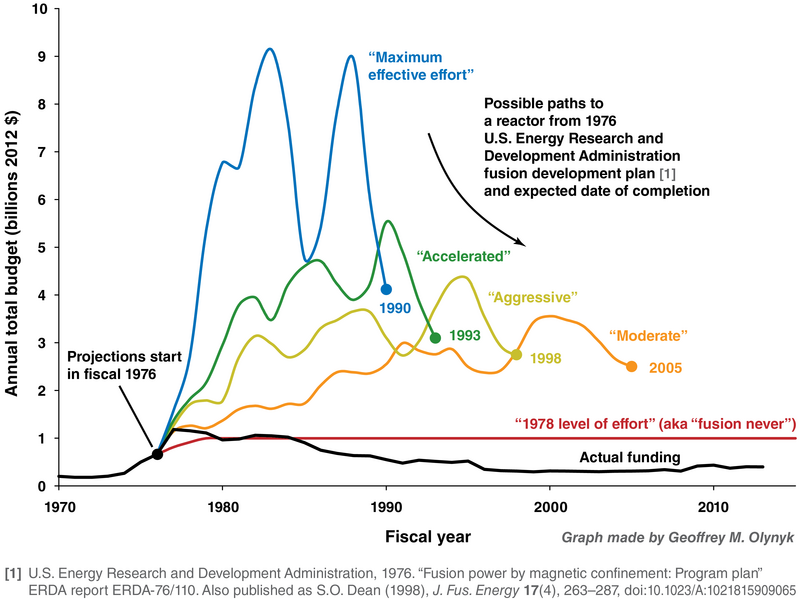
It was too late ten years ago
It is too late today
It will be too late in ten years
It is always too late.
But weirdly it is never too late to be anti nuclear power.
Knowing nothing about the process, can i ask, is the time it takes to build one based on current standards? Like if we were to focus more resources into the construction of new plants wouldnt they be built faster?
The latest nuclear power plant built in the US is seven years behind schedule and almost $20 billion over budget. It bankrupted Westinghouse Energy, and is slated to cost consumers more than double what comparable electricity costs because of these overruns.
And this was a plant that was using newer construction techniques like offsite assembly to reduce costs.
Were there mistakes during the build process like lowballing spending figures or building time so they are permitted to build or did they just royally fuck up some other way?
Looks like one holdup nowadays is the ability to source HALEU (Uranium that is 4x as enriched as the typical fuel used in current reactors).
https://www.wyomingpublicmedia.org/...
It was sourceable from Russia before they invaded Ukraine.
Since I don't see it mentioned anywhere: Ignoring the economical and environmental issues that nuclear power still has compared to actual renewables, it has a geostrategic problem: Uranium is a geologically limited resources, which just creates political and economical dependencies. And since Russia has a lot of it, keeping working sanctions against them alive is pretty problematic, if you need to buy your energy resources from them. See gas supply.
New archetypes of NP can run on depleted fuel. There's enough of that around for more than 50yrs of power.
Nuclear power is the ONLY form of clean energy that can be scaled up in time to save us from the worst of climate change.
Mmmm I agreed with you until reading this. The 6th IPCC Assessment Report showed us that Wind + Solar + Battery Storage are still a safer bet for rolling out non-fossil fuel energy sources at the fastest rate we can launch them. Nuclear sadly still takes too long to build.
I think there is a space for advanced nuclear, though. Small Modular Reactors, Fast Breeders, and such should be encouraged going forward. The US (and I think UK) each have funds specifically designated to the development of advanced nuclear too.
But old nuclear will take too long to get a hold on emissions. I still think nuclear fits in a well-balanced energy portfolio, but not of the specific technology of the 1950s-1990s.
We've had the cure for climate change all along, but fear that we'd do another Chernobyl has scared us away from it.
I mean, Chernobyl is kind of an outdated example. Fukushima would be the more recent one to point at, or even Three Mile Island. Not particularly useful for your argument. Still, I think if people got educated about all 3 of those examples from history, they'll come out convinced that nuclear is still a safe bet.
Problem is, like I said above, that conventional nuclear takes too damn long to build.
Not to mention the conventional plants don't seem to be faring all that well...
The study also questions the reliability of the nuclear fleet, particularly given the dramatically low availability of French power plants this year – nearly half of the 56 nuclear reactors were closed even though the EU was in a complicated period of electricity supply with frequent peaks in the price of electricity above €3/kWh.
That sounds pretty awful when everyone expects nucleur to handle baseload.
Yeah, the argument of nuclear crumbles when you start to peak behind the curtain of operation. Still, renewables have the same problem.
Wind turbines break shafts, studs, bolts, lifts, generator step-up (GSU) units, etc. Then you still need oil for all the mechanical systems in a turbine too, which can degrade. Operations can keep up with this though, and in my experience wind can be up and running a lot more frequently with reference to failures that cause downtime compared with maintenance of nuclear with reference to downtime for it.
Same with solar, or even better with solar because the only moving parts with solar are the axis trackers that move panels such that they always point at the sun. Lots more uptime that doesn't involve radiation exposure, although that concern for operations has probably been designed out as reactor technology has grown up.
Or at least I'd hope...
Canada is also investing in modular reactors, so there are already several large players in the field.
emphasis mine:
Anti-nuclear is like anti-GMO and anti-vax: pure ignorance, and fear of that which they don’t understand.
First of all anti- #GMO stances are often derived from anti-Bayer-Monsanto stances. There is no transparency about whether Monsanto is in the supply chain of any given thing you buy, so boycotting GMO is as accurate as ethical consumers can get to boycotting Monsanto. It would either require pure ignorance or distaste for humanity to support that company with its pernicious history and intent to eventually take control over the world’s food supply.
Then there’s the anti-GMO-tech camp (which is what you had in mind). You have people who are anti-all-GMO and those who are anti-risky-GMO. It’s pure technological ignorance to regard all GMO equally safe or equally unsafe. GMO is an umbrella of many techniques. Some of those techniques are as low risk as cross-breeding in ways that can happens in nature. Other invasive techniques are extremely risky & experimental. You’re wiser if you separate the different GMO techniques and accept the low risk ones while condemning the foolishly risky approaches at the hands of a profit-driven corporation taking every shortcut they can get away with.
So in short:
- Boycott all U.S.-sourced GMO if you’re an ethical consumer. (note the EU produces GMO without Monsanto)
- Boycott just high-risk GMO techniques if you’re unethical but at least wise about the risks. (note this is somewhat impractical because you don’t have the transparency of knowing what technique was used)
- Boycott no GMO at all if you’re ignorant about risks & simultaneously unethical.
What provides me trepidation is the economic system means slack jawed corpos with MBAs will be working tirelessly to skirt safety.
Now if the government was to run ... Wait, that is communism and is therefore the bad thing to do /s
Even if you could magically increase the number of nuclear reactors started before 2012 tenfold to keep up with wind and solar, you'd have to triple uranium mining overnight to fuel them for the first time.
There are plenty of places already doing a mix of renewables with in-fill from batteries and transient gas generation and it works just fine. eg. South Australia. No coal or nuclear is needed and the gas is gradually being phased out in favour of other renewable sources.
The majority of solid nuclear waste, the kind that lasts milenia, can be reprocessed in to fuel and used again. France is particularly good at this.
The water released from Fukushima contains no solid nuclear waste. Rather, its irradiated water where some of the hydrogen has become tritium. Tritium has a half life of about 12 years, and is naturally occuring from solar radiation. The safest way to deal with it is to filter it, then dilute it so that the percentage of tritium is not much higher than the natural level. This is what Japan is is doing, and will continue doing for several years.
Simply put, safely dealing with nuclear waste is a well understood process, and the main reason it doesn't get done is because of objections from anti nuclear-power activists
You should look into the modern tech here, it isn't just burying millions of tons of toxic waste under New Jersey. There are "breeder reactors" that use the recycled fuel to generate more power. They actually generate more fissile material than they consume, so instead of waste, they mostly produce more fuel.
They also don't exist in large scale energy production and likely never will. (Just some test plants) They're too expensive compared with other energy generation so no-one's seriously considering them right now.
Solar the fastest growing energy and the battery storage is cheaper every year.
I heard a bit from a podcast that stuck with me:
ALL Energy is nuclear energy-
The sun is a nuclear power source.
Plants absorb that nuclear energy and whether we eat them, or eat animals that ate them, that is still energy from a nuclear source.
Some of those plants ended up rotting for millenia underground, and we dig that up, now in the form of coal, oil or natural gasses- then burn it...thats still just nuclear power.
Even the wind is nuclear power, as is its mostly caused by the uneven heating of the air by the sun, as the earth rotates, leading to the creation of higher and lower pressure areas.
The podcast (which was about solar energy- i work for a solar panel company, thats why it was on in the work van, lol) went on to say that logically, nuclear, solar, to an extent wind are therefore the best ways to 'generate/ harvest' power- everything else is just laundering nuclear energy through an inefficient, and usually destructive battery.
And people’s age and background has so weirdly much to do with how they internalize nuclear safety risk. My best german friend is very opposed to fossil fuels and believes in much stronger renewable focus, but is absolutely opposed to nuclear and basically laughs about how stupid he thinks that risk is. It’s wild.
Especially when you realize how little impact Chernobyl and Fukushima really had. Even including those two accidents, coal plants have emitted vastly more radioisotopes (which occur naturally at low levels in coal, but since we burn such vast quantities of coal…) and vastly more carcinogens.
It doesn't really matter whether you think nuclear energy is risky or not - it's economically the worst option. It's the most expensive of all the main sources of power. It's much cheaper to just transition to a mix of mostly renewable power and plenty of places have already done it with success. So why do something unnecessary like nuclear when it's more expensive than the alternatives?
It's crazy you got over a hundred down votes, most which are just anti nuclear reactions brainwashed into them by corporations who knew they could make more money off coal, and made nuclear out to be the enemy.
Chernobyl is a city inhabited today. In fact, the reactors right next to the ones that burnt were still producing energy a few years ago.
Hopefully your ignorance won't last 10k years and you'll learn that nuclear is far less dangerous than your car for example.
Pripyat is not inhabited in a normal way. There are no children or families and there won't be. Simply because children eat dirt and dirt is radioactive. Saying it is inhabited like you did implies there is normal life happening. It never will be again.
Anti-nuclear is like anti-GMO and anti-vax:
This sort of generalization is ignorance.
Nuclear power is the ONLY form of clean energy that can be scaled up in time to save us from the worst of climate change.
Wrong, nuclear power plants takes a lot of time to start and nothing can scale up to infinite spending. The solution and cure to climate change is to stop endless consumerism, if you don't do that society will keep demand yet another power plant to power up some useless shit
No, others did that already plenty here.
It also doesn’t help that people got brainwashed that solar energy and heat pumps will solve all our problems. I don’t have enough space to install so many solar panels to provide power to heat pump during the Eastern European winter and even if I did, ROI will be longer than their expected lifetime. And we still use lead during production, and no one wants to recycle them. These geniuses here import broken solar panels and dump them into the ground and cover them, call that recycling. FFS, nuclear waste disposal is less scary than this uncontrolled shit.
You do understand that solving the world's carbon energy crisis is not an individual person's job, right? We're not talking about me and you getting a solar lease in lieu of nuclear. We're talking about spending about 10% of the cost of 100% nuclear to build 100% solar and wind. For startup costs, going 100% renewable is literally orders of magnitude cheaper than going nuclear. And most countries have the space of potential for it. Yes, as I mentioned elsewhere, building power in and around cities is more complicated, but that is where roof units can come in. It is estimated that any major city could be self-sufficient if every building in it had solar panels on the roof and storage batteries. Even at the higher cost of smaller scale builds, the price difference between solar and nuclear is so large that a municipal solar grid is downright cheap, even if it has to be built that way. And it's pretty cool how effectively it would mitigate large-scale power outages as a free bonus.
Please understand, most people who oppose nuclear do so for more reasons than the nuclear waste. They hate that people keep focusing on this expensive technology that will take too long to solve the problem, when we have renewable energy that is just so much cheaper to build.
You don't have enough space to install solar panels, but you do have space for a nuclear reactor? Interesting!
Don't you love it when you get heavily downvoted but no-one is brave enough to challenge your point of view?
I mostly agree with you. Solar is good if you own a house, with a roof and have thousands in disposable cash to invest, but that's not most people.
Heat pumps can't be run on your solar power alone and if your house isn't well insulated, they can be extremely inefficient, ending up costing you substantially more than sticking with gas or oil. And that's not getting in to the other short comings of heat pumps which I believe is a separate debate.
As many people in this thread have said, the best time to invest in nuclear was thirty years ago, but the next best time is now. Give us tonnes of cheap, carbon free electricity to throw in to a heat pump and then they make sense.
Normally I'm not a "lesser of two evils" type, but nuclear is such an immensely lesser evil compared to coal and oil that it's insane people are still against it.
Anti-nuclear people in here arguing about disasters that killed a few k people in 50 years. Also deeply worried about nuclear waste that won't have an impact on humans for thousands of years, but ignoring climate change is having an impact and might end our way of life as we know it before 2100.
They're bike-shedding and blocking a major stepping stone to a coal, petrol and gas free future for the sake of idealism.
The biggest enemy of the left is the left
do not let "perfect" be the enemy of "good enough"
edit: quick addendum, I really cannot stress this enough, everyone who says nuclear is an imperfect solution and just kicks the can down the road -- yes, it does, it kicks it a couple thousand years away as opposed to within the next hundred years. We can use all that time to perfect solar and wind, but unless we get really lucky and get everyone on board with solar and wind right now, the next best thing we can hope for is more time.
I am not sure when the narrative around nuclear power became nuclear energy vs renewables when it should be nuclear and renewables vs fossil fuels.
We need both nuclear and renewable energy where we try to use and develop renewables as much as possible while using nuclear energy to plug the gaps in the renewable energy supply
I live less than 2 miles from the last remaining coal power station in England.
I would much rather have nuclear instead of a chimney chucking god knows what into the air (and subsequently into me) for my entire life.
Greenpeace was founded to be an anti-nuclear organization. See, most of the founding members were members of the Sierra Club (another environmentalist organization) but the Sierra Club was actually pro-nuclear power. The Sierra Club was actually fighting against the installation of new dams due to the effect of wiping out large swaths of river habitat and preventing salmon runs and such.
Anyway, in 1971 there was an underground nuclear bomb test by the US government in an area that was geologically unstable. (there were a bunch of tests to see just how geologically unstable). Protesters thought that the test would cause an earthquake and a tsunami.
Anyway, the people who were unhappy with the Sierra club not actively protesting nuclear power, wanted to protest this nuclear bomb test too, so they formed an organization called the "Don't make a wave committee". They sued, the suit was decided in the US's favor, the test went off, and no earthquake happened (which is how the earlier tests said it would go).
At some point, the "Don't make a wave committee" turned into Greenpeace.
Also about this timeframe, Greenpeace started receiving yearly donations from the Rockefeller Foundation.
The Rockefeller Foundation is the charitable foundation created by the Rockefeller heirs that "uses oil money to make the world a better place" but they kind of don't. They've been anti-nuclear since the beginning, and even directly funded some radiation research in the 1950s that lied about safe exposure limits to radiation, claiming that there was no safe limit. That research went on to shape international policy, and by the time new research came out, the policy was already written and thus hard to change.
As a side note, another alumnus of the Sierra Club was approached by the then CEO of Atlantic Oil and directly paid a sum of something like $100k (in 1970 money) to found another anti-nuclear environmentalist organization called Friends of the Earth.
Why go nuclear when renewable is so much cheaper, safer, future proof and less centralised?
Don't get me wrong. Nuclear is better than coal and gas but it will not safe our way of life.
Just like the electric car is here to preserve the car industry not the planet, nuclear energy is still here to preserve the big energy players, not our environment.
100% right.
It doesn't make any sense without reprocessing though, have to do both. Fortunately France and Finland have active programs.
The US needs to both learn how to do reprocessing again and build more plants.
any danger that comes from nuclear energy is minuscule compared to the danger that comes from fossil fuels, which are proven to be a main factor in climate change and to cause cancer
Wind and solar > nuclear > fossil fuels
Nothing really against nuclear except how it is being weilded as a distraction from better, cleaner, energy. We need to be going all in on converting everything to wind and solar, with batteries and other power storage like water pumping facilities filling the gaps.
Nuclear needs a few more issues figured out, like how to actually cheaply build and get power from all those touted newer cleaner reactor styles.
One thing I don't see a lot of people talking about is how nuclear is probably better for the environment due to how you don't have to cut down a Forrest to generate a viable amount of electricity meanwhile nuclear only requires two factory sised buildings to generate more than enough electricity to be viable and that's assuming you have a sister breeder reactor to generate power from the waste
I don't really know anything about this topic, but I heard there are new designs of nuclear fission plants that are much safer and "unmeltdownable"? Called Molten Salt Reactors https://en.wikipedia.org/wiki/Molten_salt_reactor
Cause once again no one can see the potential advancements nuclear technology can have if it had proper investment. Everyone see's Chernobyl and Fukushima and then they switch off.
Yes Renewables are better than nuclear for the moment but to demonize and not even discuss it is just burying your head in the sand
If the Great Filter theory is correct, climate change will most likely be our Great Filter.
Our species is simply not equipped with the ability to deal with the problems it created. Many people can, but they're not powerful to do anything, and there's too many uneducated people for the masses to rise up about this problem.
We think so short term, it's impossible for some people to think about the future and accept that we'll need to change the way we live now so that we can keep living then. They're hung up on Chernobyl because it was a big bang that killed lots of people at once and it was televised everywhere that has a society and TVs, but they are unable to see that in the long term coal and gas have killed and are still killing way more people than nuclear accidents, because it's a process that's continuous and kills people in indirect ways instead of a big blast.
I find it fascinating how few people remember the time when Greenpeace was literally selling Russian gas.
holy crap a voice of reason, hopefully they listen. And hopefully she's free to come scream at the climate activists here in the US too.
As a bit of a "young climate activist" myself (certainly more of a jaded, realistic one) , nuclear is still a bad idea. We don't need a overabundance of electricity, we need more sustainable energy. The last thing we should be doing as environmentalists is giving governments and capitalists more resources to weaponize- ntm more opportunities to critically fuck up our planet. Yes, nuclear energy CAN be produced totally safely. However, from a logistics standpoint this depends on keeping a number of factors in check and one has to account for the materials involved. Storage of nuclear waste is already a problem on planet earth. The U.S has bunkers full of this sludge that will kill anyone who gets close- Not to mention how unethical industry practices are when it comes to mining on a world wide scale!
Kyoto was in 1997. 2030 is 33 years, you can't seriously consider 1.5 generations is a sprint.
Which, by the way, there is almost no conceivable way we are going to meet the 2030 deadline to maintain 1.5C. We have to think longer term.
There still is no zero emissions technology for long haul airlines, shipping, or pouring concrete for infrastructure. Those are all huge emitters.
The activist argues nuclear power is a crucial tool against climate change and disagrees with Greenpeace's concerns about its environmental impact. Greenpeace defends its position, emphasizing the importance of prioritizing renewable alternatives like solar and wind for cutting emissions.
This is the best summary I could come up with:
In April, the environmental campaign group announced it would appeal against the EU Commission’s decision to include nuclear power in its classification system for sustainable finance.
Ia Aanstoot, from Sweden, who for three years took part in the Friday school strikes movement started by Greta Thunberg, said Greenpeace’s legal challenge served fossil fuel interests instead of climate action.
This week, Aanstoot submitted papers to the EU court of justice asking to become an “interested party” in the upcoming legal battle between the European Commission and Greenpeace.
One of these, Julia Galosh, a 22-year-old biologist, said: “I’ve protested opposite Greenpeace in horror as they campaigned to stop Germany’s nuclear reactors – something which led to much more demand for coal.
A Greenpeace EU spokesperson said: “We have the greatest respect for folks who are worried about the climate crisis and want to throw everything we have at the problem, but building new nuclear plants just isn’t a viable solution.
Encouraging investments into nuclear energy by including it in the EU taxonomy risks diverting funding away from renewables, home insulation and support for people hit by extreme weather.
The original article contains 764 words, the summary contains 186 words. Saved 76%. I'm a bot and I'm open source!
Nuclear power is neither safe nor ecologically sustainable. The waste is immensely toxic for hundreds of thousands of years. The model is centralized so wealthy oligarchs own the power source and sell it to everyone else. Better to move toward distributed power generation that isn't massively toxic. Greenpeace must stay anti-nuke.
Nuclear energy is a terrible idea in both a physically (climate change) and socially destabilizing world.
Even Gen4 proliferation-resistant reactors still represent a lethal threat in the event of a release of fissionable materials into the local environment. Building a nuclear reactor without a cast-iron guarantee that there will be a supply of engineering staff, components, materials and clear strong regulation to keep it running safely is a surefire path to disaster.
Whilst the technology and physics behind it are well understood, we have shown time and again in a few short decades of utilizing this technology that we lack the responsibility in our administrative structures to properly manage the risks.
It would take just one full-on reactor meltdown or disaster to poison an entire continent. We have consistently demonstrated that we cannot responsibly assume that risk, which is why there is opposition to nuclear power.
If you want to avoid bad things from happening, do not deploy a dangerous technology and instead focus on what we can do. Renewables are more than capable of providing for our energy needs, and the big kicker here is that they can do so without putting the literal power "off" switch in the hands of the grid or plant operator.
I don't think this is the solution everywhere. In my country there is no safe space to put the waste.
And then don't forget France had real trouble keeping them going during summer heat waves because the rivers were so warm, they didn't cool down their nuclear power plants enough.
Amazing to me that on a platform that is the epitome of the power of decentralization we don't see the same advantages with energy production and storage.
I am not in favor of development of nuclear power for 2 reasons:
Uncertain future costs. Building a nuclear reactor is very expensive and takes a long time. The cost curve for renewable production (solar, wind) as well as storage (batteries) has fallen so dramatically in the last decade it's impossible to make a financial commitment to building a nuclear plant. That's why there are very few applications in the US (https://www.nrc.gov/...) - nobody wants to financially back an investment that is likely a money loser.
Grid security and stability. Having centralized power sources has exposed the US grid to inadequate security and protection from attack (https://www.tripwire.com/....). The solution is decentralization, which occurs naturally when solar/wind and batteries are used for storage. For those arguing battery technology and deployment is inadequate and impossible for grid stabilization, there is an easy solution to this problem - VTG. We are deploying hundreds of thousands (soon to be millions) of EVs. Vehicle-to-Grid technology can solve the storage problem with renewables very easily and in parallel to the goal of transitioning to renewables.
Nuclear, the costliest energy source available with massive room for long build projects and years of service contracts to manage the waste materials and deconstruction costs with at least nine figures. Cui bono?
Wind and solar ia cheap and save, batteries work. Build time is manageable.
I swear to god all these "Omg nuclear will save us from climate change bro! Small modular reactors are right around the corner, trust me" tech bro types are fossil fuel industry plants to try and distract people from building renewables and instead build nuclear reactors that will ensure some construction company's CEO gets a multi-million bonus every year for the next 15 years and not much else.
Im not a fan of nuclear but not super against it. It takes a lot of capital and resources for a return far in the future and there are options that can get us more sooner. Waste is an issue as long as it exists and is not taken care of properly long term and overall its the least desirable of solutions outside of straight out burning stuff.
Cue the nuclear shills that will handwave away any legitimate concern with wishful thinking and frame the discussion as solely pro/anti fossil, conveniently pretending that renewables don’t exist.
ETA:
Let's look at some great examples of handwaving and other nonsense to further the nuclear agenda.
Here @danielbln@lemmy.world brings up a legitimate concern about companies not adhering to regulation and regulators being corrupt/bought *cough… Three Mile Island cough*, and how to deal with that:
So uh, turns out the energy companies are not exactly the most moral and rule abiding entities, and they love to pay off politicians and cut corners. How does one prevent that, as in the case of fission it has rather dire consequences?
So of course the answer to that by @Carighan@lemmy.world is a slippery slope argument and equating a hypothetical disaster with thousands if not millions of victims and areas being uninhabitable for years to come, with the death of a family member due to faulty wiring in your home:
Since you can apply that logic to everything, how can you ever build anything? Because all consequences are dire on a myopic scale, that is, if your partner dies because a single electrician cheaped out with the wiring in your building and got someone to sign off, "It's not as bad as a nuclear disaster" isn't exactly going to console them much.
At some point, you need to accept that making something illegal and trying to prosecute people has to be enough. For most situations. It's not perfect. Sure. But nothing ever is. And no solution to energy is ever going to be perfect, either.
Then there's the matter of misleading statistics and graphs.
Never mind the fact that the amount of victims of nuclear disasters is underreported, under-attributed and research is hampered if not outright blocked to further a nuclear agenda, also never mind that the risks are consistently underreported, lets leave those contentious points behind and look at what's at hand.
Here @JohnDClay@sh.itjust.works shows a graph from Our World in Data that is often thrown around and claims to show "Death rates by unit of electricity production":
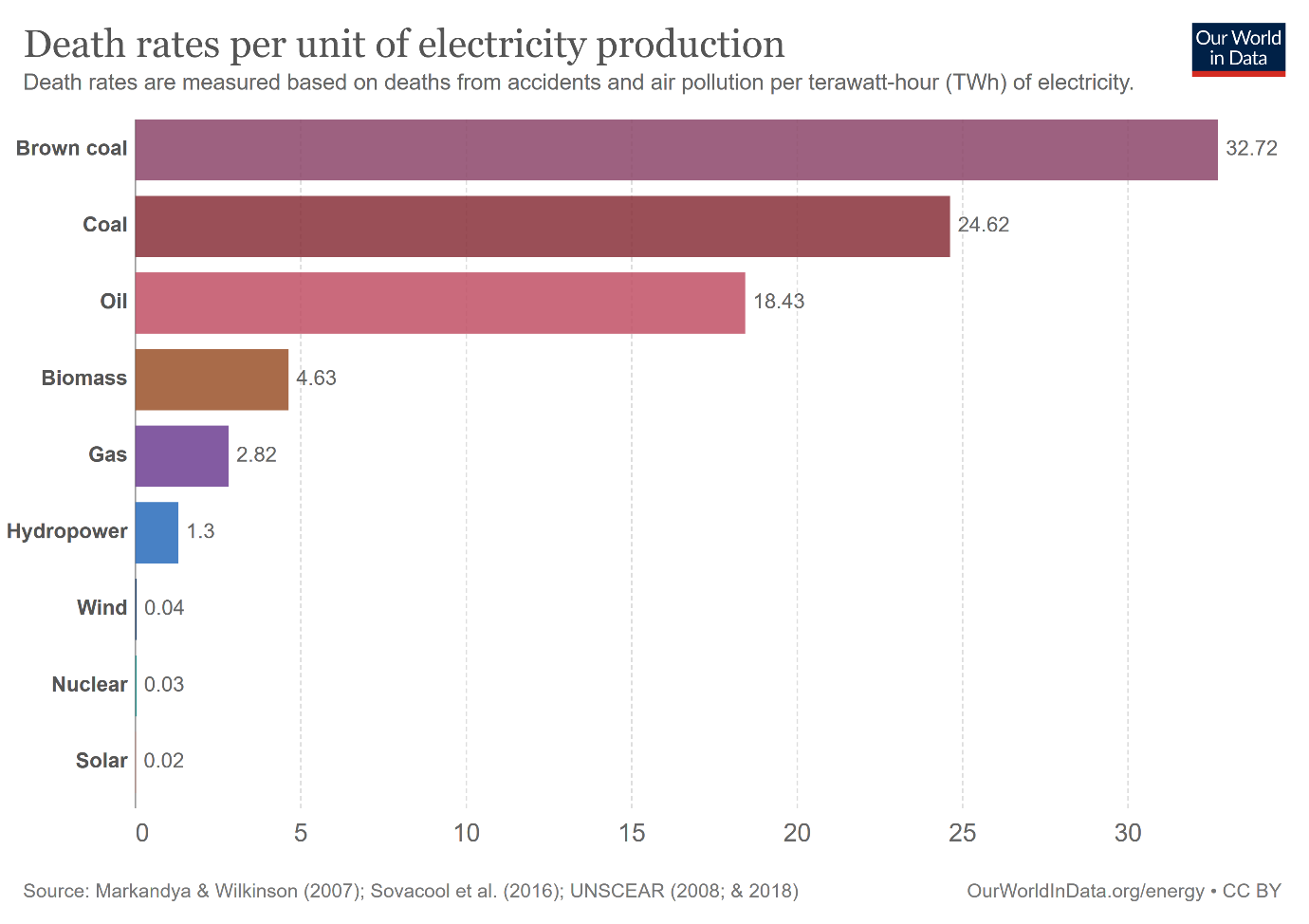
Seems shocking enough and I'm sure in rough lines, the proportions respective to one another make sense to some degree or another.
The problem however is that the source data is thrown together in such a way that it completely undermines the message the graph is trying to portray.
According to Our World in Data this is the source of the data used in the graph:
Death rates from energy production is measured as the number of deaths by energy source per terawatt-hour (TWh) of electricity production.
Data on death rates from fossil fuels is sourced from Markandya, A., & Wilkinson, P. (2007).
Data on death rates from solar and wind is sourced from Sovacool et al. (2016) based on a database of accidents from these sources.
We estimate deaths rates for nuclear energy based on the latest death toll figures from Chernobyl and Fukushima as described in our article here: https://ourworldindata.org/...
We estimate death rates from hydropower based on an updated list of historical hydropower accidents, dating back to 1965, sourced primarily from the underlying database included in Sovacool et al. (2016). For more information, see our article: https://ourworldindata.org/...
Fossil fuel numbers are based on this paper which starts out by described a pro-nuclear stance, but more importantly, does a lot of educated guesstimating on the air-pollution related death numbers that is straight up copied into the graph.
Sovacool is used for solar and wind, but doesn't have those estimates and is mainly limited to direct victims.
Nuclear based deaths is based on Our World in Data's own nuclear propaganda piece that mainly focuses on direct deaths and severely underplays non-direct deaths.
And hydropower bases deaths is based on accidents.
So they mix and match all kinds of different forms of data to make this graph, which is a no-no. Either you stick to only accidents, only direct deaths or do all possible deaths that is possibly caused by an energy source, like they do for fossil fuels.
Not doing so makes the graph seem like some kind of joke.
Meh, nuclear isn't anti-climate but anti-environment (not only waste but the production too).
The European Commission is being sued by environmental campaigners over a decision to include gas and nuclear in an EU guide to “green” investments.
Eight national and regional Greenpeace organisations including France, Germany and EU office in Brussels are asking the court to rule the inclusion of gas and nuclear invalid.
https://www.theguardian.com/...
I totally support Greenpeace in this. Neither nuclear nor gas should be considered a "green" investment. Ia Aanstoot, the "18 year old climate activist", is wrong to support the European Commission's stance on this.
The problems with nuclear power is not the waist affecting the environment just by sitting their, but by having humans gain access to that waist and doing nefarious things with it. I am all for breader reactors, but they output waist perfect for use in nuclear bombs. I have little faith that we could guard that waist sufficiently until it reaches a secure dump, and that faith scales down as the number of reactors scales up.
I always feel like I'm taking fucking crazy pill when we talk about nuclear energy.
Are we forgetting Chernoble, 3 mile island, or even more recenlty fukishima?
Sure, nuclear energy is great, cheap and reliable.. but IF something goes catastrophically wrong, like I dunno.. earth quakes, hurricanes, tornados, floods, etc (IE things we can't really plan for) you run the risk of not being able to fix it easily...
I guess I"m not a huge fan of making large swaths of the earth uninhabital if shit goes sideways.
Seems everyone who wants nuclear has no answer when it comes to waste.
Ah, yes, teen figures out nuclear energy problems from bedroom. I'm sure she has a great career ahead spewing bullshit for some industry.
A coal power station belches far more radioactive contaminants in to the atmosphere than any nuclear power station.
Wind and solar aren't ready, that's the whole point! They're great when it's windy and sunny, but useless when it's still and night time. Until mass power storage is a solved problem, wind and solar are unable to provide the base load power that can be provided by fossil fuel/nuclear power stations needed by advanced nations.
To preface, i dont support coal at all, its way worse than nuclear.
If i remember right, the coal thing was measuring radioactivity in the air around coal and power plants. Thats not the nuclear waste im talking about. Spent nuclear fuel is dangerously radioactively for longer than the whole of human civilization. It puts plastic's lifespan to shame. Its no where on the scale of volume as fossil fuel waste, but pound for pound i believe it is the worst substance we can produce.
If you remind me later today ill explain how energy storage is easily solvable, itll take longer than i have now
The air radiation thing is misleading, saying the area around coal plants is more radioactive than nuclear plants isnt saying anything, because the air around nuclear plants isnt radioactive.
Most US nuclear waste isnt buried, because we dont have anywhere ready to. Its stuck in on site storage. It might be safely stored for now, but that waste is gonna accumulate like nothing before because of how crazy long it remains dangerously radioactive. Nuclear waste produced 10000 years from now is still gonna be competing with nuclear waste produced today for room to be safely stored.
Alright its later today so heres how renewable energy as a baseline supply works. We actually already have a working example of it, hydro electric. Renewable energy thats used as baseline. When you think energy storage i think most people think of batteries, but theyre mostly suited for mobile energy storage, like cars and handheld devices. For utility power we have much more scalable, and simpler energy storage. For hydroelectric, they take excess electricity generated, and power pumps to pump the water back uphill, to use for later demand. Its physical energy storage. You can power a motor to lift a weight and pulley system with excess energy, then run it in reverse as a generator for demand. This is basic engineering, and its as scalable as you need it.
I understand pumped storage well. The problem with it is the required size of the reservoirs and the availability of suitable locations.
Pumped storage as it stands in the UK is really very useful for managing dips and spikes in power demand but unfortunately far, far short of being able to get us through a day or two of no wind.
Right, pumped storage hydro electric was an example of renewable electricity being baseline load. I gave a different suggestion for wind and solar storage if you dont have a good location for pumped storage.
Bullshit. Nuclear waste (more precisely, spent fuel that can be reprocessed for new fuel or other useful radionuclids) is the only waste we have actual good solutions for. It's not an engineering problem, we know very well how to safely dispose of the small amount of ultimate nuclear waste.
All the other waste, including waste from producing new and retiring old solar panels and wind turbines, basically just gets thrown into the landscape with no containment whatsoever. And some of that stuff is toxic, some will never degrade (plastics used in composite materials the wind turbine blades and towers are made of).
Plus, if you only used nuclear energy throughout you life, the amount of ultimate waste can literally fit into a coke can. That's how efficient and energy dense it is.
What's this amazing waste disposal method you're convinced exists? Last I checked, the waste will still be around for at least a millennia and the only process we have to deal with it is bury it in a hole with a sign that says 'BAD' in a way we hope future generations can still interpret.
Last you checked? When was that?
Kyle Hill has a very educational video about this if you're interested:
Can't you chuck it back into a reactor and reuse it that way, to help reduce the radioactivity, and get more power back out of it?
We already have more nuclear waste than we have capacity to store. And we arent reusing that nuclear waste. If you wanna become a nuclear engineer and get them to start using it please do, but right now the nuclear waste plan is to bury it for many millenia
Out of sight out of mind, right? Great solution. Coke can? Ummmmmmmmmmm nope.
Wind and solar are not magic bullets. Better than fossil fuels, yes. But they come with their own "the ocean is too big to pollute" type quagmires that we overlook when deployed on the small scale. The most basic example: solar panels are dark in colour -- deploying a few of them is trivial, but deploying a lot of them over time will cause the average albedo of the earth to change, heating it. This won't be a problem today, but would be in a century. Etc. Still better than greenhouse gasses though.
Nuclear likewise has issues. You're just straight up adding heat to the system. And depending on the reactor design, you have waste. But it's a huge improvement over fossil fuels.
Solar panels arent typical light surfaces, they dont convert all the light absorbed into heat, their whole point is they convert some light absorbed into electricity.
Add onto the fact black is already a popular roof color.
I'm not downvoting because I don't agree, I'm downvoting because the statement is factually inaccurate - coal power produces more radioactive waste than nuclear power does.
I'm not here to discuss oil and gas industry funded propaganda and disinfo.
Not really. Ideally people should only downvote when something isn't contributing to the conversation, and if you disagree you reply to it and voice your disagreement.
But people are going to be people, so it eventually always turns into a "disagree" button, cause it's much easier than commenting.
Who decided that's how downvoting should be used? There is no official rulebook (especially on the fediverse), and etiquette is decided as a group, but there isn't clear consensus on this.
The technical function of the downvote is to push the comment down far enough that people won't see it. And so people will continue to use it as a way to communicate that they do not approve of the comment. And telling people to stop downvoting comments they don't like is trying to enforce a rule they never agreed to.
how do you determine if something is not contributing to the conversation though?
For example, if I made a pro vaxx post and someone posted some anti vaxx propaganda, would you downvote it?
Isn't that just a soft 'rule' established via Reddiquette?
More pro nuke propagate while Japan dumps waste into the ocean. Perfect timing actually. to all the haters and downvaters I give you a link showing how solar and wind are cheaper and better. Of course you will ignore it. Who needs evidence when you're already sold amirite
KPFA - The Ralph Nader Radio Hour: The False Promise of Small Nuclear Reactors – The Ralph Nader Radio Hour – August 21, 2023
Episode webpage: https://kpfa.org/...
Media file: https://archives.kpfa.org/...
Carbon contains radioactive isotopes and if you use a lot of it to generate electricity you end up with a lot of it in a single spot. It's specifically carbon-14 you measure when using radiocarbon dating to estimate how old an item is.
... approximately 2,000 coal samples from the Western United States ... concentrations of uranium fall in the range from slightly below 1 to 4 parts per million (ppm). ... Coals with more than 20 ppm uranium are rare in the United States. Thorium concentrations in coal fall within a similar 1–4 ppm range, ... Coals with more than 20 ppm thorium are extremely rare.
concentrations of coals in China are estimated based on uranium analyses of 1535 coal samples ... Late Jurassic and Early Cretaceous (J3–K1), and Eogene and Neogene (E–N) coals are 2.91, 5.43, 3.67, 1.18, 1.84, and 3.92 μg/g, respectively. The overall average weighted uranium concentration of coals in China is 2.31 μg/g.
https://www.sciencedirect.com/...
AFAIK that's 1.18-5.43 ppm.
Obviously, when you burn that, it gets concentrated.
Never attribute to malice what can be attributed to ignorance. They probably really do care but have little formal education and also the algorithms have decided to send them to a particular bubble of the internet.
Well, bananas are crazy radioactive...
I had to get measured before and after training to work in nuclear in the military, and they ordered us not to eat bananas for a week before either test.
Not that bananas are bad for you, it's just exposure is tracked well below limits there'll actually be negative side effects. So eating a couple bananas recently is enough to throw up red flags on the test
Bananas aren't even that radioactive. 0.1 microsieverts.
If you really want to expose yourself to large amounts of radiation, start smoking. 160,000 microsieverts a year, contains radioactive polonium and lead.
Not that bananas are bad for you, it’s just exposure is tracked well below limits there’ll actually be negative side effects. So eating a couple bananas recently is enough to throw up red flags on the test
because you wanna be combative, I'll be the same.
what are we supposed to do when it's not sunny, or if we live in parts of the world that don't see much/any sun, and it's not windy. batteries? you already know we aren't at a point that is viable yet, we'll get there, not today. what are we supposed to do when the entire plant scales up the demand for solar panels to replace the lack of nuclear, and suddenly there isn't enough scale to fulfil that demand and prices skyrocket.
I want a future of energy stability that is able to handle a changing climate, and changing political climates. I want a world where people have endless, cheap, free, low carbon cost energy without it being the plaything of whoever is a political leader this week. a combination of nuclear, solar, wind and anything else we can throw in there does that.
going all in on just two that have similar problems, does not.
Yh solar and wind is better, until it's night time and the wind is still.
Until mass power storage is a solved problem we need base load power the demand of which can currently only be met by fossil fuels or nuclear.
Honestly, saying "yh, but wind and solar!?!?" whilst clearly having very little concept of the power demands of a nation makes you seem extremely silly.
A catastrophic earthquake caused a massive tsunami which hit a 40-year-old reactor and caused the worst nuclear accident since Chernobyl.
One person died as a result of the nuclear portion of the disaster.
One.
The perfect storm of shit hitting the fan killed one person. Modern reactor design and safety is so much better than Fukushima Daiichi, and outside Japan, there's no reason to build a reactor within 100 miles of a tsunami danger zone.
...while Japan dumps waste into the ocean.
China releases vastly more tritium into the ocean than Japan ever will, and has for years.
KPFA - The Ralph Nader Radio Hour
Nader is a Russian shill who whines about "How much suffering will he (Biden) tolerate being inflicted on the long-suffering Russian people? "
Further we've known for years that Russia will fund any Western Environmental Group that it can leverage to produce more dependency on Russian Oil and Gas. If Nader isn't one of those he may as well be since he's serving their objective.

@lemmy.world
A community for discussing events around the World
Rules:
Rule 1: posts have the following requirements:
- Post news articles only
- Video links are NOT articles and will be removed.
- Title must match the article headline
- Not United States Internal News
- Recent (Past 30 Days)
- Screenshots/links to other social media sites (Twitter/X/Facebook/Youtube/reddit, etc.) are explicitly forbidden, as are link shorteners.
Rule 2: Do not copy the entire article into your post. The key points in 1-2 paragraphs is allowed (even encouraged!), but large segments of articles posted in the body will result in the post being removed. If you have to stop and think "Is this fair use?", it probably isn't. Archive links, especially the ones created on link submission, are absolutely allowed but those that avoid paywalls are not.
Rule 3: Opinions articles, or Articles based on misinformation/propaganda may be removed.
Rule 4: Posts or comments that are homophobic, transphobic, racist, sexist, anti-religious, or ableist will be removed. “Ironic” prejudice is just prejudiced.
Posts and comments must abide by the lemmy.world terms of service UPDATED AS OF OCTOBER 19 2025
Rule 5: Keep it civil. It's OK to say the subject of an article is behaving like a (pejorative, pejorative). It's NOT OK to say another USER is (pejorative). Strong language is fine, just not directed at other members. Engage in good-faith and with respect! This includes accusing another user of being a bot or paid actor. Trolling is uncivil and is grounds for removal and/or a community ban.
Similarly, if you see posts along these lines, do not engage. Report them, block them, and live a happier life than they do. We see too many slapfights that boil down to "Mom! He's bugging me!" and "I'm not touching you!" Going forward, slapfights will result in removed comments and temp bans to cool off.
Rule 6: Memes, spam, other low effort posting, reposts, misinformation, advocating violence, off-topic, trolling, offensive, regarding the moderators or meta in content may be removed at any time.
Rule 7: We didn't USED to need a rule about how many posts one could make in a day, then someone posted NINETEEN articles in a single day. Not comments, FULL ARTICLES. If you're posting more than say, 10 or so, consider going outside and touching grass. We reserve the right to limit over-posting so a single user does not dominate the front page.
We ask that the users report any comment or post that violate the rules, to use critical thinking when reading, posting or commenting. Users that post off-topic spam, advocate violence, have multiple comments or posts removed, weaponize reports or violate the code of conduct will be banned.
All posts and comments will be reviewed on a case-by-case basis. This means that some content that violates the rules may be allowed, while other content that does not violate the rules may be removed. The moderators retain the right to remove any content and ban users.
Lemmy World Partners
News !news@lemmy.world
Politics !politics@lemmy.world
World Politics !globalpolitics@lemmy.world
Ask Historians !askhistorians@lemmy.world
Recommendations
For Firefox users, there is media bias / propaganda / fact check plugin.
https://addons.mozilla.org/...
- Consider including the article’s mediabiasfactcheck.com/ link
go to feed...
@lemmy.world
A community for discussing events around the World
Rules:
Rule 1: posts have the following requirements:
- Post news articles only
- Video links are NOT articles and will be removed.
- Title must match the article headline
- Not United States Internal News
- Recent (Past 30 Days)
- Screenshots/links to other social media sites (Twitter/X/Facebook/Youtube/reddit, etc.) are explicitly forbidden, as are link shorteners.
Rule 2: Do not copy the entire article into your post. The key points in 1-2 paragraphs is allowed (even encouraged!), but large segments of articles posted in the body will result in the post being removed. If you have to stop and think "Is this fair use?", it probably isn't. Archive links, especially the ones created on link submission, are absolutely allowed but those that avoid paywalls are not.
Rule 3: Opinions articles, or Articles based on misinformation/propaganda may be removed.
Rule 4: Posts or comments that are homophobic, transphobic, racist, sexist, anti-religious, or ableist will be removed. “Ironic” prejudice is just prejudiced.
Posts and comments must abide by the lemmy.world terms of service UPDATED AS OF OCTOBER 19 2025
Rule 5: Keep it civil. It's OK to say the subject of an article is behaving like a (pejorative, pejorative). It's NOT OK to say another USER is (pejorative). Strong language is fine, just not directed at other members. Engage in good-faith and with respect! This includes accusing another user of being a bot or paid actor. Trolling is uncivil and is grounds for removal and/or a community ban.
Similarly, if you see posts along these lines, do not engage. Report them, block them, and live a happier life than they do. We see too many slapfights that boil down to "Mom! He's bugging me!" and "I'm not touching you!" Going forward, slapfights will result in removed comments and temp bans to cool off.
Rule 6: Memes, spam, other low effort posting, reposts, misinformation, advocating violence, off-topic, trolling, offensive, regarding the moderators or meta in content may be removed at any time.
Rule 7: We didn't USED to need a rule about how many posts one could make in a day, then someone posted NINETEEN articles in a single day. Not comments, FULL ARTICLES. If you're posting more than say, 10 or so, consider going outside and touching grass. We reserve the right to limit over-posting so a single user does not dominate the front page.
We ask that the users report any comment or post that violate the rules, to use critical thinking when reading, posting or commenting. Users that post off-topic spam, advocate violence, have multiple comments or posts removed, weaponize reports or violate the code of conduct will be banned.
All posts and comments will be reviewed on a case-by-case basis. This means that some content that violates the rules may be allowed, while other content that does not violate the rules may be removed. The moderators retain the right to remove any content and ban users.
Lemmy World Partners
News !news@lemmy.world
Politics !politics@lemmy.world
World Politics !globalpolitics@lemmy.world
Ask Historians !askhistorians@lemmy.world
Recommendations
For Firefox users, there is media bias / propaganda / fact check plugin.
https://addons.mozilla.org/...
- Consider including the article’s mediabiasfactcheck.com/ link
go to feed...
Good!
Anti-nuclear is like anti-GMO and anti-vax: pure ignorance, and fear of that which they don't understand.
Nuclear power is the ONLY form of clean energy that can be scaled up in time to save us from the worst of climate change.
We've had the cure for climate change all along, but fear that we'd do another Chernobyl has scared us away from it.
save