
Microsoft just deleted Windows 11's 32GB RAM recommendation docs, as prices soar and it rushes to sell 8GB RAM PCs
13 days ago by sanitation to c/pcmasterrace
Fuck Nvidia. Fuck SamA with a rusty chainsaw.
This thread is full of misconceptions about RAM use. It is normal and efficient for an OS to reserve memory for processes even if it not really used. This memory will be juggled around in case that is needed. It would be very bad for a modern OS if you somehow lowered your used RAM to near 0%. That would make the computer slower.
See for example this: https://www.linuxatemyram.com/
The same thing goes for Windows. It reserves RAM to be used. Like it should be.
Sure, Windows is bloated.
But posting screenshots of your task manager tells us nothing. If it uses 30% of your RAM at start time, that's fine. Or not. Can't really tell.
Modern OS that isn't Windows though can use significantly less RAM. It's all the telemetry shit and always-online shit thats been jammed into the OS that makes it run poorly. Theres no reason to run CoPilot in File Explorer.
If your processes require RAM, it’s fine to use it. Windows obviously has many processes like that and reserves lots of RAM.
A Linux system can also have RAM-heavy processes if you choose to install and run them. In that case, a high RAM usage indicates that these processes are functioning correctly. Conversely, very low RAM usage suggests that the system is running as intended, assuming you haven’t installed unnecessary applications.
While RAM usage numbers can tell you something about installed and running processes, they don’t necessarily tell much about system performance. High or low values alone don’t definitively tell you whether the system is running well or poorly.
The amount of available RAM (which includes RAM actively used for caches but which will be immediately reassigned by the OS if requested by applications) matters more if you do a lot of task switching.
But posting screenshots of your task manager tells us nothing. If it uses 30% of your RAM at start time, that's fine. Or not. Can't really tell.
Man if only there was some type of metric that showed available memory instead of cached
Actually I think you meant hard allocation in which case it can actually be bloated applications that request too much preallocation from the OS (source: every Java jar ever).
Windows 11 is bloated enough that people using local AI avoid it like the plague. These aren't dumb, non-technical people. They're the opposite of that. They all use Linux or maybe Windows 10 (still updated and you can use IoT which goes to 2032). A near-frontier quality AI told me using IoT would free up about 1-2gb of ram compared to Windows 11.
A near-frontier quality AI told me using IoT would free up about 1-2gb of ram compared to Windows 11.
Oh, well as long as it was a high quality hallucination machine that told you that.
Based on my usage of Linux, Windows 10 and Windows 11, I have no doubt that Windows 11 uses at least 1-2gb more of ram. It runs like crap on older PCs while Windows 10 runs okay. That's the true test.
I've dealt with AI and know the history with hallucinations. Today Hallucinations are more of an issue when it's a controversial topic (politics, religion, or issues the political influencers have taken control of in the media).
They're fed training data pushing a narrative preferred by the AI developers, who leave out the contradictory info. It's a lot like social media moderation. Ultimately, there's a group of individuals at the company who think a certain way and think the rest of the world should think like them too. It's more of an issue after the R&D model has been turned into a commercial variant at the company by the engineers there and it's out of the hands of the Ph.Ds who originally made it.
As soon as you prompt a basically decent AI to not rely on a training data or a superficial web scrape, and it goes looking for contradictory info, then it re-thinks what it told you. This is more of an issue with the commercial corporate subscription AIs and the older small LLMs from years ago that didn't have web scraping capability. Things have definitely changed in the last year or two where the dense models with web scraping capability are concerned. At least, if you go with the uncensored or ablitterated "Thinking" versions of them available on the Huggingface site, or you use a third party service to access a large open weights model that's been made uncensored by whoever maintains it.
It's relevant. To sum it up, this much smarter-than-average part of the PC user base routinely uses Linux rather than Windows 11. A part of the user base that is far more familiar with relative performance of both on the same hardware.
You know what doesnt need 32gb? Linux.
i havent used computer with less than 32Gb in a decade
All three of my PCs running Linux have 16GB in them. Never run out of RAM.
So you're saying that upgrading my tower to 128 GB was overkill? I suppose I could sell one of the ram sets now for probably double what I paid for all 4 sticks in 2023
People run Linux with full plasma desktop with like 8 gb ram. It's the browser that eats up several gb from that, not the desktop. Desktop alone is probably 4 gb max.
But sure, depending on what else you run, you want more memory. But if windows recommends 32 gb just to run the system, that's crazy.
You would think this would encourage better optimized software, but I doubt devs will actually do that. Most modern code practices are about ensuring that code is more easily maintained, often at the cost of performance. Breaking "clean code" rules can easily make programs run 10-25x faster, but will be much harder to maintain.
We also seeing a lot of vibe coding now, which mixes clean code practices (which are well documents online) with messier, less well planned code.
That's grossly over simplifying the problem. "Clean code" is also not a formally defined concept, which could include anything and everything.
I've had more performance problems due to hacky workarounds, themselves necessary because of lack of foresight during development, rather than a slow abstraction (in fact, I don't think I've ever seen the latter)
Indie developers, like the 1-5 staff game studios on Steam, never stopped doing so. You can run most indie games on an old PC today. The big AAA game companies like Activision are taking a big gamble on the next generation, which they insist you'll need a newer console or PC to run. Bethesda tried that with Starfield and it didn't work out so well. The game's not as terrible as people say, but its kind of in the middle of the pack of AAA gaming RPGs and it demanded a fairly large amount of VRAM to run well. I predict things will not go well for games like Modern Warfare 4 that won't run on the last gen consoles or PCs. If developers aren't aiming at older devices then they're making a niche product not a mass market product
What's forcing them? Do we have alternatives?
What a fucking garbage can company.
That's because Teams is a piece of shit, not because 16GB isn't enough normally.
Teams is the most performance inefficient shit I've ever been forced to use.
We use both Zoom and Teams for meeting with partners. On my piece of shit work laptop, I have no problem with Zoom. Teams on the other hand will randomly cut my audio, lag my cursor, or cause peripherals to stop working when I'm in a meeting. I simply can't fathom how it's as bad as it is.
No. No I can play games on Linux without capping my 16.
Edit: yes I checked page file use, dip-ass. Not counting GPU ram.
Ehh, my main machine eats up 12-16GB with just background tasks, and that's on W10. Nobody gives a fuck about optimization since the late 00s.
E: just woke up my system

Well, I'm installing Linux (CachyOS) on my former W10 PC this weekend. So, my 16gb of ram will be well utilized.
At least someone still cares about optimization.
I guess going from 7-8 to 600-1.2k seemed like such an improvement I didn't think to GO HARDER to 300. Though my Ubuntu server VMs get that I assume lol.
The number of people that still don't understand this, even after it's been discussed ad nauseum for decades is frightening.
Unused RAM is wasted RAM. You want it used. You want cached data there for instant access. What matters is how much is available for something else if you need it, and Windows does a shit job of getting that info across.
I'm pretty sure I have the pagefile disabled; both C and D are NVMe drives, and D is raid0. I disabled superfetch a few minutes ago, rebooted, and don't see any performance impact, but the used memory when idle is now 10GB, vs the 19 in that screenshot. No other changes.
I could see the appeal if I was using a platter drive for my programs or frequent data, but it's not 2008 anymore. I'd rather see actual usage over 'the computer knows best'.
E: me spell good
My Linux system (which used to run Window so it has 32 GB of RAM), won't even hit 8 GB if I'm not gaming. I've opened up multiple apps just to show how efficient it is. I think it was sitting around 4 GB before I started running things to see if I can make it balloon easily.
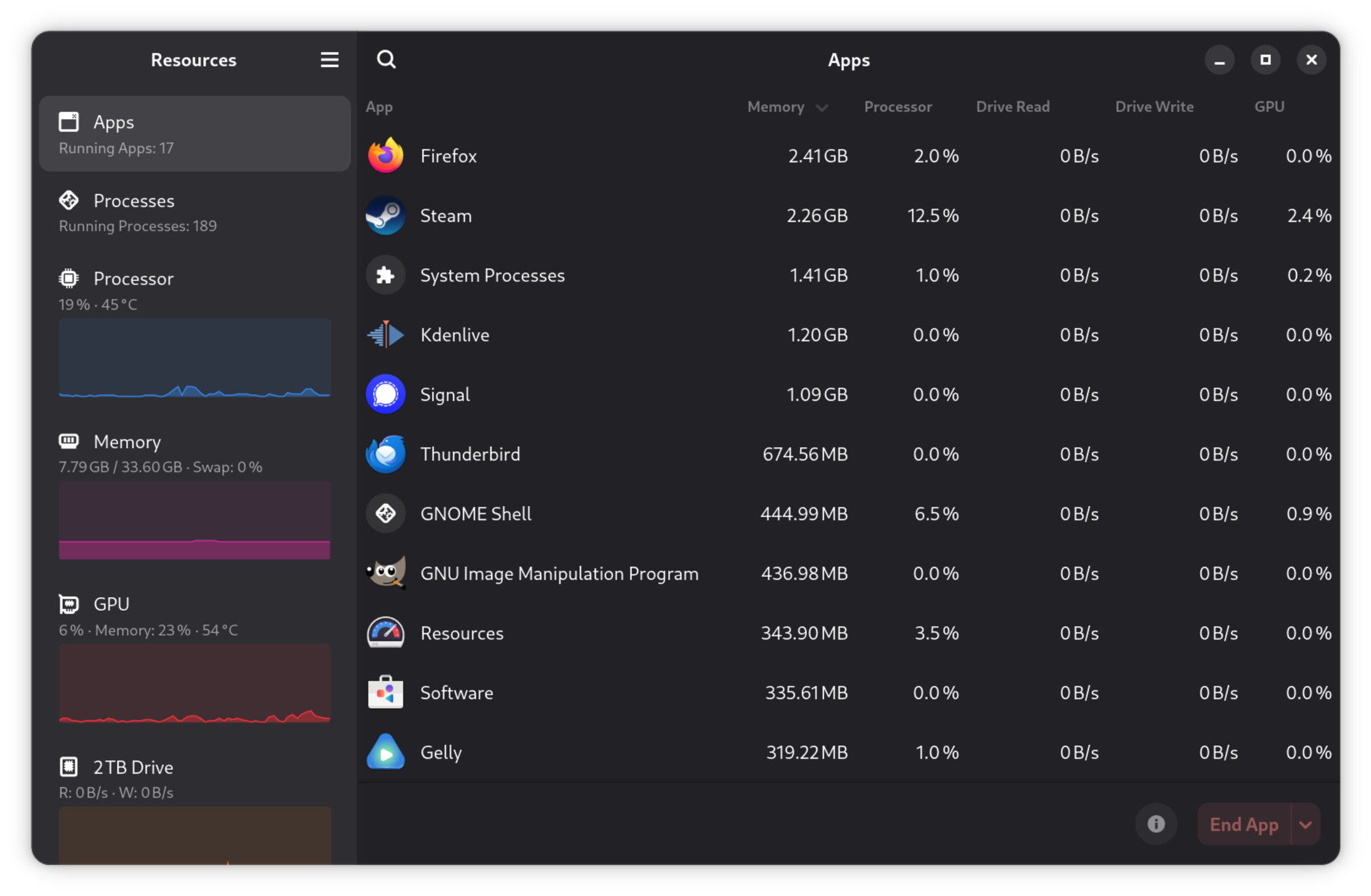
And I'm running most my apps as flatpaks which I've heard may add some slight overhead in terms of RAM usage - someone correct me if I'm wrong about this.
My work computer (granted it likely has tons of background security tools running) uses 10/16 GB's just to get to the desktop and do nothing. The best part is, because ~1.2 GB's of RAM gets allocated for the integrated graphics, I'm really only left with ~4.8 GB's of RAM to do actual work. But wait, it gets even better! This week I found out some bullshit Copilot feature was enabled and taking up another ~1.2 GB's of RAM, leaving me with a total of 3.6 GB's of RAM. So I disabled the WSAIFabricSvc service and reclaimed a sliver of dignity and work space.
Flatpaks bring all their own libraries with them rather than using the system ones.
- (plus) you avoid dependency hell, apps "just work"
- (minus) centralised version updates are less effective for bug and security fixes; all flatpaks must be updated separately
- (minus) all flatpak apps take additional disk space since they bring everything with them
- (minus) all flatpak apps take additional memory; Linux can't keep a single copy of a library read-only in memory if multiple apps are using it
I think they have their place for apps that are under very heavy development, or for apps which are extremely "resource heavy" in comparison to the system resources that they use (by which I mean, games). I wouldn't want my bread-and-butter system utilities to be flatpaks.
SysMain / Superfetch has altered your perception of how much RAM you actually use.
I haven't heard of that since the Vista days, totally forgot about it. Doesn't make sense, I've been all-flash* (E is still HDD for backups, no programs) for well-over a decade. Maybe I should disable it and see if it makes a difference. C is a Samsung 960 Pro and D is a Western Digital Black SN750 in raid0, so it's not really helping even if it is doing something...
The alternative is your CPU spooling up and a longer delay launching applications.
In your screenshot, you already have 70% available memory. Are you on a quest to maximize idle ram? If so, why?
In order for left to right:
- AMD software updater
- HASS.Agent
- Sophos Home
- Synology Drive
- Wireguard
- spacedesk
- Haven (discord replacement)
- Vesktop (alternative discord frontend)
- AMD software
- Creative Sound Blaster Command
- Signal
- Rainmeter
- Telegram
- Bitwarden
- Logitech G Hub
- Playnite
- Steam
- Trucky
- ShareX
- KDE Connect
- f.lux
- Wallpaper Engine
- NextDNS
- Windows Security
Steam is far and away the biggest resource hog at 450MB, I'm assuming mostly from the browser engine.
Fuck yeah. All these years we've complained that Windows was getting so insanely bloated and the system requirements were going crazy, and finally they decided to put in the time and effort to really optimize it so it runs on lighter setups.
Who knew it would be so easy as just removing the recommended specs entirely!
Had me in the first half. As if that clusterfuck fascist OS would run efficient on 8GB
Honestly, the only reason we really needed that much ram to begin with was because no one optimized anything.
I certainly won’t excuse Microsoft here, but if the RAM shortages cause developers to reevaluate their nonfunctional requirements, that will be a small victory.
Which is still insane, given that 10 wanted 1 or 2. We haven’t seen a jump like this since XP to Vista.
What is this, 2012?
Just ship them with windows XP or windows 7 if you only have 8GB RAM...
Do as we say not as we do

@lemmy.world
A community for PC Master Race.
Rules:
- No bigotry: Including racism, sexism, homophobia, transphobia, or xenophobia. Code of Conduct.
- Be respectful. Everyone should feel welcome here.
- No NSFW content.
- No Ads / Spamming.
- Be thoughtful and helpful: especially when new beginners have questions.
go to feed...
@lemmy.world
A community for PC Master Race.
Rules:
- No bigotry: Including racism, sexism, homophobia, transphobia, or xenophobia. Code of Conduct.
- Be respectful. Everyone should feel welcome here.
- No NSFW content.
- No Ads / Spamming.
- Be thoughtful and helpful: especially when new beginners have questions.
go to feed...
8GB wouldn't get me through a cold boot and the stack of corporate mandated spyware security agents.
save