
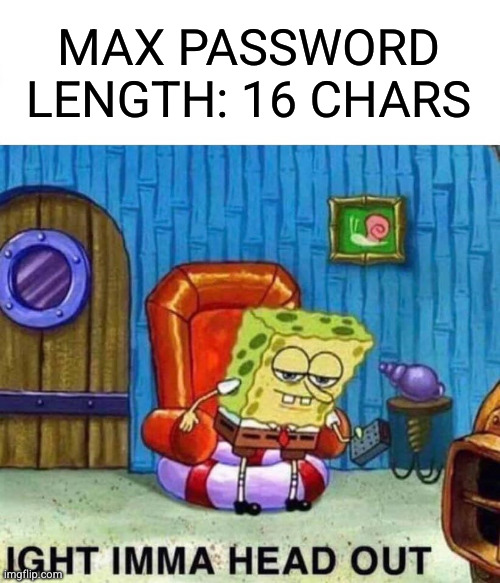
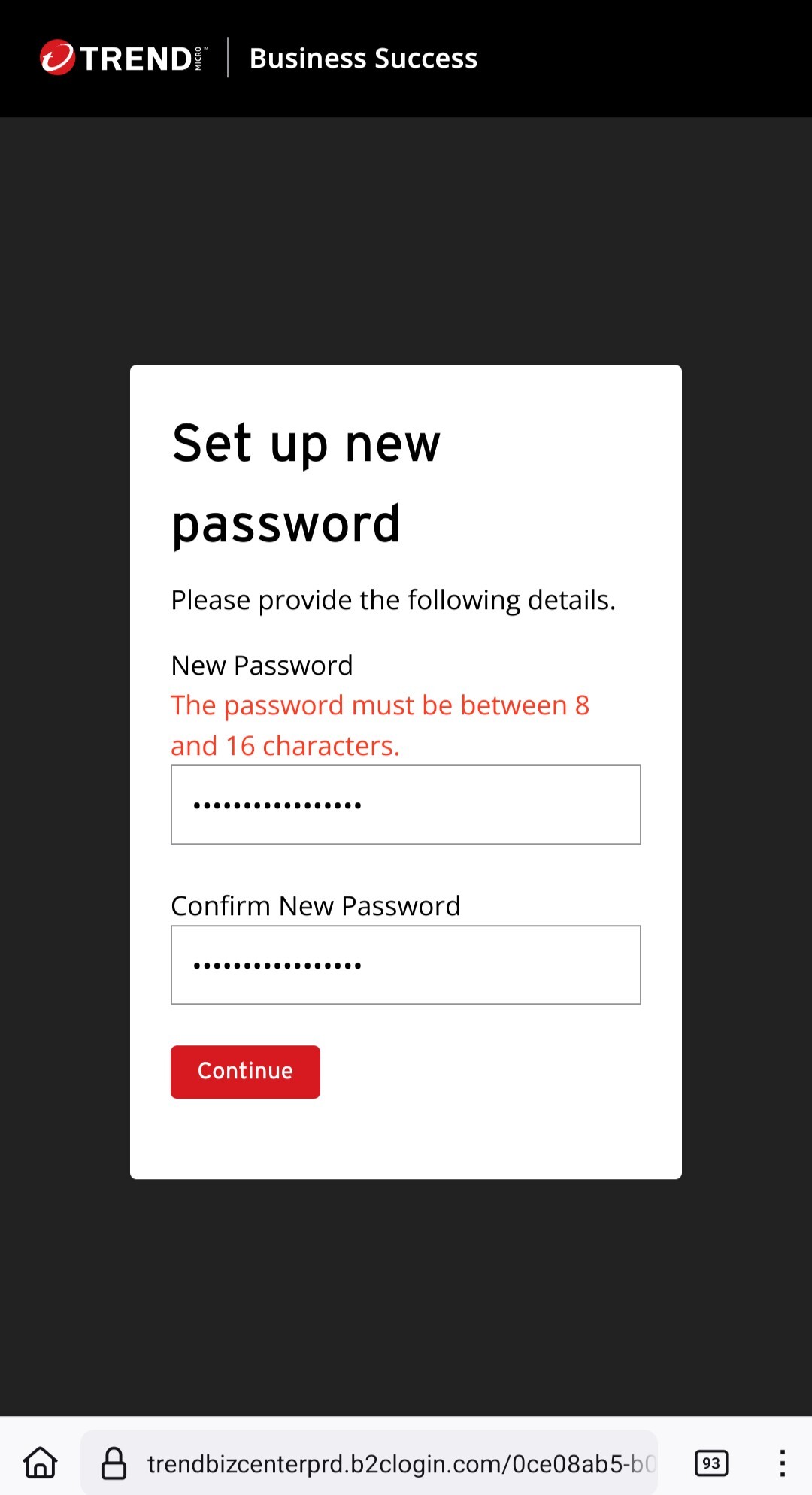
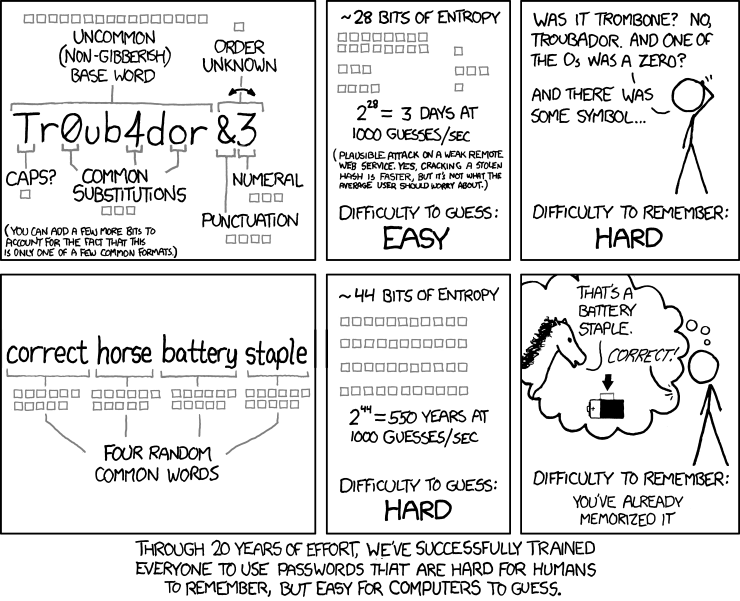
Last week, I tried to register for a service and was really surprised by a password limit of 16 characters. Why on earth yould you impose such strict limits? Never heard of correct horse battery staple?
slazer2au 32 points 2 years ago
If a company tells you your password has a maximum length, they are untrustable with anything important.
Lemmy-UI has a password limit of 60 characters. Does that make it untrustworthy?
cron 58 points 2 years ago
OWASP recommendation is to allow 64 chars at least:
Maximum password length should be at least 64 characters to allow passphrases (NIST SP800-63B). Note that certain implementations of hashing algorithms may cause long password denial of service.
The lemmy-UI limit is reasonably close and as everything is open source, we can verifiy that it does hash the password before storing it in the database.
There is a github issue, too.
faltryka 15 points 2 years ago
It being open source helps because we can confirm it’s not being mishandled, but it’s generally arbitrary to enforce password max lengths beyond avoiding malicious bandwidth or compute usage in extreme cases.
unmagical 20 points 2 years ago
If a company tells you your password has a maximumn length, they are untrustable with anything important.
I would add if they require a short "maximum length." There's no reason to allow someone to use the entirety of Moby Dick as their password, so a reasonable limit can be set. That's not 16 characters, but you probably don't need to accept more than 1024 anyway.
phcorcoran 12 points 2 years ago
Sure but if my password is the entire lord of the rings trilogy as a string, hashing that would consume some resources
unmagical 5 points 2 years ago
Of course, but if you're paying for network and processing costs you might as well cap it at something secure and reasonable. No sense in leaving that unbounded when there's no benefit over a lengthy cap and there are potentially drawbacks from someone seeing if they can use the entirety of Wikipedia as their password.
DaPorkchop_ 2 points 2 years ago
You can also hash it on the client-side, then the server-side network and processing costs are fixed because every password will be transmitted using same number of bytes
Revan343 1 point 2 years ago
you probably don't need to accept more than 1024 anyway.
OWASP recommends allowing at least 64 characters. That would cover all of my passphrases, including the ones that are entire sentences
AA5B 1 point 2 years ago
I wonder if a lot of it is someone using their personal experience and saying “just a little bigger ought to cover it”
When I used my own passwords, I rarely used more than 12 characters, so that should be enough
All the password generators I’ve used default to about 24 chars, so 30 ought to be enough for anyone
clearedtoland 13 points 2 years ago
The number of government websites that I’ve encountered with this “limitation.” Even more frustrating when it’s not described upfront in the parameters or just results in an uncaught error that reloads the page with no error message.
DarkDarkHouse 1 point 2 years ago
Or accepts and silently truncates it 🤬
DaPorkchop_ 2 points 2 years ago
Wait, really? I always thought bcrypt was just a general-purpose hash algorithm, never realized that it had an upper data size limit like that.
primrosepathspeedrun 2 points 2 years ago
also, if they think a strong password is only about types of characters. a dozen words from as many languages and 5+alphabets is just as good!
its to the point I don't bother remembering my passwords anymore, because this bullshit makes user-memorable-hard-to-machine-guess passwords impossible.
Reverendender 1 point 2 years ago
I am now very concerned about a certain medical implant device company
boredsquirrel 0 points 2 years ago
True!
wer2 14 points 2 years ago
It doesn't matter the input size, it hashes down to the same length. It does increase the CPU time, but not the storage space. If the hashing is done on the client side (pre-transmission), then the server has no extra cost.
For example, the hash of a Linux ISO isn't 10 pages long. If you SHA-256 something, it always results in 256 bits of output.
On the other hand, base 64-ing something does get longer as the input grows.
DaPorkchop_ 4 points 2 years ago
Then you can salt+hash it again on the server.
wer2 3 points 2 years ago
Hashing is more about obscuring the password if the database gets compromised. I guess they could send 2^256 or 2^512 passwords guesses, but at that point you probably have bigger issues.
Sluyter548 6 points 2 years ago
Can you not simply have a hashing algorithm that results in a fixed length hash?
explodicle -1 points 2 years ago
Why not just store the first X characters of the hashed password?
explodicle 1 point 2 years ago
Where can I read more about how it's not secure?

cron 39 points 2 years ago
Do you know the password game?
The digits in your password must add up to 25.
Spiralvortexisalie 8 points 2 years ago
Yeah but the stakes are higher in Jersey you can get fined or even jail for messing up that password.
halloween_spookster 15 points 2 years ago
When I was working on a password system a few years ago, I found some amazingly bad password requirements. One that stuck with me was it couldn't contain any two digit years (e.g. 08).
I'll also leave this here: https://dumbpasswordrules.com/sites-list/
DaPorkchop_ 1 point 2 years ago
That sounds like a rule from The Password Game
ChickenLadyLovesLife 4 points 2 years ago
Ugh, I'm unfortunately even more bothered by the random extra spaces at the start of the first and last requirements than I am by the security horror.
RebekahWSD 3 points 2 years ago
I am now even more relieved that the NJ courts have removed me permanently from jury duty, so my chances of interacting with that entire nonsense has gone down. A bit. Just a bit down.
Now I just must try to not be taken to court or take one to court.
This is where hiding inside might help.
paris 57 points 2 years ago
The worst is when it either won't tell you what the character limit is so you have to just keep lowering it and retrying until it finally works, or when the infrastructure for signing up has a different character limit than the infrastructure for logging in, so you can sign up with a long password but can't actually sign in with it. I once encountered a website that had this issue for both the password AND username so I had to change my password and then contact support to change my username. Absurd.
Nicadimos 18 points 2 years ago
I used to manage a system that had a longer character limit on the creation than in the sign in. To fix it, they just let you type in more characters when you signed in but only validated the first 8 anyway. 🤦♂️
Transporter_Room_3 16 points 2 years ago
Honestly at that point, it's not worth using the service to me if I have to contact support just to sign in.
CoggyMcFee 5 points 2 years ago
I used a service that had password validation on the “current password” field when you update your password. My password had stopped being valid due to a change in their password policy, but I couldn’t fix it because the “update password” form kept saying my current password was invalid. I know — you told me to change it!!!!
absGeekNZ 3 points 2 years ago
I have had this before, I was so confused for a while.
Made account used my password manager, so I knew the password was correct, went around the loop a few times of "forgot password"; finally shortened form 25 to 16 characters and it just worked.
nokturne213 29 points 2 years ago
Mine does not allow spaces. They used to use a 4 digit pin as 2FA. Not a new pin you got every time you logged in, the same 4 digit pin.
cynar 15 points 2 years ago
A lot of bank computing is a complete clusterf@#k. Getting even basic changes and bug fixes requires it being signed off on by various regulators and committees. Apparently, 18 months for a 1 line change is normal. This has ended up with layers of new work being frankensteined onto older systems. E.g. Internet banking, for a long time, physically printed checks, via an automated machine, posted them, and then had them read in, via an automated machine. Hence why Internet bank transfers took 2-3 days.
I had issues with my banks truncating my password a while back. It only looked at the first 8 characters.
AlecSadler 11 points 2 years ago
One of my past banks used to be case-insensitive. They aren't anymore (as far as I know). Their name starts with Key and ends with Bank.
ChickenLadyLovesLife 2 points 2 years ago
My bank got busted a few years ago for cheating customers using their coin-counting machines. Literally nickel-and-dimed their own customers. They removed the machines and just threw loose cloth over the empty spaces - an ongoing testament to their shame, if they could feel shame, which they can't. Out of sheer laziness I'm still with them.
Wizard_Pope 1 point 2 years ago
Sheesh
SkunkWorkz 1 point 2 years ago
Crazy that there are still banks that use a username and password for login.
tfw_no_toiletpaper 1 point 2 years ago
What else should it be, aside from additional 2FA?
SkunkWorkz 1 point 2 years ago
In my country all banks just use, instead of a username, the IBAN plus bank card serial number and they give their clients a hardware token that generates one time passwords. The client inserts their bank card into the hardware token then enter their PIN and gets the OTP to login. And when the client wants to make a transfer the bank generates a code that the client has to enter into the hardware token after entering their PIN to generate an OTP which the client uses to confirm the transfer. And if the client has the bank app installed on their phone the bank website generates a QR code which the client can scan with the app and then the client can login with their biometrics. Of course the client has to activate the app with the hardware token first.
This isn’t that much different from a username, password plus 2FA. But this way it takes out the weakness that is the client. This prevents the client from using an easy password or use a username and password that they use everywhere else. Old people don’t write down their password anywhere since there is no password. But they know their PIN by heart since they use it all their life. And it doesn’t rely on apps or SMS for 2FA. So people without a smartphone or even a mobile phone can still use it. Keyloggers are useless since the PIN is entered on the hardware token. Sure a sophisticated con is still possible but thefts like these https://appleinsider.com/... where the thieves can drain a bank account if they just steal the phone and phone’s passcode and reset the 2FA are impossible.
The biggest weakness is ofcourse that if someone knows your PIN and obtains your bank card they can enter your bank account online. So the same security measure still applies with this that you should open a savings account at a different bank than your checking account.
Lycist 40 points 2 years ago
Its even better when they don't tell you that your password is too long, and they truncate it somewhere unknown.
Tried a randomgen 32 character password at the local sheriff's office. Copy and pasted it directly out of my password manager into the password creation field so I know I didn't typo it and when I tried to login it wouldn't work. Took me a bit of troubleshooting to figure out what happened.
wreckedcarzz 4 points 2 years ago
That happens all the fucking time, and it's infuriating. Most recent example was with Kagi, which I eventually found out had a max of 72, truncated, no warning. I bitched out their support and they were like 'nbd, and it should have warned you' and I'm like 'nope, no warning at all' which means they didn't bother checking if a warning actually showed or prevented the input, just 'I wrote it so we must be good'.
They claim to have fixed this, but ugh. Took me a half an hour, and I started with the suspicion that it was being truncated. Test your shit if you're going to be stupid, people.
AA5B 2 points 2 years ago
The longer it is, the harder for anyone to guess, write down, remember, or brute force. For that long a password, someone can actually see my password and then have effectively zero chance of being able to use it.
But maybe it’s more a ”why not?” In one side it’s generated so you can use it equally well, and in the other side it should be hashed to a standard length so they should be able to manage it equally well.
frezik 1 point 2 years ago
When I did the math with a reasonable list of alphanums and symbols on a US standard keyboard, a 40 char randomly generated password had equivalent security to a 256 but block cipher key. Describing the difficulty in brute forcing that starts with the phrase "assume you can convert all the energy from a supernova at 100% efficiency into a thermodynamiclly perfect computer". A roundabout way of saying impossible.
40 chars random is already overkill.
frezik 1 point 2 years ago
Bcrypt and scrypt have a limit of 72 chars, so it's probably that. Implementations can work around it by putting the password through a pre-hash, but most don't bother. There are tons of reasonably secure password storage systems with that limit.
youngalfred 39 points 2 years ago
A prominent Australian bank has these requirements:
For Internet Banking, your password must be six to eight characters long.
To improve security, it should:
contain both numbers and letters.
include upper and lower-case letters (your password is case sensitive).
Rhaedas 6 points 2 years ago
Could be (probably still is) running COBOL. It's a combination of "if it works and costs money to upgrade, why change" but mostly "if we migrate one thing it will break five other things".
clearedtoland 7 points 2 years ago
8??? For banking? I haven’t used less than like 16 in at least 5, maybe 10 years. Jeez.
subignition 4 points 2 years ago
Put a colon in your password and crash the whole system
JustAnotherRando 4 points 2 years ago
I don't think it could be hashed if it is case insensitive. It's fairly early so I may be misremembering but I'm not aware of any hashing algo that ignores case.
Edit: Ah, actually they could be storing the password as a hash, but they would probably have to do like a password. ToLower() call or something where they morphed the string before checking... The thought of which just makes me shudder.
tiredofsametab 6 points 2 years ago
Early 2000s internet banking was a trip.
299792458ms 3 points 2 years ago
I had to make a 10 character password for Santander
proton_lynx 3 points 2 years ago
No no, not 8 characters, 8 numerical characters!
proton_lynx 2 points 2 years ago
Is that a sequence? No way, José!
milicent_bystandr 3 points 2 years ago
Numerical Chateaubriand*, and total sum must be less than 3.
* okay Google, if that's what you really think I meant to type.
milicent_bystandr 4 points 2 years ago
Banks don't have much money for paying people, methinks. They're famously poor practically non-profits.
MisterFrog 33 points 2 years ago
I got this from a bank. A BANK. Not only was it limited to 12 characters. THEY ALSO LIMITED THE SPECIAL CHARACTER SET.
I complained and was told, oh that's why we have the security number for (a unchanging six digit code), and I'm like, that's basically 1 password with 18 character limit and 6 of the characters are definitely numbers.
Not only that, 2FA is not available for logon, it just says "to authenticate certain types of Internet and Mobile Banking transactions".
I couldn't believe it. Surprise, surprise, there are no minimum password security regulations in Australia...
primrosepathspeedrun 14 points 2 years ago
but not 2! and not THAT special character! and...
Agent641 17 points 2 years ago
"Ope, sorry, that password is already in use by pu55ysl4y3r69420@gmail.com. Please choose a different one!"
PraiseTheSoup 8 points 2 years ago
I would thank you to quit publishing my email address in public forums for no reason.
primrosepathspeedrun 5 points 2 years ago
OOPS we think this password is too long for you to remember, try again! and change it again in a month. your best buy account that we forced you create and are going to have a data breach on in about fifteen minutes is VERY IMPORTANT AND MUST BE SECURE
pixelscript 6 points 2 years ago
I just reset my password with Southwest Airlines today. They had both the stupid 16 character limit and the stupid list of permitted special characters. But they also had the perplexing criterion that the first character of the password specifically couldn't be one of those permitted special characters.
Literally why.
subignition 3 points 2 years ago
Poor input sanitization probably.
pixelscript 1 point 2 years ago
I'm not saying it was a soft rule where the form refused to validate my input. It was an actual, fully-described rule in the bulleted list among the other rules. For whatever reason they specifically went out of their way to enforce it. And I cannot fathom why they would.
primrosepathspeedrun 1 point 2 years ago
when CEOs make security policy.
milicent_bystandr 2 points 2 years ago
Your password must contain at least one swear word.
funkless_eck 1 point 2 years ago
I hate that, why can't I use something like £ or Ł?
Treczoks 24 points 2 years ago
Eons ago, I got an account for using a software on an IBM mainframe. Keep in mind that the machine used masks with fixed-width text fields on the terminal (TN3270, IIRC), even for the login mask. Being security cautious, the first thing I did after login was to change my password. The "change password" mask allowed for passwords of up to 12 characters, which I used freely. I logged out, got back to the login mask - which only allowed for an eight character password...
grue 23 points 2 years ago
"correct horse battery staple" is for your password manager password. The regular passwords for services should be random character gibberish.
Edit: to be clear, though, I'm not excusing their failure to allow >16 characters of gibberish.
Hexbatch 10 points 2 years ago
Obligatory link https://imgs.xkcd.com/comics/password_strength.png
HowManyNimons 23 points 2 years ago
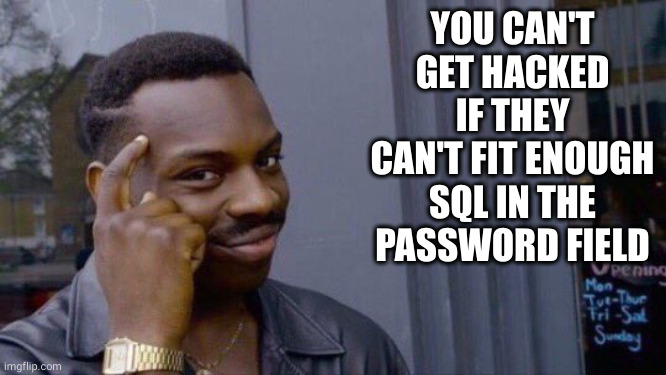
ADD FIELD PASSWORD VARCHAR(16)
SlopppyEngineer 4 points 2 years ago
Christopher Null feels his pain.
edgemaster72 6 points 2 years ago
testfactor 21 points 2 years ago
Tell me about it. USAA has a password policy of "between 8 and 12 characters."
Like, that's not even secure under old understandings of secure. A max of 12 should be, like, an actual offense with sanctions attached if they get hacked at some point. Especially for a financial institution. Ridiculous.
Definitely used a one-off password for that one...
silkroadtraveler 4 points 2 years ago
Wow that’s true, what a crock.
USAA strikes me as the most Wonder bread Texas Aw Shucks company that smiles to your face while outsourcing as much as possible (and stabbing you in the back in the process). Case in point. USAA only allows TOTP through Symantec’s proprietary app. I’m moving everything away from them except for auto insurance (which will likely go away at some point too as they’re not really that valuable for that anymore either).
wreckedcarzz 1 point 2 years ago
Huh? I have had a USAA account for many years and my current password is far beyond 12 characters. I use both the website and the app...
testfactor 2 points 2 years ago
Weird. I had to make up a new one cause all my normal passwords were too long.
Several people on here have had the same issue it seems, and Google agrees thats their limit is 12.
Not sure how you got around it. Maybe you're using a USAA reseller or something? You sure that your password's more than 12 characters?
wreckedcarzz 3 points 2 years ago
Nope, direct account with USAA. I wonder if the way the user/pass is entered into the field, that it doesn't trip the check for length? I don't manually copy/paste, and also use autofill for initial setup/changing credentials. I've seen it before on other websites but it usually truncates on the login auth and yells at me.
...
I just tried it, actually - sonofabitch. It (the change password flow) took the password via pw mgr, (apparently) truncated it, accepted it; this was a while ago but I remember the process. Just now, the login flow takes my username, password, truncates it (50+ chars, 13, or 12, doesn't matter), accepts it. 11 chars throws an 'incorrect login' message, so I don't have a borked account. At no point has it ever complained about password length. Jesus christ.
testfactor 2 points 2 years ago
Absolutely beautiful. What a company, lol.
The real beauty of it is that I can't fathom the logic. Unless they're storing the passwords as plaintext, it's not like it can be a storage issue. The hashes will be a constant size. I guess it takes longer to hash bigger inputs, but like, that difference should be unnoticeable until thousands of characters.
Did the engineer who made it truly not fathom that people might have passwords longer than 12 characters? That's the kind of mid-90s logic that makes me genuinely worry that the passwords aren't hashed on the backend, or are just MD5'd or something...
Makes absolutely no sense at all.
CafecitoHippo 19 points 2 years ago
My current employer has the dumbest restrictions for passwords to our core system. It is a large regional bank. Our core system must have a password that is either 7 or 8 characters long (nothing shorter or longer). It cannot have any vowels or special characters. It cannot have any capital letters. It cannot have two numbers in a row.
davidagain 1 point 2 years ago
Ah yes, the password rules from 1980.
CafecitoHippo 2 points 2 years ago
Whoops. Forgot a restriction, can't use repeating characters either so that one doesn't work either.
Ensign_Crab 2 points 2 years ago
"p4s5w0rd"
CafecitoHippo 1 point 2 years ago
Yeah but then you gotta change it every 30 days and it can't use any of your last 24 passwords so you can't even cycle through 10 numbers in one spot or even two spots. So you'd have to do like "p0s0w0rd" and then do "p1s0w0rd" and so forth.
OrnateLuna 1 point 2 years ago
By any chance wanna share your approximate location, asking for a friend
cordlesslamp 5 points 2 years ago
How about a bank app that requires 6 numbers password (not the app PIN, but the user account's password).
dQw4w9WgXcQ 4 points 2 years ago
A lot of older systems I worked on had password requirement of exactly 7 characters, no special characters, no numbers and no upper case. Must have been interesting times in security when those systems were made.
tiredofsametab 0 points 2 years ago
It's all fun and games until someone realizes they can just create lots of accounts with large passwords and fill your space.
JadedBlueEyes 23 points 2 years ago
Not a problem because passwords are hashed, which means they take up a fixed size, and you should have form upload size limits anyway.
tiredofsametab 6 points 2 years ago
hashed, which means they take up a fixed size
One would hope so anyway,
you should have form upload size limits
The above conflicts directly with OP's Accept any utf8 string
milicent_bystandr 5 points 2 years ago
I opened an account in 2014 and I'm still uploading my password.
x0x7 3 points 2 years ago
Ok. Take up to 65,536 bytes of utf8 string. Or better yet. Accept any password length. I mean any. But instead of transmitting it you bcyrpt on their machine and then use the resulting key to hmac sign a recent timestamp that can't be reused.
neidu2 14 points 2 years ago
Ran into this when I chose a password for my new work e-mail. As my employer is Chinese, error messages show up in mandarin, so it took me a while to understand what the problem was: Must be between 9 and 16 characters long.
herrvogel 17 points 2 years ago
What? The password should only receive the hashed password, and that's gonna have a fixed length. What's stored in the db should have the exact same length whether the password is 2 characters long or 300. If the length of the password is in any way a consideration for your database, you've royally fucked up long before you got to that point.
ChickenLadyLovesLife 3 points 2 years ago
The answer is always a poorly coded everything.
Sibbo 1 point 2 years ago
You are expecting a lot from someone who thinks a password needs a low maximum length. It makes sense to limit password length to avoid dos attacks, but certainly to something longer than 16.
Ptsf 1 point 2 years ago
There are going to be very few hashing algorithms that can take a certain byte value and hash it down into a unique smaller byte value. If you miscoded the database and stored the hashed passwords into a value of a fixed length, you have to abide by that length without some trickery or cleaveriness. Is that not the case? Every time I've seen this limitation in wild code that has been the case.
herrvogel 1 point 2 years ago
That's true. But fortunately even the most basic hashing algorithms are more than enough to make worrying about these things pointless when it comes to passwords. You have to poorly implement everything by hand and make a series of bad calls to run into any issues.
joeldebruijn 13 points 2 years ago
This one time I got this catch22 situation with a service.. Turned out password reset in the Android app accepted 32 characters but in the browser less.
Fish 6 points 2 years ago
Happened to me a couple days ago when resetting a password for Paypal. The browser limit was 20 characters for the 2nd password box but had a higher limit for the first password box.
Though, it appears they recently modified the form to pop up with an "Enter a shorter password" message. With that being said, PayPal has apparently always had shitty password policies.
BradleyUffner 12 points 2 years ago
My favorite was "Your password must begin with a letter"
haui_lemmy 19 points 2 years ago
pain text
Accidentally accurate
boredsquirrel 4 points 2 years ago
Paypal has (had?) absurdly short limits
wreckedcarzz 2 points 2 years ago
Has. 20 char max.
davidagain 3 points 2 years ago
Drives me nuts when this happens.
Ensign_Crab 1 point 2 years ago
Dammit, I just spent 5 minutes rolling dice and flipping through a binder. One of us takes this shit seriously.

cybersecuritymemes
@lemmy.world
4419
119
595
Only the hottest memes in Cybersecurity
go to feed...
cybersecuritymemes
@lemmy.world
4419
119
595
Only the hottest memes in Cybersecurity
go to feed...
This is my biggest pet peeve. Password policies are largely mired in inaccurate conventional wisdom, even though we have good guidance docs from NIST on this.
Frustrating poor policy configs aside, this max length is a huge red flag, basically they are admitting that they store your password in plan text and aren’t hashing like they should be.
If a company tells you your password has a maximum length, they are untrustable with anything important.
save