Found the American.
That post seems to be missing.
Scolding7300 29 points a year ago path: 0 17179033 17183718, hotness: undefined, score: 29, children: 2
Scolding7300 3 points a year ago path: 0 17179033 17183718 17200677 17210932, hotness: undefined, score: 3, children: 0
technocrit 1 point a year ago
Independent of whom/what?
witty_username 6 points a year ago path: 0 17179033 17206079 17210530, hotness: undefined, score: 6, children: 0
markovs_gun 45 points a year ago
"I just take scientists out and give them a bunch of funding for their research, and they always give me the results I want. Now of course they could always say no, but they won't because of the implication. You know, that if they produced results that disagreed with me, that I would refuse to fund future studies. Of course I would never do that, but they don't know that. So they give positive results for me. You know, because of the implication."
CosmicTurtle0 16 points a year ago
It's this comment that made me realize that Dennis is the human embodiment of our capitalistic system
Zero22xx 32 points a year ago
And this kind of shit unfortunately is fuel for anti-vaxxers and conspiracy types. It's not just misinformation on social media that we have to thank for people's mistrust, it's also the scientists that downplayed how bad sugar is or who turned a blind eye to what cigarettes do in the interests of money.
Opinionhaver 31 points a year ago
The issue with many of these studies is that they compare people who eat red meat to those who either avoid it specifically or don’t eat meat at all. The problem is, red meat isn’t the only variable at play. Vegans and vegetarians, in particular, are likely to have much healthier lifestyles overall than someone who eats red meat - which is more or less synonymous with the “average person.”
What I’d really like to know is the difference between red meat eaters with healthy lifestyles, compared to both the average person and those who don’t eat meat at all.
JeremyHuntQW12 12 points a year ago path: 0 17187080 17196361, hotness: undefined, score: 12, children: 9
jet 6 points a year ago
Every study conflates high sugar consumption with meat consumption. If a pizza is considered a serving of meat, in all fairness it should also be considered a serving of plant based foods. Carbohydrates make up the bulk of pizza. And those come exclusively from plants
We know sugar is bad for health. These observational studies are useless unless they can control for sugar and carbohydrate intake as a factor.
cortex7979 1 point a year ago path: 0 17187080 17196361 17200019 17209499, hotness: undefined, score: 1, children: 1
exasperation 3 points a year ago
This particular linked study, that is the basis for this thread, limited itself to only unprocessed red meat.
Robust_Mirror 9 points a year ago
Nutritionally speaking pork is a red meat. All mammal meat is red meat, non mammal meat is not.
Soulcreator 8 points a year ago
Would you be able to give examples of healthier behaviors that vegans and vegetarians perform that the general population does not?
If one made their choice to abstain from meat for ethical reasons and not health reasons I'm not sure their lifestyle would be drastically different from their counterparts, then again I'm not sure what particular behavior patterns you are referring to which could throw off studies.
tocopherol 6 points a year ago
I abstain from meat for ethical reasons, a similar ethical reason encourages me to use public transit and bike instead of driving, to reduce my impact on life and the environment. This is anecdotal but most vegans/vegetarians I've known are concerned with their impact in general, it's rare that they only obstain from eating meat but do everything else as an average US meat-eated would.
Opinionhaver 4 points a year ago
On average, there are far more people among vegetarians and vegans who generally pay more attention to what they eat and don’t eat, exercise more, and likely smoke and drink alcohol less as well. Obviously, there are exceptions - but I’m talking about averages here.
nsrxn -3 points a year ago
since vegan fare is pretty limited, i think the first thing is that vegans don't eat nearly as much fast food. they probably eat out less overall. which is going to require a lifestyle that carves out time at home to cook or meal prep.
StupidBrotherInLaw 5 points a year ago
You do realize you're not obligated to respond to comments, right? If you don't know what you're talking about, you're allowed, encouraged even, to not respond.
markstos 4 points a year ago
Maybe the restaurants you go to have fewer options, but vegans go to restaurants that have things they can eat, and practically every restaurant has options now. French fries, for example, are a fast food item that’s usually vegan.
jet 7 points a year ago
Not to mention most of the antimeat studies are observational food surveys with weak hazard ratio outcomes.
Most annoyingly the classification of "meat" is infuriating and biased. In some of the studies any sandwich, any pizza, any sugar covered possible meat containing item counts as meat. It's well established that sugar is very detrimental for health.
The only people avoiding sugar at large care about their health, so there is tremendous healthy user bias, and the advice for the last 50 years or so has been to avoid meat if you want to be healthy... Reinforcing the healthy user bias.
A high quality disciplined study to show the effect of meat on health would include metabolic markers like ketones, track sugar independently, and not use a once every 4 year food questionnaire.
The key to knowing if the study is serious, or sensational, is if they use relative risk or absolute risk in their findings. Nobody publishes absolute risk with respect to meat consumption....
Opinionhaver 6 points a year ago
Well, it would - in the sense that an unbiased study might still find that a meat-eater (i.e. the average person) is less healthy than someone who doesn’t eat meat, and then falsely conclude that meat is the reason, rather than accounting for all the other lifestyle differences. Meanwhile, a study funded by Big Meat would obviously find that meat is good for you - which, let’s not forget, could also be true.
jet 5 points a year ago

The left/blue side of the graph are outcomes that show meat decreased all cause mortality, the right/red side of the graph are outcomes that show meat increases all cause mortality. If you were a hungry researcher, you could publish unending papers indicating either way from this same observational data pool! - Hence the constant news cycle driven by dietary agendas - not based on hard science RCTs.
The problem with open-ended observational studies, is you can't prove causation, and you can find tons of associations for or against whatever you like.
Grilling the data: application of specification curve analysis to red meat and all-cause mortality
when investigators analyze data from observational studies, there are often hundreds of equally justifiable ways of analyzing the data, each of which may produce results that vary in direction, magnitude, and statistical significance
Evidence shows that investigators’ prior beliefs and expectations influence their results [5]. In the presence of strong opinions, investigators’ beliefs and expectations may shape the literature to the detriment of empirical evidence
Then somebody will come along and do a metanalysis of the studies that were just basically association farming. And claim to find some universal truth.. at a certain point we have to look at these observational studies as not science, hell it's not even academics, it's advertising, propaganda, and agenda pushing. These are hypothesis generating, they should be the beginning of science, they are not the conclusion of science. And they should never be used for policies, or even marketed to lay people.
RBWells 1 point a year ago
If there was a study, I would volunteer. I'm an omnivore now for 20 years, after being vegetarian for about the same amount of time, never vegan. I live a reasonably healthy lifestyle but office job and do like to drink about thrice a week, only one drink (so moderate, I think) . I'm sure there are lifestyle matched vegetarians and vegans.
Personally I'm healthier but heavier (was underweight, now middle of healthy BMI which feels fat to me but I do literally feel good) with some meat in the diet but don't eat it every day. Cholesterol was high when I was vegetarian, still is. Only thing that drops that is regular fasting, which unfortunately was a reliable migraine trigger for me.
Flamekebab 26 points a year ago
I'm reminded of the scientist paid for by big tobacco in Thank You for Smoking...
Robust_Mirror 21 points a year ago
From a health perspective you can simplify it to mammals = red meat. Birds, fish, reptiles, insects etc = not red meat.
And yeah it's dosage based. Generally speaking you want to stay under 350g (by cooked weight) red meat a week. More than 500g a week is when it starts to be consistently linked with higher health risks. If you want to be really technical it could be said 0g is better than 350g, but in this range the increased risk tends to be near insignificant.
jet -17 points a year ago
A minority of us, but a growing minority, look at the data and come to the conclusion that the meat isn't the problem. It's the sugar and carbohydrates people eat with the meat that are the problem.
If you cut out all of the fructose, glucose, and carbohydrates from your diet. Your health outcomes are going to be amazing regardless of your meat consumption
jet -10 points a year ago
If you want a bunch of paper references I recommend
https://www.dietdoctor.com/low-carb/science every statement has a number, and those numbers directly linked to the scientific articles to back the statement
If you prefer to listen to a medical lecture: https://www.youtube.com/watch?v=kDJsxw0uMLM
Or if you'd rather read a detailed medical textbook https://shop.elsevier.com/...
The nut of it is, most of the modern non-communicable diseases are based in sugar and carbohydrate consumption. The world has about a billion people with type 2 diabetes documented, and that is strictly because of excess carbohydrate consumption.
Of course there's more nuance, inflammation plays a significant factor, and combining fat and carbohydrates at the same time create cellular inflammation due to the Randall cycle (not a cycle) cross inhibition.
There's excellent work going on about the impact of constantly elevated insulin levels, and how that causes most of the manifestations of metabolic disease. And insulin levels are directly driven by carbohydrate consumption, persistently snacking all day means all day elevated insulin.
Most people would be better off eating a whole food diet, no processed foods, nothing from a factory. That eliminates most of the easy sugars, most of the carbohydrates. If somebody wants to eliminate even more, they could try out a low carb, or even a ketogenic diet or even a zero carb diet.
exasperation 7 points a year ago
If somebody wants to eliminate even more, they could try out a low carb, or even a ketogenic diet or even a zero carb diet.
Most recent studies of long term ketosis show accelerated aging markers, and some potentially harmful increases in LDL and VLDL cholesterol. Some propose periodic resets out of ketosis to avoid some of the accumulated long term issues, while taking advantage of some of the short term benefits for overall insulin sensitivity and obesity.
The human body has many, many ways to meet its nutritional needs. We're omnivores and we have lots of anthropological history of different cultures surviving primarily on carbs, primarily on animal products, and all sorts of in between.
There are plenty of issues with people on carnivore diets, too, so I would caution against trying to swing the pendulum too far in the other direction. I've never seen anything suggesting that there's a statistically significant delta between a high carb whole foods diet and a low carb whole foods diet. And even within those frameworks, it's entirely possible that the qualitative differences between one whole food still makes a difference compared to another whole food, like the observed studies regarding red meat being bad, fatty fish being good, legumes being good, fermented vegetables being good, etc.
Nutrition science is pretty incomplete. We're only recently learning bits and pieces about the role of the microbiome, and haven't even finished accumulating the information we started learning in recent decades about endocrine feedback loops in nutrition and metabolism. It'll take a lot of data and analysis to have confidence in what people are saying, and I personally take it all in with interest but skepticism.
Wiz 4 points a year ago
Side note, I had a couple of high blood pressure readings recently, and was considering using one of the injectable drugs for weight loss. But after talking to a doctor, I thought I'd try watching the food that goes into my "pie hole" first.
That was a few weeks ago when I saw my doctor. Since then, I've been eating much fewer processed foods, and more fruits and veggies. I was surprised at the difference of caloric intake and carbs from snack foods compared with regular fruit as a snack. "Tortilla chips: serving size 5 chips!" And eating the processed snack always leaves me wanting more. I also added some moderate walking exercise.
So after 4 weeks I'm down 8.5 pounds, about 3+% of my body weight. I already feel a big difference. Now I'm thinking I don't need to inject expensive chemicals into my belly. Maybe I can just eat healthier foods and walk a few miles per week.
technocrit 2 points a year ago
path: 0 17200188 17200662 17200984 17201330 17206036, hotness: undefined, score: 2, children: 1
lmao. no time for this. enuf grifting...
UnderpantsWeevil 5 points a year ago
If you cut out all of the fructose, glucose, and carbohydrates from your diet.
Problem is, these foodstuffs are cheap and easy to preserve and distribute. So a lot of what you're suggesting boils down to "if you buy more fresh produce" which ultimately means "if you spend more money on groceries that spoil faster".
Even that doesn't address the relative health hazards of chronic high consumption of red meat when compared to white meat. But, again, we're talking about an enormously subsidized beef industry even compared to fish and chicken (where it seems we're intent on raising prices through ecological destruction/abysmal hygiene). The game still boils down to having this avalanche of surplus ground beef that's practically being given away next to healthier options that are far more expensive.
jet -1 points a year ago
I live in a part of the world where beef is not subsidized. Even here the butchers give away fat (the cuttings / trimmings from their other products). The protein requirements on a carnivore diet are not different then any other diet, the rest of the diet can be made up of inexpensive fat.
Clent 2 points a year ago
They also define independent as any study not associated with the meat industry.
There are biases in the other direction which were not weighted. How many of these studies are associated with vegans. Let's see that break down because I'm guessing their bias is worse than the meat industry's bias.
sfled 8 points a year ago
Also, RoundUp is so safe you can drink it!
https://youtu.be/QWM_PgnoAtA?t=26
The cognitive dissonance...
p3n 6 points a year ago
There is no such thing as an impartial sponsor; some are more obviously biased than others, but the belief in a fictitious impartiality is part of the problem. It shouldn't take a meta-study for people to see am obvious conflict of interest.
I'm biased. You are biased. Everyone is biased.
i_love_FFT 8 points a year ago
What if the sponsor is the blanket university funding for a professor's research? It may have some bias, but there is no steak in the actual result.
I expect to see "these results call for more research on the topic", but that's pretty much it.
lmmarsano 4 points a year ago
steak
stake?
Accepting funding from sponsors responsible for pollution & publishing environmental toxicology studies that disfavor those sponsors was pretty common at the university medical office where I worked.
Initiateofthevoid 8 points a year ago path: 0 17194045 17206143, hotness: undefined, score: 8, children: 1
p3n 1 point a year ago
I guess I didn't communicate my point effectively. I wasn't trying to nitpick semantics. I was trying to say that people don't think critically because they assume impartiality.
If the first thing people did when they looked at a study was to ask what possible biases or conflicts of interest the sponsors have, then conducting a meta-study concluding that biased studies are biased wouldn't be news to anyone.
thatradomguy 6 points a year ago
Ok, now do coffee.
turtlesareneat 5 points a year ago
I haven't seen a lot, health-wise, that suggests coffee is detrimental. Environmentally it's a harder sell every year with climate change and the number of coffee drinkers still yet to peak, but the economics will counter that soon enough.
jet -2 points a year ago
Reporting in!
The observational weak relative risk studies can be pumped out infinitely, they do not inform on cause and effect sadly. The best data we have of prewesternized cultures eating meat heavy diets shows no incidence of cancer in these populations (first tribe nomads, inuit, etc). Humans have been eating meat for at least 2.5 million years, yet cancer has only jumped up to the epidemic it is today in the last 150 years. Something in the environment and diet has changed, absolutely. What is the causative factor? The anti-meat papers with weak relative risk tells me that its not the meat, we should be looking for a very strong signal (50% of people born today will have cancer in their lifetimes - 150 years ago basically nobody got cancer).
I could speculate, and I have my own theories, but we are looking for a significant change in the last 150 years as our culprit. Meat is not a new invention. Processed food, fructose, sugar, industrial food oils, pesticides in the food supply - all have bloomed in the last 150 years, I would hazard a guess and say these are the real harbingers of modern disease we need to focus on. Curiously these epidemiological food questionnaire papers don't look at these factors, maybe because its hard to fill in a survey for sugar (its in all processed food).
cortex7979 3 points a year ago path: 0 17178801 17194758 17209592, hotness: undefined, score: 3, children: 1
jet 2 points a year ago
LDL is not a disease, its necessary for human life. Damaged (Oxidated, and Glycated) LDL is a indicator of significant cardiovascular problem, but undamaged LDL is not a disease. If someone has elevated LDL and they are not eating a sugar heavy diet, they should get plaque imaging to see what their actual atherosclerotic risk is.
pulsewidth -2 points a year ago
Humans have been eating meat for at least 2.5 million years, yet cancer has only jumped up to the epidemic it is today in the last 150 years. Something in the environment and diet has changed, absolutely. What is the causative factor? The anti-meat papers with weak relative risk tells me that its not the meat, we should be looking for a very strong signal (50% of people born today will have cancer in their lifetimes - 150 years ago basically nobody got cancer).
Life expectancy in 1875 in the USA was 39.41 years. The vast majority of cancers will not cause significant illness (or show up at all) in population groups that die of other disease/injuries before 40 - so, handwaving away the studied correlative links with cancer in population groups today that eat a lot of meat just because 'people ate red meat 150 years ago and they didn't get cancer' is what scientists call 'illogical'.
And that's completely ignoring the fact that we have far advanced medical technology in the last 150 years so we are actually diagnosing more cancers because we're finding them when they are smaller and more treatable (that's a good thing).
jet 5 points a year ago
Life expectancy in 1875 in the USA was 39.41 years.
This is true, but this is the mean. This includes everybody who dies in childhood. If you made it to 10 years old you are likely to live until 60.
https://www.infoplease.com/...
This is exactly why the office of the President requires a minimum age of 35. It wasn't because they were going to die in 4 years, it was because they had the expectation they had lived for a lot longer.
pulsewidth -3 points a year ago
Why would we rule out all the kids under 10 from the life expectancy stat? To skew it older just to make it seem like people lived longer back in 1875? We don't do that with life expectancy stats now, the life expectancy for 2020 is 78.81 and yes that includes anyone unfortunate enough to die as a child or infant. It also doesn't mean that anyone who is 74 will be dead in ~4 years, it's an average - which is helpful when talking about large demographics (which we are).
Wtf does the president have to do with anything lol. They only pick presidents over 35 "because they had the expectation they had lived for a lot longer". So.. They expect that people who are older than 35 have lived longer than those who are under 35? Um yes that is how the passage of time works.
I'm not sure how this helps the discussion.
SocialMediaRefugee 4 points a year ago
It also depends on the tone of the social media site discussing it.
RagingRobot 4 points a year ago
A study of studies? That's interesting. I wonder how often that happens? I should do a study about it. A study of studies about studies.
paris 8 points a year ago
A review of studies is a meta-analysis. What you're describing is a meta-meta-analysis, which is also a thing! Here's one I found from a cursory search..
milicent_bystandr 4 points a year ago
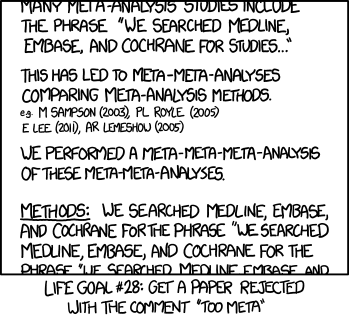
Alt text: Life goal #29 is to get enough of them rejected that I can publish a comparative analysis of the rejection letters.
Goretantath 4 points a year ago
No shit sherlock.
homesweethomeMrL 3 points a year ago
This just in: sell-out fuckers suck.
SocialMediaRefugee 21 points a year ago
Read the end of any research paper and it indicates any possible conflicts of interest. Youtube isn't a reliable source.
entwine413 20 points a year ago
They usually disclose their funding in the journal article. Otherwise, this meta analysis wouldn't be possible.
bblkargonaut -2 points a year ago
My father gave up red meat and soda around 2002. My dad's clone, my uncle didn't give up anything. Yes they are clones, I sequenced them myself. Since then my dad has always been at least 20lbs heavier than my uncle despite having almost identical activity levels since they had similar jobs and shared hobbies for most of the time. Now 23 years later my dad has heart congestive heart failure and a torn meniscus in his knee while my uncle has a perfect heart but has needed both knees replaced. I think the biggest difference is definitely the sugar because my uncle tends to drink diet soda and my dad fruit juice, tea and coffee.
bblkargonaut 4 points a year ago
Lol, why'd this link get cross posted to c/vegan
StereoCode -2 points a year ago
I'm gonna eat it no matter the results because it's delicious.
exasperation 4 points a year ago
There's three metrics to think about:
- Actual number of years reduced/increased
- Actual probability of that change in lifespan
- Statistical certainty that the trend we observe is actually linked to the variable we're studying.
Russian roulette (traditional 1 round in 6 chambers) in a hospice ward (where everyone has been given a prognosis of less than 6 months to live) would be a very high certainty of shaving months off the life of 1/6 of the studied population. In the grand scheme of things, that's not a very high risk. But at the same time, we can look at it and say "yes, shooting oneself with a revolver is very bad for health." Putting a more or less deadly round in the chamber is probably not going to be a hugely significant change in outcomes, even if we can objectively say that one is better or worse for the person's health than the other.
Almost all dietary/nutrition studies involve much smaller swings in lifespan or health conditions, probabilistically over a smaller portion of the population, with less statistical certainty in the observations. But the science is still worth doing, and analyzing, because that all adds up.
thanks for using Leebra!
go to feed...
save